The Hidden Cost of Cash: Why Going to the ATM Is Costing You More Than You Think
We've all been there. You spot a shop, realise you've got no cash, find the nearest ATM, queue for ten minutes, draw R500, and walk away thinking the transaction was free. But it wasn't. The ATM took R10 to R30 off you. The taxi to get there cost R20. The half hour you queued is half an hour of your life you don't get back. And the R500 in your pocket? You'll probably spend it faster, lose track of it, or have it stolen on the wrong day. The true cost of cash in South Africa is bigger than most people realise — and the more you measure it, the more digital payments make sense. This isn't a moral argument against banknotes; it's a maths argument.
ATM Fees and What Cash Really Costs You Every Month
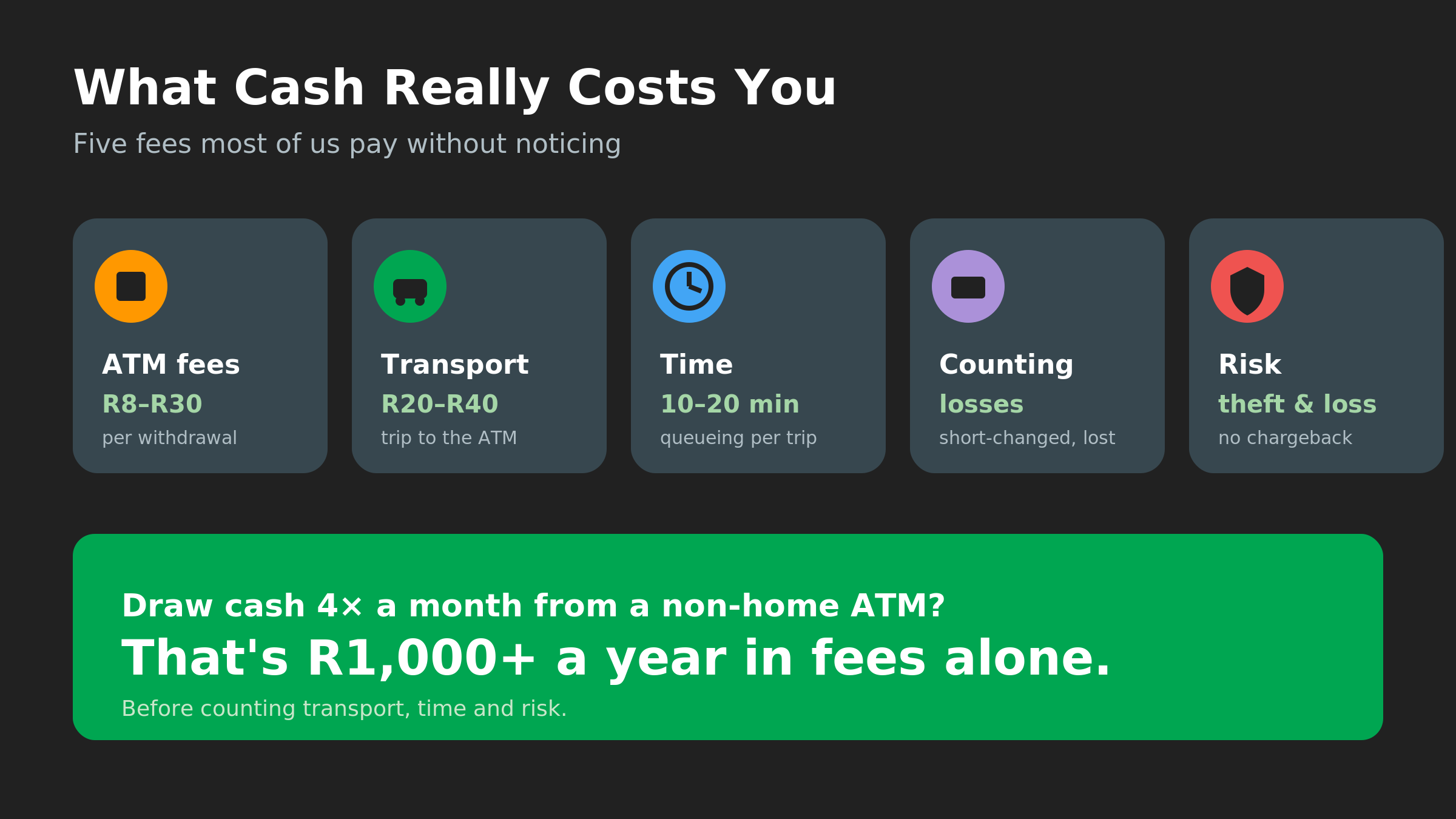
Most of us pay for cash in five separate ways without thinking about it:
- ATM withdrawal fees — Typically R8 to R30 per transaction depending on the bank and ATM
- Transport to get to the ATM — Often a R20 to R40 taxi or fuel round-trip
- Time queueing — Easily 10–20 minutes per trip, especially on payday
- Counting losses — Notes get short-changed, lost in pockets, or miscounted
- Risk costs — Theft, robbery, and accidental loss
Add these up. Someone who draws cash four times a month from a non-home-bank ATM can easily spend R80–R120 in withdrawal fees alone, before transport. Over a year that's well over R1,000 — enough to start a small emergency fund.
The Payments Association of South Africa (now BankservAfrica's PASA) has long flagged that ATM and cash-handling fees fall hardest on lower-income users, who tend to withdraw small amounts often — which is the most expensive way to use cash.
Cash Feels Free, But Here's Why It Isn't
There's a psychological reason cash seems cheaper than card payments: you only pay the fee once, at the start, and then forget about it. The R20 ATM fee becomes "the cost of getting money," not "the cost of every spend." Mentally, you're spending free notes for the rest of the day.
Card and digital wallet payments work the opposite way. You see the exact amount of each purchase. You can review every transaction in your app. There's nothing hidden between you and the price.
Behavioural economists call this the pain of paying. Cash dulls the pain, which can make us spend more loosely. A consistent body of research has found that people tend to spend more, and remember spending less, when paying in cash compared with paying digitally for the same items.
If you've ever drawn R500 on a Saturday and somehow had R20 left by Monday with nothing to show for it — that's not a budgeting failure. That's partly the design of cash.
The Time Tax No One Talks About
Money is one cost. Time is another. Between queueing at ATMs, queueing at bank branches, and travelling to both, cash management quietly eats hours every year — time that doesn't show up on any statement.
A digital wallet erases most of that. Pay your rent, send money to another wallet user, buy airtime, top up electricity, settle a DStv bill — all from your phone, in seconds. The time you save is real.
Add to that the inconvenience of broken ATMs, out-of-cash machines on payday, and areas you'd rather not stop in, and the case for going digital gets stronger every year.
Theft, Loss, and the Real Risk of Carrying Cash
This is the cost nobody likes to talk about because it's emotionally heavy. But it's real.
The South African Police Service reports tens of thousands of street robberies and ATM-related crimes every year, and most target cash. Once it's gone, it's gone — there's no reversing a cash transaction, no fraud team to call, no chargeback. A robbed wallet is a destroyed budget.
Digital payments aren't perfect. Scams and phishing do happen, and we've written extensively about how to protect yourself from digital payment scams. But the asymmetry is real: a stolen card can be frozen with one tap in an app. Stolen cash is just gone.
The Real Comparison: Cash vs a Digital Wallet
Here's the honest part most "go cashless" articles skip: a digital wallet isn't free either, and getting cash into a wallet has its own cost. So let's be straight about the maths.
The trick isn't to keep withdrawing and re-depositing cash — it's to receive your money digitally in the first place. With SOLmate, having your salary or payments paid in by EFT is free. From there you tap to pay in stores (free), buy airtime and electricity (free), and send money to other SOLmate users (free) — so you simply stop touching the expensive parts of cash.
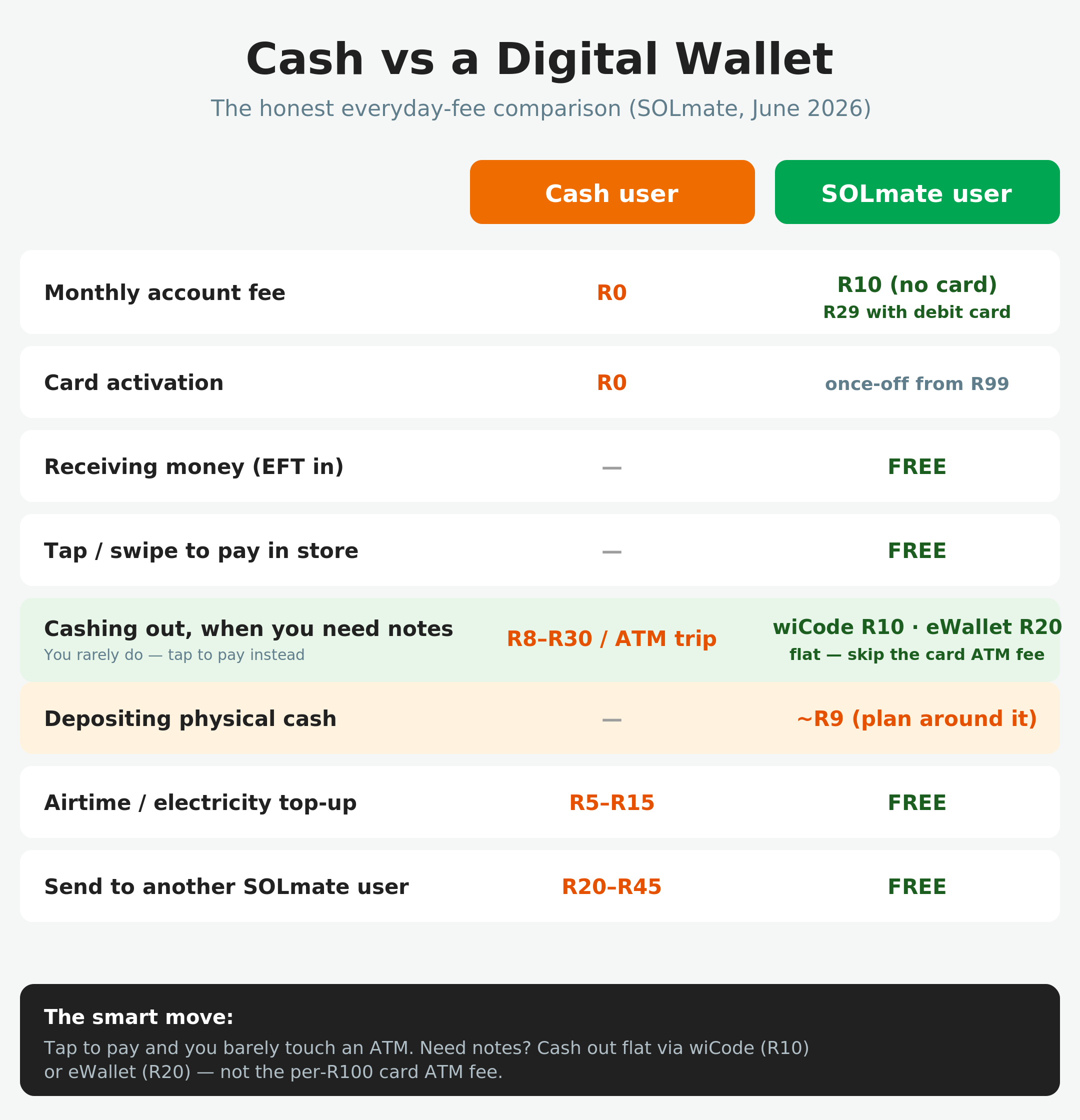
Here's how the everyday fees compare for a typical user:
| Cost type | Cash user | SOLmate user |
|---|---|---|
| Monthly account fee | R0 | R10/month (no card) or R29/month with debit card |
| Card activation | R0 | Once-off from R99 (card plan only) |
| Receiving money (EFT in) | n/a | Free |
| Tap / swipe to pay in store | n/a | Free |
| Cashing out, when you need notes | R8–R30 per ATM trip | wiCode R10 flat or eWallet voucher R20 flat |
| Depositing physical cash | n/a | ~R9 (ATM topup) or a retailer cash-in fee |
| Airtime / electricity top-up | R5–R15 in fees | Free |
| Send to another SOLmate user | R20–R45 (taxi / ewallet) | Free |
Here's the part that surprises people: as a SOLmate user you barely need an ATM at all. Tapping to pay covers your everyday spending, so the cash you would have drawn just stays digital and free to spend. And when you genuinely need notes in hand, you skip the card ATM withdrawal entirely — it's charged per R100, which adds up fast — and cash out the smart way instead:
- wiCode voucher — a flat R10, redeemable at the till at Shoprite, Checkers, Pick n Pay and thousands of other stores. One small fee, whether you take out R200 or R2,000.
- eWallet voucher — a flat R20, instant and reliable, withdrawable at both retailers and ATMs.
A flat fee beats a percentage every single time you take out a meaningful amount. The only cost left to plan around is loading physical cash in — and that disappears the moment your money arrives by free EFT in the first place. That's where the real digital wallet savings come from.
See more on how SOLmate compares to traditional banking →
Sending Money Home
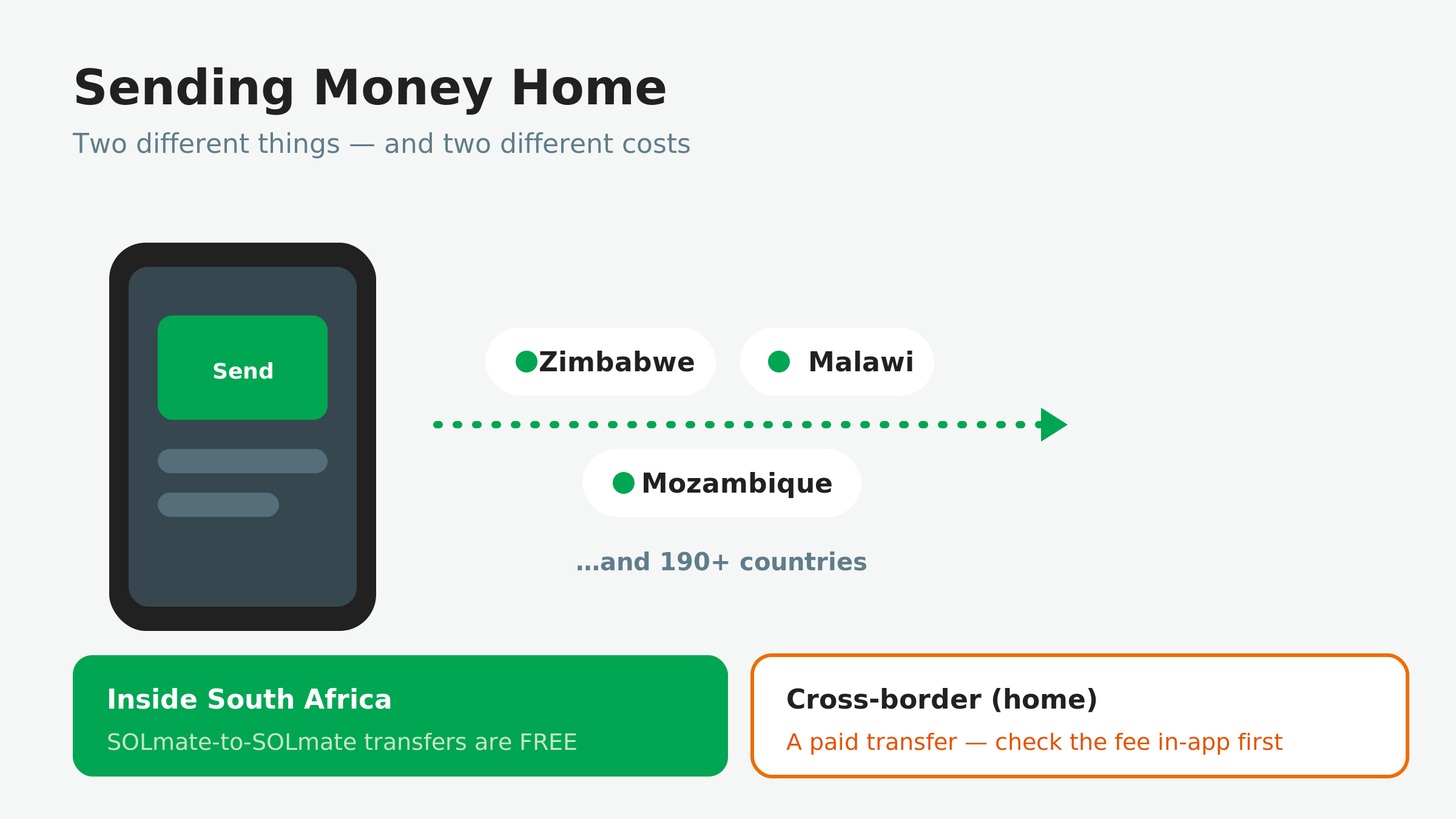
If you support family in another country, "send money home" is its own category — and it's not the same as a free wallet-to-wallet transfer. Cross-border transfers (to Zimbabwe, Malawi, Mozambique and 190+ other destinations) carry a transfer fee, just like any remittance service.
The advantage is doing it from your phone instead of standing in a money-transfer queue, at transparent rates you can see before you send. SOLmate-to-SOLmate transfers inside South Africa are free; international transfers are a paid service — always check the fee shown in the app before confirming. You can see the Zimbabwe corridor here.
When Cash Still Makes Sense
A balanced view matters. Cash is not the enemy — there are legitimate situations where it's the right tool.
- At informal traders that don't accept cards yet (although this is changing fast)
- For tipping car guards, petrol attendants, and waiters where small cash amounts feel right
- In areas with poor network coverage where you can't reliably tap to pay
- For emergencies where a small cash reserve gives peace of mind
The point isn't to ban cash. It's to stop defaulting to cash for everything. A useful rule of thumb: use cash for small, person-to-person moments and digital for everything else. That single shift cuts most of the fees, time and risk without changing how much you actually spend.
Why South Africa Is Moving to Cashless Payments Faster Than You Think
Five years ago, tap-to-pay was new. Today it's almost universal in cities and growing fast in townships and rural areas. Spaza shops are adopting QR-code payments. Taxi associations are piloting digital fare systems. The South African Reserve Bank has set out clear goals for a safer, lower-cost national payment system, citing both cost and crime as reasons to reduce dependence on cash.
For people who've been underbanked, this matters most of all. If a traditional bank has ever turned you away because you have a passport or an asylum permit instead of a green ID, a wallet like SOLmate opens an account with just a South African ID, a foreign passport, or valid asylum-seeker documentation — and no work permit needed. That means the digital economy, and all the savings that come with leaving cash behind, is finally open to migrants and foreign nationals supporting family back home.
A Smarter Way to Carry Your Money
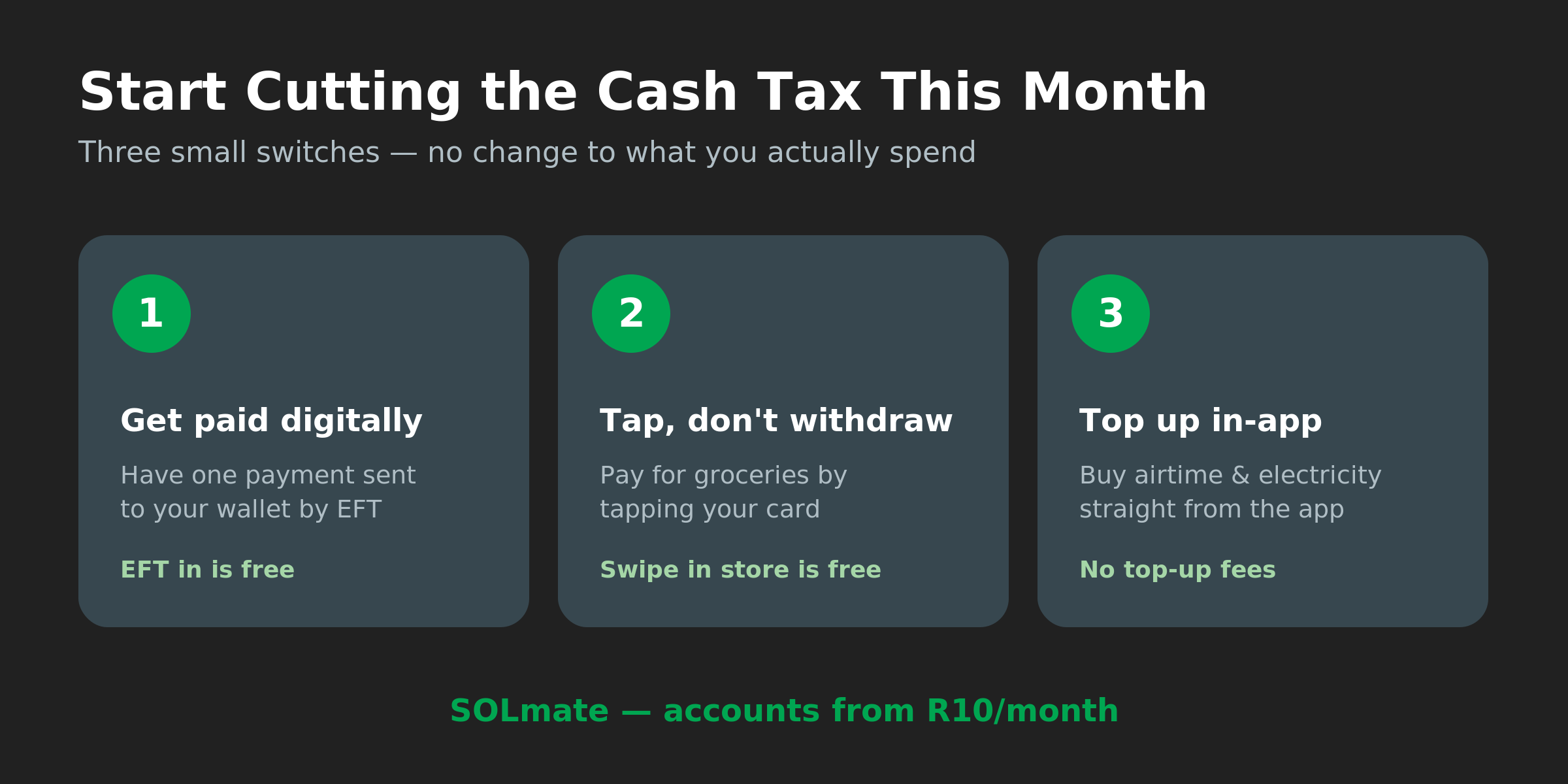
The shift away from cash doesn't have to happen overnight. Start with one thing this month:
- Have one payment you currently receive in cash paid to you digitally instead
- Use tap-to-pay for groceries rather than withdrawing cash first
- Buy your airtime or electricity in-app instead of paying a top-up fee
You'll feel the difference in your wallet — and in your time — by the end of the month.
Ready to cut your cash costs? Sign up for SOLmate — accounts start at R10/month, or R29/month with a Mastercard debit card (once-off activation from R99), with free airtime and electricity top-ups, free EFT deposits, and free transfers to other SOLmate users. See the full pricing breakdown here.
Frequently Asked Questions
How much do ATM fees cost in South Africa?
ATM withdrawal fees in South Africa typically run from about R8 to R30 per withdrawal, depending on your bank and whether you use your own bank's ATM. Drawing small amounts often is the most expensive pattern — four withdrawals a month can cost over R1,000 a year in fees alone.
Is it cheaper to use cash or a card in South Africa?
For most everyday spending, a card or digital wallet works out cheaper. Tapping or swiping to pay is usually free, while cash carries ATM fees, transport to the ATM, and theft risk. The main cost on the digital side is loading physical cash into a wallet — so the cheapest approach is to receive your money digitally and spend it without withdrawing.
What's the cheapest way to withdraw cash from a SOLmate wallet?
Most SOLmate users rarely withdraw at all, because tapping to pay is free. When you do need notes, skip the card ATM withdrawal (it's charged per R100) and use a flat-fee method instead: a wiCode voucher costs a flat R10 and is redeemable at tills like Shoprite, Checkers and Pick n Pay, while an eWallet voucher costs a flat R20 and works instantly at both retailers and ATMs. A flat fee is cheaper than a percentage for any meaningful amount.
How much does a SOLmate account cost?
A SOLmate account is R10 a month without a card, or R29 a month with a Mastercard debit card (a once-off activation fee from R99 applies to the card plan). Airtime and electricity top-ups, EFT deposits, in-store tap payments, and transfers to other SOLmate users are free. See the full pricing page for the latest.
Can I open a digital wallet account without a South African ID?
Yes. SOLmate accepts a South African ID, a foreign passport, or valid asylum-seeker documentation, and you don't need a work permit. This makes it one of the few accounts available to migrants and foreign nationals who have been turned away by traditional banks.
Is it free to send money home from South Africa with SOLmate?
Transfers between SOLmate users inside South Africa are free. Sending money across the border — to Zimbabwe, Malawi, Mozambique and other countries — is a paid service with a transfer fee, shown in the app before you confirm. We show the cost upfront rather than hiding it in the exchange rate.
Want to read more about the future of South African payments? Check out our explainer on PayShap
Sources: SOLmate Pricing | South African Reserve Bank