
Work Permits for Malawians in South Africa
Malawians have no ZEP-style permit in South Africa. This guide covers the 30-day visa-free rule, the three lawful work visa routes and what each asks.

Working legally in South Africa as a Malawian runs through one door: a mainstream work visa. There is no Malawian equivalent of the Zimbabwe Exemption Permit, no special dispensation and no shortcut, so the choice is between the General Work Visa, the Critical Skills Work Visa and the Intra-Company Transfer, each with its own requirements. What a Malawian passport does give, under the visa exemption list the Department of Home Affairs issued in June 2024, is entry for visits of up to 30 days without a visa; what it never gives is the right to work. This guide goes through the three routes, what each asks and what it gives. Checked on 27 November 2026.
Where Malawians stand
Two facts set the Malawian position apart from every neighbouring country with a special arrangement. First, the exemption permits South Africa has issued over the years, the Zimbabwe Exemption Permit and the Lesotho Exemption Permit among them, cover their named countries only; Malawi has never had one, so the ordinary visa system is the whole system. Second, the 30-day visa-free entry Malawians enjoy is the shortest among the region's SADC neighbours on the exemption list, where Zimbabwean passport holders get 90 days and Zambians 90 days per arrival. Neither fact is an obstacle to working legally; both are reasons to plan the route before the trip rather than after it.
One clarification from November 2026 is worth having in hand: the Department of Employment and Labour publicly confirmed that it does not issue work permits to foreign nationals. Work visas are granted by the Department of Home Affairs alone; the labour department's role sits inside the General Work Visa process as an assessment, not as a permit. Anyone selling a "labour department work permit" is selling a document that does not exist.
The three routes at a glance
| Route | Who it fits | What it gives | What it asks |
|---|---|---|---|
| General Work Visa | Anyone with a South African job offer not on the skills list | Work for a specific employer | Employer-driven labour market test, points-based assessment |
| Critical Skills Work Visa | Occupations on the Critical Skills List | Up to five years at a time, the most stable footing | An occupation on the list, SAQA evaluation of qualifications |
| Intra-Company Transfer | Employees of multinationals moving to a South African branch | Up to four years, not renewable | An existing employer relationship within the same group |
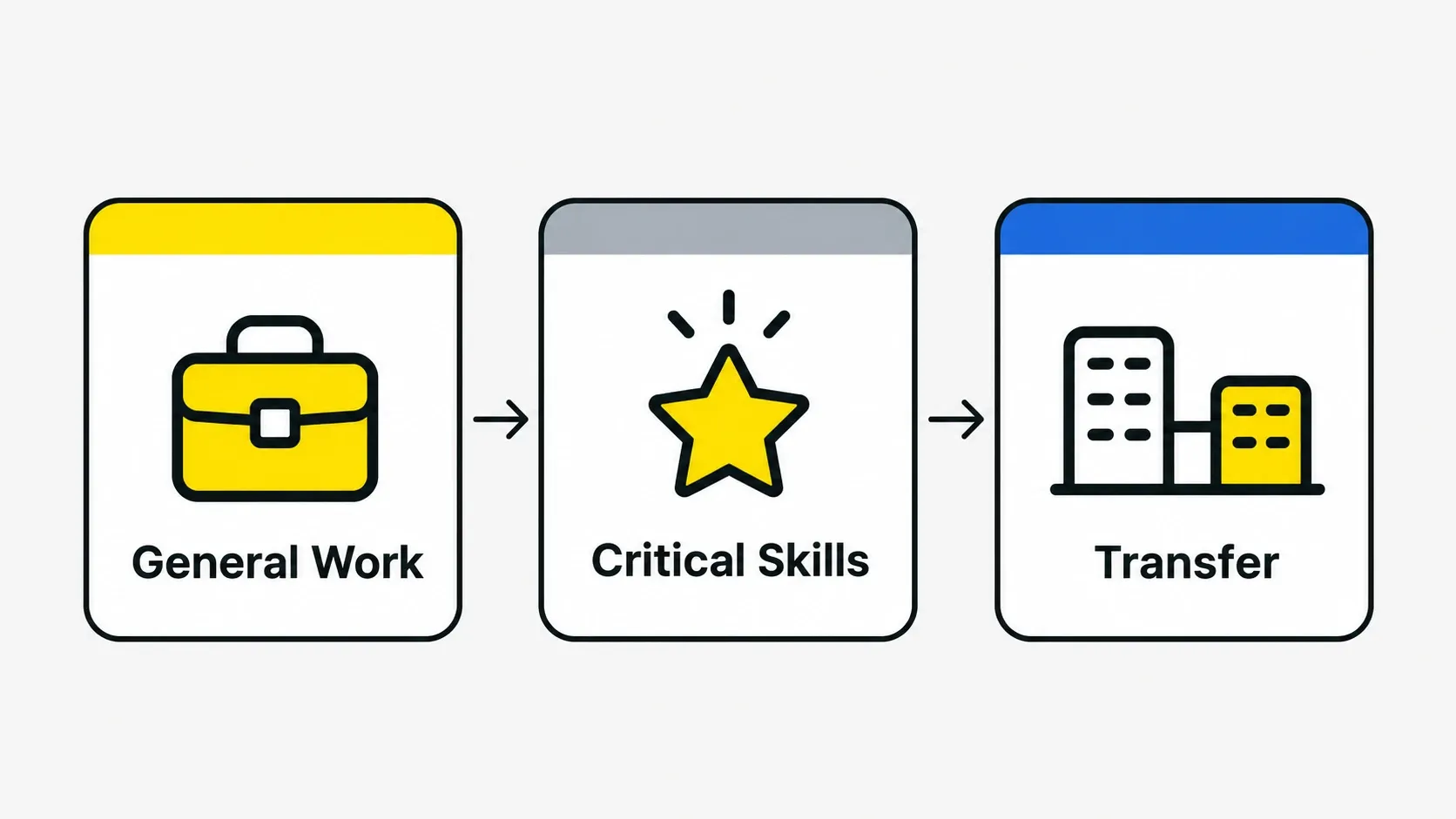
The General Work Visa: employer-driven, points-assessed
The General Work Visa starts with a job offer, and the employer carries much of the load: the role must be shown as one that could not be filled by a South African citizen or permanent resident, through the labour market process run by the Department of Employment and Labour, before Home Affairs considers the visa itself. The assessment introduced in the 2024 regulations scores qualifications, work experience, the salary offered and age.
Two practical consequences follow. The realistic timeline is months rather than weeks, and the applicant's role is mostly preparation: qualifications, a valid passport and clean documents, while the employer drives the process. An employer unwilling to do its part of the paperwork is, in practice, an employer without a lawful position to offer.
The Critical Skills Work Visa: the stable route
For occupations on South Africa's Critical Skills List, the 2022 revision of which remains the operative list, the Critical Skills Work Visa is issued for up to five years at a time. It asks for the occupation to be on the list, an evaluation of the foreign qualification by SAQA, and registration with the relevant professional body where the occupation requires it.
One recent practice worth knowing: where the SAQA evaluation is still pending, the visa can be issued for a shorter period first and extended once the evaluation is favourable. Zimbabwean ZEP holders have a waiver that removes the SAQA and labour-recommendation steps on their route to a General Work Visa; no such waiver exists for Malawians, so applicants meet the full requirements, and budgeting time and money for the SAQA evaluation up front is part of planning the route.
The Intra-Company Transfer: the multinational door
The Intra-Company Transfer Work Visa serves employees of multinational companies moving to a South African branch of the same group, and it is issued for up to four years, not renewable. For Malawians already working for a company with South African operations, it is often the fastest structured route, because the employer relationship already exists and the visa recognises it. The limit matters for planning: four years is the whole window, and what follows, if the stay is to continue, is a different visa category applied for on its own merits.
Visits are not work
The 30-day visa-free entry is generous for visits and worthless for employment: a visitor's stay never includes the right to work, and the thirty days run from the date of entry. Working on a visit undermines the current stay and any future application, and 2026 made the price concrete: in June, several hundred Malawians were repatriated from South Africa after periods outside the legal system, and Malawian legislators spent July debating restrictions on undocumented travel for job seekers. The lawful order is fixed and does not bend: the correct visa first, the job second.
Proving your status to an employer
Employers in South Africa carry a legal duty to confirm that every foreign employee has the right to work, so the question "can I see your permit?" is routine, not suspicion. Three habits make it painless: keep the visa and a scanned copy in separate places, keep the passport valid for the whole visa period, and where a landlord, school or institution asks for address proof on top of status documents, know in advance what counts as proof of residence in South Africa.
For the full picture of how the standard system works for nationals of the region, including the ZEP routes Zimbabweans use, the guide to work permits for Zimbabweans in South Africa covers the same machinery from that side of the border.
With the right to work in place: where the salary lands
A work visa solves the legal question; the money questions follow immediately. A salary needs somewhere to land, and a wallet account opens with a foreign passport only, without an SA ID, a work permit or proof of residence, the same way anyone opens an account in South Africa without an SA ID. From there the salary can be received directly, as explained in the guide to getting paid without a traditional bank account, and the part that matters most to most Malawian earners, supporting family back home, stops depending on bus schedules and starts depending on a phone number.
Short answers
Can a Malawian work in South Africa?
Only with a work visa. The lawful routes are the General Work Visa, the Critical Skills Work Visa and the Intra-Company Transfer, and the 30-day visa-free entry Malawians enjoy never includes the right to work.
Do Malawians need a visa to enter South Africa?
Not for visits of up to 30 days, under the visa exemption list issued by the Department of Home Affairs in June 2024. Longer stays, and any stay involving work or study, need the relevant visa.
Is there an exemption permit for Malawians, like the ZEP?
No. The exemption permits cover their named countries only, Zimbabwe and Lesotho among them; Malawi has never had one, and Malawian applicants use the standard visa system in full.
What is the fastest work visa route for a Malawian?
The Critical Skills Work Visa, where the occupation is on the Critical Skills List. Where it is not, the General Work Visa applies, and because it is employer-driven, the realistic timeline is months rather than weeks.
Does the ZEP waiver help Malawian applicants?
No. The waiver that removes the SAQA evaluation and the labour recommendation applies to Zimbabwe Exemption Permit holders moving to a General Work Visa. Malawian applicants meet the full requirements of the route they choose.
Who issues work permits in South Africa?
The Department of Home Affairs alone. In November 2026 the Department of Employment and Labour publicly confirmed it does not issue work permits; its role is an assessment inside the General Work Visa process, not a permit of its own.
Sources
Checked on 27 November 2026. The 30-day visa exemption for Malawian passport holders, alongside the 90-day exemptions for Zimbabwe and Zambia, comes from the official visa exemption list issued by the Department of Home Affairs on 18 June 2024 (visa exemption list, DIRCO). The Critical Skills Work Visa requirements, including the SAQA evaluation and the operative 2022 Critical Skills List, come from the Department of Home Affairs (DHA critical skills requirements, October 2024). The clarification that only Home Affairs issues work visas was reported on IOL on 18 November 2026. The June 2026 repatriations of Malawians were reported by GroundUp via allAfrica on 22 June 2026, and the July 2026 parliamentary debate in Malawi by allAfrica on 16 July 2026. Visa applications are handled through VFS Global, the Department of Home Affairs' visa application partner (VFS Global). This article is general information, not legal advice on immigration status; for a specific case, speak to a registered immigration practitioner.
SOLmate is not a bank. SOLmate (SOL Ecosystem (Pty) Ltd) is an authorised financial services provider (FSP No. 52248) and registered credit provider (NCRCP16037).