Johannesburg to Harare by Bus: A Practical Guide
The cheapest way home is still the bus: about 1,100 kilometres, one border post and an overnight ride. Here is what the trip involves and why your money should arrive before you do.

The bus from Johannesburg to Harare is the cheapest way to make the trip: about 1,100 kilometres, one border crossing and usually an overnight ride. Door to door, expect 16 to 20 hours; most buses leave Johannesburg in the afternoon and arrive in Harare the next day. Schedules and fares on this route change more often than on domestic routes, so this guide sticks to what does not change: the road, the border, the paperwork, and how to travel with as little cash as possible. Checked on 26 October 2026.
The route, in plain terms
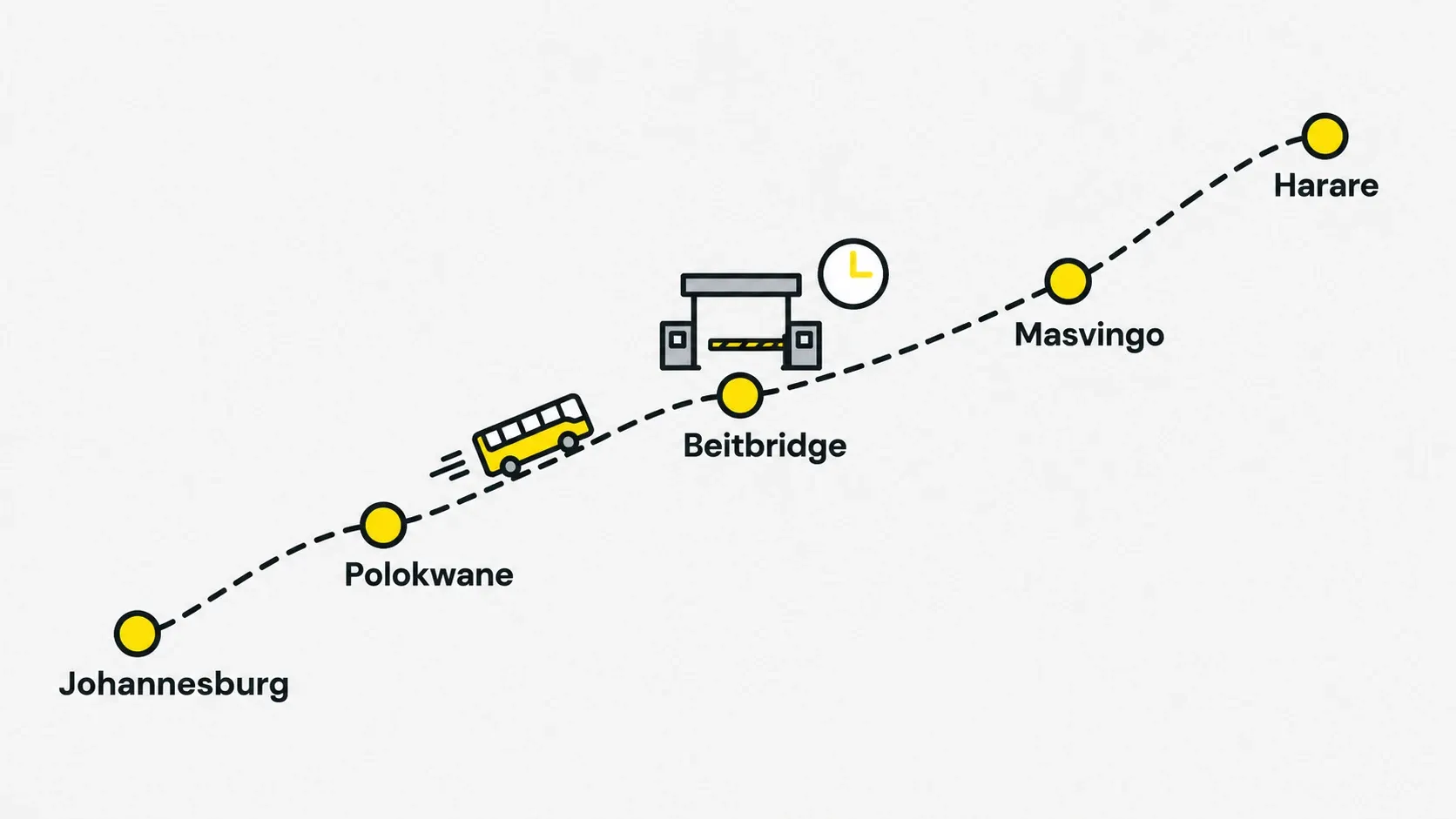
Everything runs on one corridor. From Johannesburg the bus takes the N1 north past Polokwane to Musina, crosses into Zimbabwe at Beitbridge, and continues on the A6 through Masvingo to Harare. Beitbridge is the only road border post between the two countries on this corridor, which is why everyone on the road home passes through the same gates, whatever bus they chose.
- Johannesburg to Beitbridge: roughly the first half of the trip, usually reached late in the evening.
- The border itself: everyone leaves the bus, clears South African exit control, then Zimbabwe entry control, and boards again.
- Beitbridge to Harare: the second half, with Masvingo as the natural rest and fuel stop about halfway to the capital.
Who drives the route
When you search for tickets, these are the names that come up: Intercape, Greyhound and its Citiliner service, Eagle Liner, Big Sky, Intercity Xpress and APM. Aggregators such as Busbud, CheckMyBus and justGO compare departures across operators and sell tickets online, and on a normal weekday there are more than a dozen departures to choose from. Book either through the operator's own site or through an aggregator; what matters at booking time is confirming your exact boarding point in Johannesburg, because terminals differ by operator.
As a price band, expect somewhere between roughly R900 and R2,500 one way, depending on the operator, the seat class and the season, with December the most expensive window of the year. Treat that band as a rough guide only: fares move on this route, and the live price at booking is the only one that counts.
What the trip is actually like
These are long-distance coaches with reclining seats, and the ride is overnight in both directions. A few honest expectations make it easier: coaches are usually air-conditioned to a point where a warm layer is not optional, food is what you brought or what the comfort stops sell, and your phone is your entertainment, so a power bank earns its bag space. Buses stop every few hours for food and toilets, and drivers wait for the bus, not for individual passengers who wander off.
The border: where the trip is won or lost
Beitbridge is one of the busiest road border posts in the region, and the crossing is the single least predictable part of the trip. In a quiet mid-week period, passengers can be through in under an hour. Around month-end, and especially from mid-December to early January, the queues stretch, and several hours is a realistic plan. The bus waits for all of its passengers to clear, so nobody is left behind, but everything after the border, from onward rides in Harare to family expectations, should be planned with that buffer in mind.
Four things make the crossing smoother:
- Your passport stays on your body, never in the luggage hold.
- A pen travels in the same place; there are forms, and there are never enough pens.
- Your ticket, printed or on your phone, is reachable in one move.
- Any goods you are carrying get declared honestly; the checked luggage is sometimes inspected, and the fine for a wrong answer costs more than the goods.
Documents: check them before you leave, not at the gate
Every traveller needs a valid passport, children included. For Zimbabweans who live in South Africa, the document that decides the return leg is the visa or permit: check that it is valid beyond your travel dates before you book, because fixing a status problem from a border queue is far harder than checking it at home. Children travelling without one of their parents should carry extra supporting documents, and because rules for minors change, confirm the current requirements with the Department of Home Affairs a few days before you travel.
Why your money should arrive before you do
Many people still carry the family's money home in cash on the bus, and the honest arithmetic is against it. Cash in a luggage hold can be stolen with no recourse and no trace; cash in a pocket can be lost at a comfort stop; and the month's support for a family in Harare is too important a sum to expose to either. The alternative is to let the money travel by transfer instead of by road: sent from a wallet app before departure, it arrives in Zimbabwe while the bus is still north of Musina, and the recipient collects it without anyone carrying notes across a border.
With SOLmate, sending money to Zimbabwe works from the same wallet account many Zimbabweans in South Africa already use for salaries and daily payments, and the recipient collects in Zimbabwe; the corridor and its costs are explained in the guide to sending money to Zimbabwe from South Africa. A wallet account opens with just a passport and a selfie, no proof of residence, and the steps are covered in the article on opening an account without a South African ID. If you are comparing the cost of the corridor against other options before a big trip home, the breakdown of the cheapest ways to send money from South Africa does the comparison honestly.
Keep the transfer confirmation the app produces. It is the record of what was sent, when and to whom, and it answers the family's first question, "did it go?", without a phone call to anyone; what a genuine confirmation contains, and what it does not prove, is explained in the guide to proof of payment in South Africa.
December, and the other busy windows
The route has three crowded seasons: mid-December to early January, when everyone goes home; the return rush in early January; and month-end queues at the border. If your dates are flexible, a mid-week, mid-month crossing is the difference between an hour and an afternoon at Beitbridge. If December is fixed, book two to three weeks ahead, because both seats and cheap fares run out, and expect the fare band above to bend upward.
Short answers
How long does the bus from Johannesburg to Harare take? Around 16 to 20 hours door to door, including the border stop. Most buses depart in the afternoon and arrive the next day.
How much is a ticket from Johannesburg to Harare? Roughly between R900 and R2,500 one way depending on the operator, the seat class and the season, with December the most expensive. Fares change often, so check the live price when you book.
Do you need a passport to travel by bus to Zimbabwe? Yes, a valid passport for every traveller, children included, plus a valid South African visa or permit for the return leg if you live in South Africa.
How long does the Beitbridge border crossing take? From under an hour in quiet periods to several hours around month-end and in December. The bus waits for all passengers to clear.
Is it better to carry cash or send money ahead? A transfer sent before departure arrives while you are still on the road, and cash carried on a bus has no recourse if it is lost or stolen.
Sources:
Intercape: cross-border coach routes and bookings
Busbud: Johannesburg to Harare route (operators, durations, fare band)
CheckMyBus: departures and prices on the Johannesburg to Harare route
Department of Home Affairs: travel documents and permit information
All pages were checked on 26.10.2026.
SOLmate is not a bank. SOLmate (SOL Ecosystem (Pty) Ltd) is an authorised financial services provider (FSP No. 52248) and registered credit provider (NCRCP16037). This article is general information, not financial advice.