Proof of Residence in South Africa: What Counts, and How to Get One With No Bill in Your Name
A proof of residence is a recent document with your name and home address on it. Here is what counts in South Africa, who accepts what, and what to do when no bill is in your name.
A proof of residence is a recent document from an independent source that shows your name and the physical address where you live. In South Africa that usually means a utility bill, an account statement or a lease that is not older than three months. If nothing arrives in your name, the two standard routes are a sworn affidavit from the person whose name is on the bill, with that bill attached, or a stamped letter from your ward councillor or traditional authority.
"Proof of residence" and "proof of address" mean the same thing. There is no single national list of accepted documents. Whoever is asking decides what they take, which is why a paper that works at the licensing office can be turned away at a bank. This guide sets out what the main askers publish, what to do if you rent a room or live with family, and where you can skip the document altogether.
What Counts as Proof of Residence
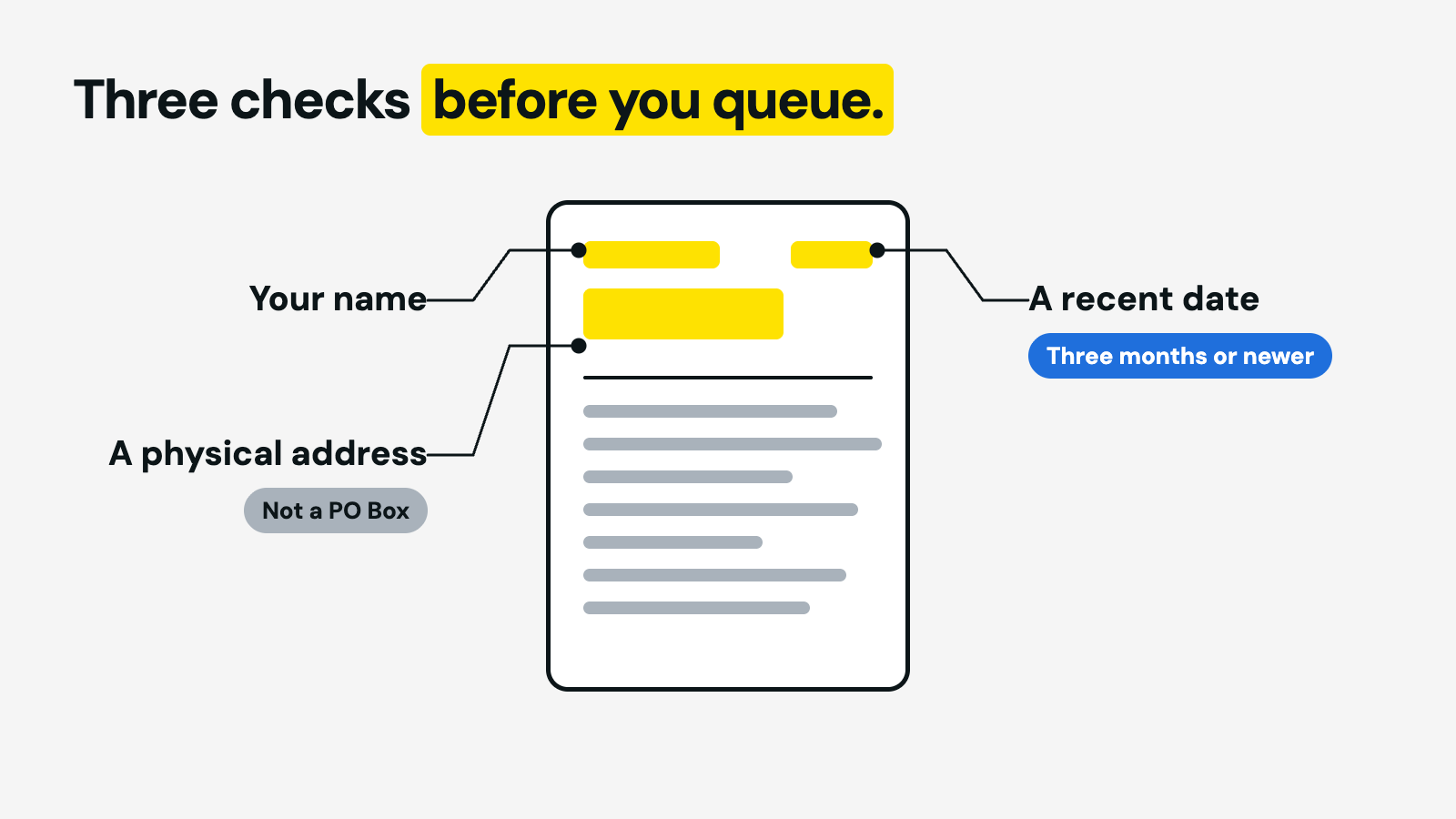
Three things matter more than the type of document.
- Your name is on it. A bill addressed to your landlord proves where your landlord lives.
- It shows a physical address. One bank's published rule asks for a "physical address or stand number and suburb" and states that PO Box numbers are not accepted.
- It is recent. Three months is the limit used by the banks we checked and by the Department of Transport.
These are the documents that appear on the published lists we read for this guide:
- A utility bill for water or electricity
- A municipal rates and taxes invoice
- A landline or cellphone account
- A retail account statement, such as a clothing account
- A bank statement
- A lease or rental agreement
- A short-term insurance policy
- A current TV licence or motor vehicle licence
- Your latest tax return
Not every asker takes every item. A lease is on the list for registering a SIM card, for example, but one of the bank lists we read does not mention it. Check the list of the place you are going to before you travel.
Who Asks, and What Each One Accepts
| Who is asking | What they publish as acceptable | If nothing is in your name |
|---|---|---|
| Driving licence renewal and other eNaTIS transactions | "Proof of residential address e.g. utility account." The Department of Transport's notice on address verification names any utility, clothing, cellphone or telephone account not older than three months. | The owner of the bill makes an affidavit declaring that you live at the address, and the bill is attached to it. If you stay in an informal settlement: a letter with an official date stamp from the ward councillor confirming your address. The department's notice also names the local tribal authority. |
| Registering a SIM card (RICA) | Any document that includes your name and residential address: a bank statement, municipal rates, a cellphone or retail account not older than three months, a lease, a rental or credit agreement, an insurance policy, a current TV or motor vehicle licence. | If you live in an informal settlement: a letter or affidavit from a school, church or retail store where you receive your post, on an official letterhead or with the institution's stamp. |
| Opening a bank account | Each bank sets its own list. One published list reads: utility bill, landline or cellphone account, municipal rates invoice, letter from your councillor or local chief, retail statement, latest tax return, short-term insurance policy, all not older than three months. Another asks for an approved document with your name and physical address or stand number and suburb. | Ask before you go. The bank lists we read do not describe a route for someone with no document in their own name, although one accepts a letter from a councillor or local chief. Some providers no longer ask for proof of residence at all. |
The rows come from the government's driving licence renewal page, the Department of Transport's notice on eNaTIS address verification, the RICA registration notice, and the customer identification pages of Standard Bank and Absa. A lender may ask for proof of income as well, which is a separate document with its own substitutes.
One Place You Can Skip It: Opening an Account
If you need the document only so that your pay has somewhere to land, check first whether the account you want asks for it. SOLmate is a South African money app, not a bank. An account opens in the app in about three minutes from one identity document (an SA ID, a foreign passport or a Section 22 asylum seeker permit) and a selfie. There is no proof of address, no bank statement, no utility bill, no lease and no letter from a landlord. The account costs R10.00 a month, or R29.00 a month with a debit card (card activation from R49), and money arriving by EFT is free.
Why One Place Asks and Another Doesn't
The Financial Intelligence Centre Act, known as FICA, makes banks and other "accountable institutions" establish and verify who their customers are. How they should do that is described in the Financial Intelligence Centre's Revised Guidance Note 7A, dated 1 September 2025.
The guidance says the basic attributes that will always be used are a person's full names, date of birth and, in most cases, an identifying number such as an ID or passport number. Residential address comes up in the next paragraph, as one example of extra information an institution may add, depending on the risk it sees. Institutions "have the flexibility to choose the type of information" they rely on.
In practice each institution writes its own rule. One bank wants a bill no older than three months, another has stopped asking, and neither is breaking the law. The same flexibility is why a foreign passport or an asylum permit can be enough to open an account, and why the checklist for opening an account online is shorter than the one at a branch. Paperwork is one difference between accounts. What they charge every month is the other.
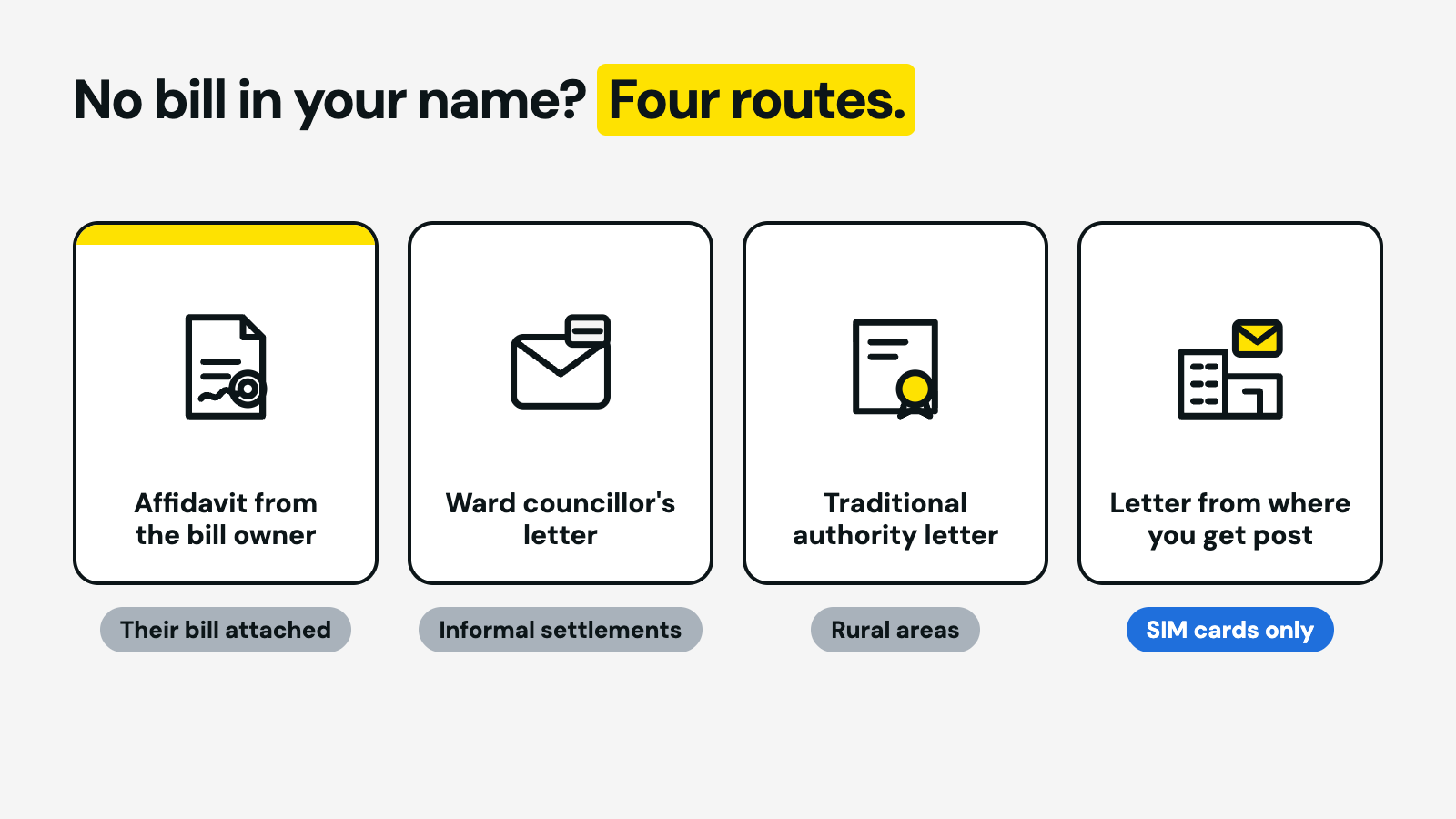
No Bill in Your Name? Four Ways People Get One
Plenty of South Africans rent a room, live in a family home or stay where no municipal account exists. These are the routes the official pages describe.
1. An affidavit from the person whose name is on the bill
This is the route the driving licence page spells out: the owner of the bill makes an affidavit declaring that you live at the address, and the bill is attached. The owner can be a landlord, a parent, a partner or whoever holds the account.
- They write down who they are, the address, and that you live there. Some municipalities publish a ready form, such as this one from Stellenbosch.
- They take it, unsigned, to a commissioner of oaths, together with their ID and a copy of the recent bill. The regulations say the declaration must be signed in the presence of the commissioner, so a form signed at home has to be redone.
- The commissioner asks whether they know and understand the contents and whether they have any objection to taking the oath, then certifies and signs it.
It costs nothing. The regulations for commissioners of oaths state that a commissioner "shall not charge any fee for administering any oath or affirmation or attesting any declaration". Police officers are commissioners of oaths, which is why most people go to the nearest police station.
2. A stamped letter from your ward councillor
If you stay in an informal settlement, the driving licence page asks for a letter with an official date stamp from the ward councillor confirming your residential address. One of the bank lists in the table accepts a councillor's letter too.
3. A letter from the traditional authority
In rural areas where there are no street addresses or municipal accounts, the Department of Transport's notice accepts a letter with an official date stamp from the local tribal authority. One bank's list words it as a letter from your "local chief".
4. A letter from where you receive your post
This one is for SIM cards only. The RICA notice lets residents of informal settlements bring a letter or affidavit from a school, church or retail store where they receive their post.
For the long run, get one account in your own name sent to the address where you live. Cellphone accounts, retail accounts, insurance policies and bank statements are all on the lists above. And if an employer is waiting for bank details while you sort out the paperwork, there are ways to get paid without a bank account.
Templates, Generators and "Proof of Residence Online"
Many searches for this topic end in "template", "example" or "pdf". A template is fine for the wording of an affidavit, but it is only words on paper until the person named in it swears to it in front of a commissioner of oaths.
A letter you type about yourself is weak for a reason. The Financial Intelligence Centre's guidance says information "created or generated by the client him/herself" is not considered reliable. That is why the accepted routes all run through someone else: a municipality, a councillor, a commissioner of oaths.
Websites that offer to "generate" a utility bill or bank statement with your details on it are selling a forged document. Handing one in to open an account or renew a licence is fraud, and the honest route above is free.
Proof of Residence: Short Answers
Is proof of residence the same as proof of address?
Yes. Both mean a document that shows your name and the physical address where you live. Some forms say "proof of residential address".
How old can a proof of residence be?
Three months is the usual limit. The bank lists we read and the Department of Transport's notice all say "not older than three months".
Can I use a bank statement as proof of residence?
Often, yes. A bank statement is on the RICA list for registering a SIM card, and one bank's page accepts a statement from another bank from foreign nationals. It is not on every list, so ask first.
Does an affidavit for proof of residence cost money?
No. The regulations say a commissioner of oaths may not charge a fee for administering an oath or attesting a declaration.
Where SOLmate Fits
A proof of residence usually stands between you and something else: an account, a SIM card, a licence. If that something is an account your pay can go into, SOLmate does not ask for one. You open the account in the app with one identity document and a selfie, and it comes with its own account number that an employer can pay by EFT.
Sources: gov.za, renew driving licence; Department of Transport, verification of address particulars for eNaTIS; RICA registration notice; Financial Intelligence Centre, Revised Guidance Note 7A (1 September 2025), paragraphs 74 and 84 to 87; Regulations Governing the Administering of an Oath or Affirmation, GN R1258 of 1972, regulations 2, 3, 4 and 6; customer identification pages of Standard Bank and Absa; SOLmate account opening; SOLmate fees. All pages were checked on 9 October 2026. Requirements change, so confirm with whoever is asking before you travel.
SOLmate is not a bank. SOLmate (SOL Ecosystem (Pty) Ltd) is an authorised financial services provider (FSP No. 52248) and registered credit provider (NCRCP16037). This article is general information, not legal advice.