How to Open a Bank Account in South Africa Without an SA ID (2026): Passport, Asylum or Refugee Permit
No green ID? A foreign passport, a current Section 22 asylum permit or a refugee permit opens a fully legal account in South Africa in about 3 minutes — no proof of address, no payslip, no work permit, no branch. Which documents work, why banks say no, and what to do if the check fails.
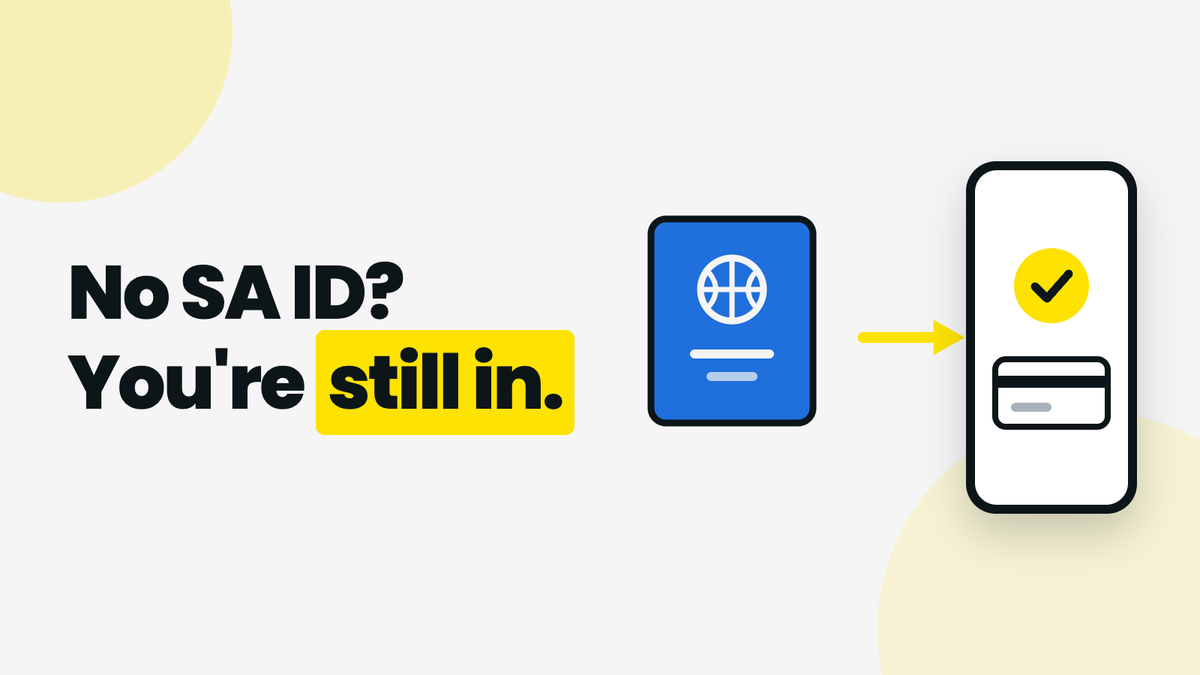
Quick answer: yes — you can open a fully legal transactional account in South Africa without a green ID, and you do not need a bank to do it. A valid foreign passport (any country), a current Section 22 asylum seeker permit or a current refugee permit is enough: a licensed digital wallet account opens in about 3 minutes, in-app, from a photo of your document and a selfie. No proof of address, no payslip, no work permit, no branch. You get a real account number your employer can pay into, plus a Mastercard. If a bank has already turned your permit away, this guide explains why that happened — and what actually works instead.
Is It Legal to Open an Account Without an SA ID?
Completely. South Africa's FICA law requires financial providers to verify who you are — it does not require that verification to happen with a green ID specifically. A valid passport is an identity document. So is a current asylum seeker permit or refugee permit issued by Home Affairs. The law was never the wall.
The wall is practice. Traditional banks layer their own internal rules on top of FICA — branch discretion, risk scoring, demands for proof of address and payslips — and that's where "come back tomorrow" comes from. Licensed non-bank providers built for this exact situation run the same FICA verification digitally: photograph your document, take a selfie, done. That's the route this guide covers, and it's how a SOLmate account opens with just one document — no branch, no queue, no judgement call at a counter.
The Documents That Actually Work
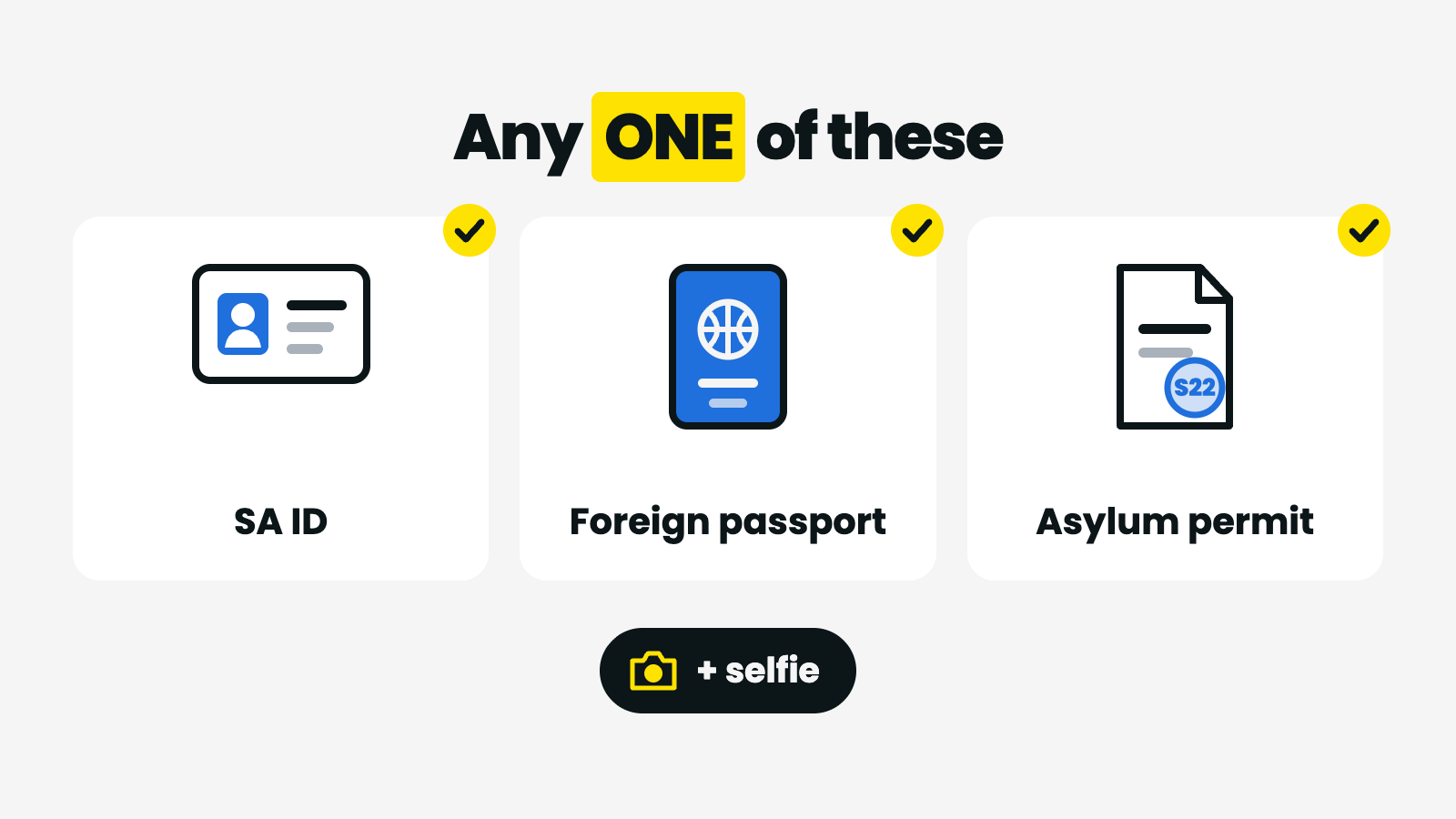
| Document | Who it covers | Works? |
|---|---|---|
| South African ID (smart card or green book) | Citizens and permanent residents | ✅ |
| South African passport | Citizens without their ID card to hand | ✅ must be valid |
| Foreign passport — any nationality | Zimbabwean, Malawian, Mozambican, Nigerian, anyone | ✅ must be valid (not expired) |
| Asylum seeker permit (Section 22) | Asylum seekers whose application is still being decided | ✅ must be current |
| Refugee permit (Section 24 recognition) | People granted refugee status | ✅ must be current |
| Refugee ID card, other Home Affairs permits | Recognised refugees with an ID card; holders of other visas | ❓ ask support before you start |
That's the whole list — one of these, plus a selfie for the biometric check. And here's what's deliberately not on it: proof of address, utility bills, a lease, a letter from your landlord, a payslip, bank statements, a work permit. None of that is needed. The document must be the physical original, photographed live in the app — screenshots, scans and edited images are rejected.
Got One of These? Open Your Account Now
If your document has a ✅ in the table, you already have everything you need. Download SOLmate, photograph the document, take a selfie — about three minutes, no branch, no proof of address, no work permit. You get a real account number for your salary, a Mastercard to spend, cash at the till and money home to 190+ countries. Open your SOLmate account — or keep reading for the detail on permits, why banks say no, what can go wrong and what it costs.
Asylum and Refugee Documents, Explained
Most guides stop at "asylum permit". In practice there are several different Home Affairs documents, and the one you hold changes what to expect.
Section 22 asylum seeker permit. Issued while your asylum application is being decided. Usually a paper document with a photo, issued for a fixed period and renewed at a Refugee Reception Office. This is the document most asylum seekers in South Africa carry, and it is a valid identity document under FICA for as long as it is current.
Section 24 refugee permit. Issued once refugee status has been formally recognised. Typically valid for a longer period than a Section 22 permit, but it still carries an expiry date and must be renewed.
Refugee identity document. A separate ID card that recognised refugees can apply for after status is granted. It is not the same thing as the Section 24 permit — if this is your main document, check with support before starting the sign-up.
Two things matter more than the section number. First, the document must be current on the day you apply — an expired permit fails verification even if a renewal is pending. Second, the name and photo must match you: the in-app check compares your selfie to the photo on the document, so a faded or damaged photo is the most common reason a perfectly legal permit fails. Official rules and renewal procedures are published by the Department of Home Affairs; they change from time to time, so check your own permit's expiry rather than relying on what a friend was told.
Why Banks Keep Turning Permits Away — and Why It's Not About You
If a bank has refused you, it's worth understanding what actually happened, because most people walk out believing they did something wrong.
Banks price risk. An applicant with a foreign passport or a paper permit, no credit history and no utility bill in their name scores as "expensive to verify" — so branch policy quietly filters them out, whatever the law allows. Asylum permits get the hardest time of all: they are paper, they expire often, and a branch that is not trained to read them will simply say no. It's a business decision dressed up as a rule.
The result is well documented: millions of working migrants and asylum seekers in South Africa earn real wages, pay real rent, support families across the border — and get paid in cash envelopes because the front door of banking stays shut. If that's been your experience, here's how people get paid without a bank account in the meantime — and why a real account number is still the better fix.
The fix isn't arguing with a branch manager. It's using a provider whose entire model is built around your documents, where the verification is automated and the answer doesn't depend on who's behind the counter that day.
What You Won't Be Asked For
Worth repeating plainly, because it is the opposite of what a branch tells you:
- No proof of address. No utility bill, no lease, no letter from your landlord or employer.
- No payslip or bank statements. Your income is not part of the identity check.
- No work permit. An identity document is what FICA asks for — permission to work is a separate matter and is not required to hold an account.
- No minimum deposit. Opening costs R0.
- No appointment, no branch. The whole process happens on your phone.
What you do need: one valid identity document from the table above, a working South African cellphone number, to be 18 or older, and to live in South Africa.
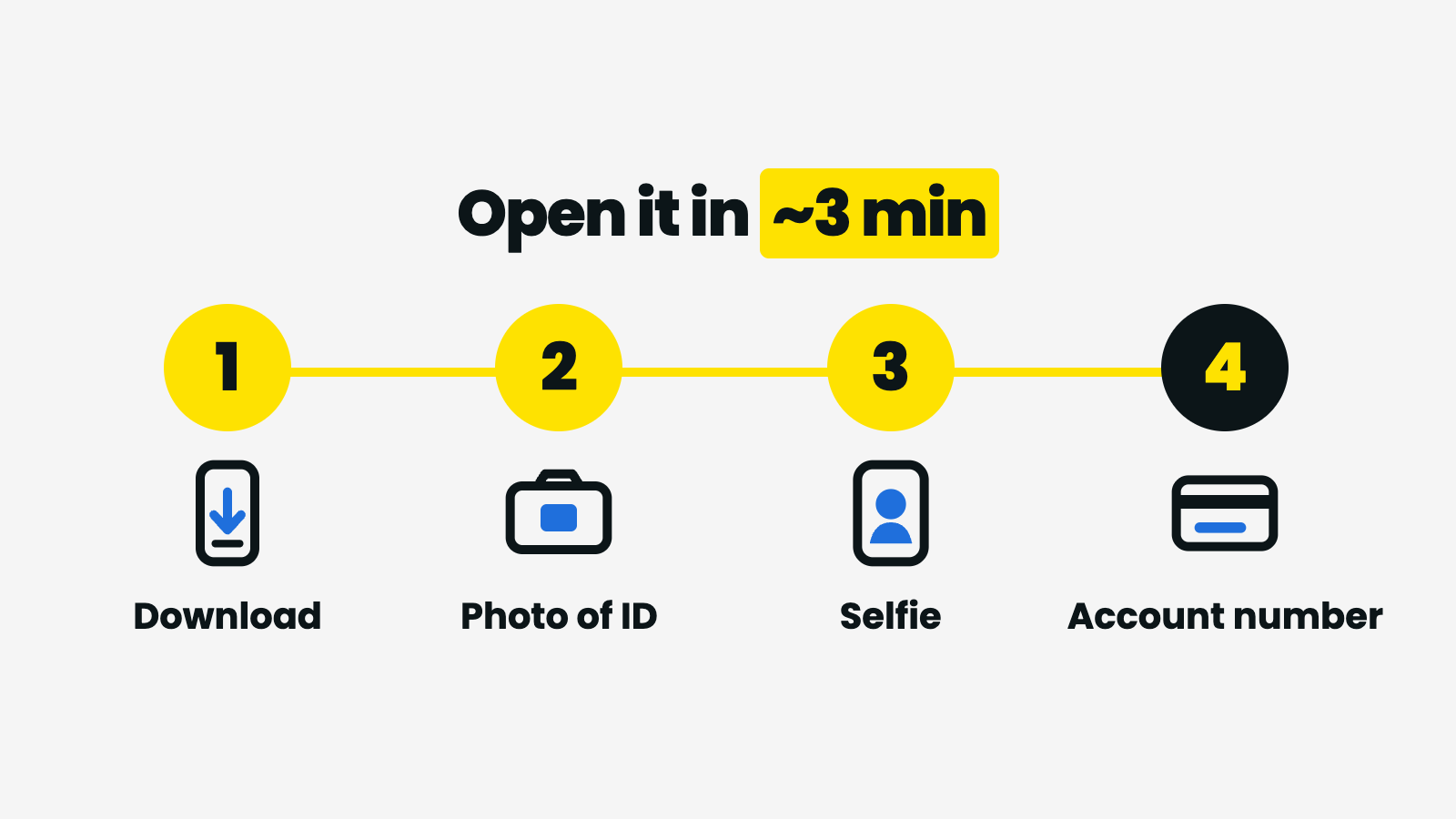
How to Open Your Account, Step by Step (~3 Minutes)
- Download the app. App Store, Google Play, Huawei AppGallery — or a direct APK if you don't use app stores. The whole sign-up happens on your phone.
- Enter your cellphone number. You'll get an SMS code to confirm it — this number becomes the key to your account, so use one you control.
- Photograph your document. Passport, SA ID, asylum or refugee permit — whichever you have. Original only, all four edges in frame, no glare, no blur, every line of text readable.
- Take a selfie. This is the in-app FICA check — it matches your face to the document photo. Good light, full face, no hat, no sunglasses, no filters.
- Get your account number. It arrives in-app within minutes, together with your personal payment reference. You can share it with your employer the same day.
Opening costs R0. From there the account runs on a small monthly fee — the plans and full fee table are public, nothing hidden in fine print.
If the Check Fails
Automated verification is strict about image quality, and that — not your nationality or status — is behind most declines. The published reasons an application is declined are all fixable:
- The document photo is cropped, blurred, or has glare across the text.
- A screenshot, scan or edited image was submitted instead of a live photo of the original.
- The selfie doesn't show the full face clearly — hat, sunglasses, filter, dark room.
- The document has expired.
- You're under 18, or not resident in South Africa.
Fix the cause and try again — a decline is not a record against you. If your permit is current, readable and it still won't pass, open the in-app support chat or read the full list of document and image requirements before retrying. Applications that appear "stuck" rather than declined usually come down to the same image issues — this guide to opening an account online walks through them.
What You Can Actually Do With It
- Receive your salary by EFT. The account number works like any other — payroll pays you the normal way, and the money lands in your wallet with an instant notification. No more cash envelopes.
- Spend with a Mastercard. Physical and virtual — tap to pay in store, shop online, withdraw at any ATM that takes Mastercard. Nobody at the till asks for a work permit.
- Handle cash where you already shop. Deposit and withdraw at Shoprite, Checkers, Usave and Pick n Pay tills with a code from the app — the shops you pass every day become your cash points, card or no card.
- Buy essentials without fees. Airtime, data, electricity and water top-ups are free in the app.
- Send money home. Transfers to Zimbabwe, Malawi, Mozambique and 190+ countries, with the fee and the amount received shown before you confirm. If you're comparing options first, here's the cheapest way to send money from South Africa.
One honest clarification: SOLmate is not a bank. This is a licensed digital account with a real account number, operated by SOLmate (SOL Ecosystem (Pty) Ltd) — an authorised financial services provider (FSP No. 52248) and registered Third-Party Payment Provider. For receiving a salary, paying with a card and sending money, the difference won't affect your day. What matters is that unlike an eWallet voucher, this account has a permanent number that EFTs can actually reach.
Limits and Fees — Know Before You Open
No small print: the account costs R10.00 a month, or R29.00 a month with the Mastercard plus a once-off card activation from R49.00 (the exact activation price depends on your risk profile and delivery address). EFT deposits in are free, and so are airtime, electricity and water purchases. Cash at a till costs R10 to withdraw and 1.75% (minimum R14) to deposit; an EFT out is R8.00. Daily and monthly transaction limits are published openly on the limits page. If your salary is modest, the maths still works — one avoided trip to a money counter usually covers the month, and here's how these fees compare with what banks typically charge.
When Your Permit Is Renewed or Your Status Changes
Your document will change over the years: a Section 22 permit gets renewed, an asylum seeker becomes a recognised refugee, a refugee gets an ID card, a passport is replaced. None of that closes an account that was opened legally — but keeping your records current matters for two reasons. First, FICA obliges every provider to keep customer information up to date, so you may at some point be asked to re-verify with your newest document. Second, if the name or number on your document changes, your employer's payments and your own records should match it. The practical rule: keep your document valid, and when it changes, tell support in the app. They'll tell you whether anything needs updating on your side.
Tricky Cases
Your permit or passport has expired. Renew first — FICA verification needs a valid, current document. An expired Section 22 or Section 24 permit will fail the check, even if you have a renewal appointment.
You only have a renewal receipt or an appointment slip. That is not an identity document and won't verify. You need the permit itself.
You're on a ZEP that's winding down. The account isn't tied to the ZEP at all — it's opened on your Zimbabwean passport, and it stays open as long as the passport is valid. Sending money to Zimbabwe works from the same account.
A bank rejected your documents before. That decision doesn't follow you. The in-app check is automated and starts from zero — if your document is valid and current, it verifies.
Your permit photo is faded or damaged. The selfie match needs a recognisable photo. If yours has worn away, a renewal at Home Affairs is the only real fix — and worth doing anyway, because every other institution will struggle with it too.
You're under 18. Accounts are for adults only; a parent or guardian with their own document can open one in their name.
Not sure your documents qualify? Ask before you start: SOLmate's support answers on WhatsApp and will tell you upfront whether what you have will work.
Where SOLmate Fits
SOLmate was built for exactly the person a branch turns away: one valid document, a selfie, and an account number in about three minutes — whether that document is a foreign passport, a Section 22 asylum permit or a refugee permit. Salary in by EFT, a Mastercard to spend, cash at the till, money home to 190+ countries. See what you need to open an account.
Frequently Asked Questions
Can a foreigner open a bank account in South Africa with just a passport?
Yes. A valid foreign passport from any country is a legal identity document under FICA. Licensed wallet accounts open with a passport plus a selfie — no SA ID, no proof of address, no work permit.
Can an asylum seeker open an account in South Africa?
Yes, with a valid, current Section 22 asylum seeker permit. The check happens in-app from a photo of the permit and a selfie — no branch visit. An expired permit will not pass, so renew first.
Does a Section 24 refugee permit work?
Yes. A current refugee permit is accepted the same way as an asylum seeker permit: photograph it in the app, take a selfie, and the check runs automatically.
Which bank accepts asylum seekers in South Africa?
Every bank sets its own internal policy, and in practice many branches refuse paper permits even though FICA allows them. A licensed non-bank digital account such as SOLmate accepts a current asylum seeker or refugee permit in-app, with no branch decision involved.
Do I need a work permit?
No. One identity document plus a selfie is the full requirement.
Do I need proof of address or a payslip?
No. No utility bills, no lease, no landlord letters, no payslips, no bank statements.
Can my salary be paid into it?
Yes — the account has its own number and payment reference, and any South African employer can pay it by normal EFT.
What happens if my asylum permit expires after I've opened the account?
An expired document does not automatically close an account that was opened legally, but every provider must keep your details current, so renew the permit and let support know in the app — you may be asked to re-verify with the new one.
What happens if my ZEP expires?
Nothing to the account: it's opened on your Zimbabwean passport, not the ZEP, and remains open while the passport is valid.
Why was my application declined if my permit is valid?
Almost always image quality: a cropped or blurred document photo, glare over the text, a screenshot instead of a live photo, or a selfie with a hat, sunglasses or a dark room. Fix the photo and try again — a decline leaves no record against you.
Sources: SOLmate account requirements, SOLmate accepted documents and image requirements, SOLmate fees, SOLmate limits, Financial Intelligence Centre (FICA), Department of Home Affairs (refugee and asylum documents). Details correct as of September 2026; Home Affairs permit rules and validity periods change and are described here in general terms only — check your own document. Bank practices are described in general terms; no specific bank's policy is stated. SOLmate is not a bank. SOLmate (SOL Ecosystem (Pty) Ltd) is an authorised financial services provider (FSP No. 52248) and registered credit provider (NCRCP16037).