Work Permits for Zimbabweans in South Africa
If you hold a ZEP, your permit is valid until 28 May 2027. If you do not, the road to working legally runs through a waiver and a mainstream work visa. Here is the current picture.

The rules around working legally in South Africa as a Zimbabwean sit on three documents: the Zimbabwe Exemption Permit for those who already hold one, a mainstream work visa for those who do not, and, between the two, a waiver that makes the bridge crossing possible. The short version: existing ZEPs are valid until 28 May 2027, a visitor's stay never includes the right to work, and the waiver has removed the two requirements that used to make the transition to a work visa nearly impossible. This guide goes through each route, what it asks and what it gives. Checked on 26 October 2026.
Where the ZEP stands right now
On 7 October 2025 the Minister of Home Affairs extended the validity of all existing Zimbabwean Exemption Permits by 18 months, to 28 May 2027, under Immigration Directive No. 21 of 2025. Two practical consequences follow from that gazette notice. First, employment remains lawful until that date even where the date printed on the physical card has passed; the extension is in the notice, not in a new card. Second, the permit's conditions are unchanged: it allows the holder to live and work in South Africa, and it does not qualify the holder for permanent residence, a position Home Affairs restated in April 2026.
Home Affairs is running a consultation on the longer-term future of the ZEP and the Lesotho Exemption Permit, with recommendations to be presented to Cabinet by the end of the 2026/27 financial year. What that means for a permit holder is practical, not political: check the current status before any big decision, because the extension dates change by ministerial notice, and an out-of-date article about permits is worse than no article at all.
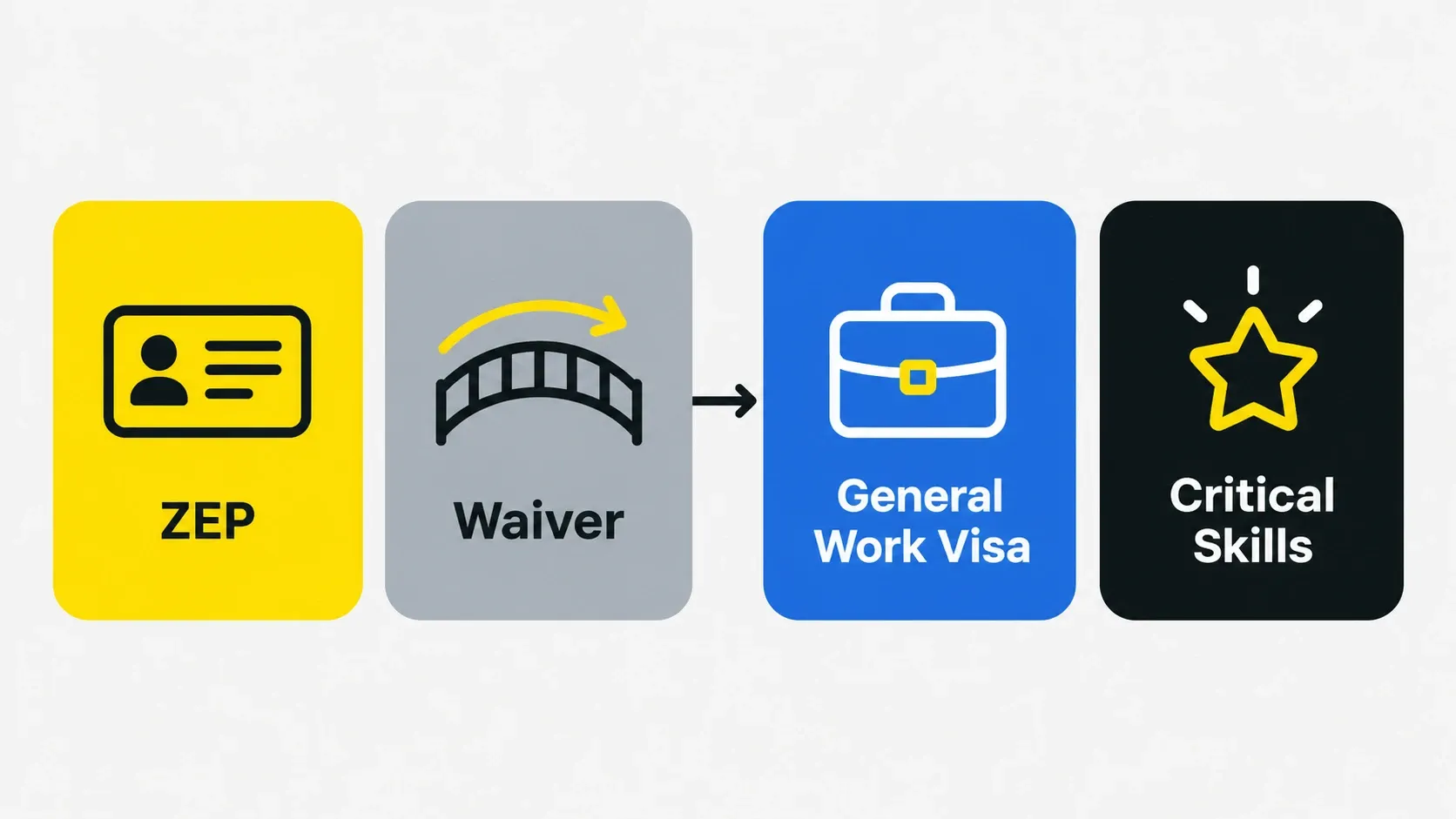
The four routes at a glance
| Route | Who it fits | What it gives | What it asks |
|---|---|---|---|
| Zimbabwe Exemption Permit (ZEP) | Existing holders | Live and work lawfully until 28 May 2027 | Keep the document; follow Home Affairs notices |
| Waiver to a mainstream visa | ZEP holders moving to a General Work Visa | A route from the exemption regime to an ordinary visa | A waiver application first; SAQA and labour requirements are waived |
| General Work Visa | Anyone with a South African job offer | Work for a specific employer | Points-based assessment, labour market check, employer involvement |
| Critical Skills Work Visa | Skilled occupations on the official list | Up to five years at a time, the most stable long-term footing | An occupation on the Critical Skills List, SAQA evaluation |
The waiver: the bridge from a ZEP to a work visa
Since the Constitutional Court judgment of 2023, ZEP holders may apply for mainstream visas from within South Africa. The obstacle was never the right to apply; it was the paperwork, and specifically two requirements: an evaluation of foreign qualifications by SAQA, and a recommendation letter from the Department of Employment and Labour. The waiver that Home Affairs introduced removes both for ZEP holders.
With the waiver letter in hand, the applicant proceeds to the General Work Visa application through VFS Global, and since late 2024 the waiver letters arrive as PDF documents by email rather than as paper copies collected at a branch. The process takes time, so a holder in stable employment who wants ordinary status should start well before any deadline, not at it. Where an employer or an institution needs dated proof of current status in the meantime, an extension letter can be requested; what it proves, and to whom it matters, is worth understanding before you rely on it.
The General Work Visa: employer-driven, points-assessed
The General Work Visa starts with a job offer from a South African employer, and the employer carries much of the load: the role must be shown as one that could not be filled by a citizen or permanent resident, and the application runs through a points-based assessment introduced in the 2024 regulations, scoring qualifications, work experience, the salary offered and age.
Because it involves two departments and an employer's paperwork, the realistic timeline is months rather than weeks. For a Zimbabwean already working on a ZEP, the practical order of operations is: waiver first, visa application second, and the employer briefed on both.
The Critical Skills Work Visa: the stable route
For occupations on South Africa's Critical Skills List, the 2022 revision of which remains the operative list, the Critical Skills Work Visa is issued for up to five years at a time. It asks for the occupation to be on the list, a SAQA evaluation of the foreign qualification, and registration with the relevant professional body where the occupation requires it.
One recent practice worth knowing: where the SAQA evaluation is still pending, the visa can be issued for a shorter period first and extended once the evaluation is favourable. Of the four routes, this is the one that builds toward long-term status, because permanent residence, which the ZEP does not open, runs through sustained legal work status, and a five-year skills visa is the most direct foundation for it.
Visits are not work
A Zimbabwean passport allows short visits to South Africa without a visa application, up to 90 days, but a visitor's stay never includes the right to work. Working while on a visit undermines both the current stay and any future application, and it is the single most expensive shortcut available, because its cost is measured in status rather than money. The lawful order is fixed: the correct visa first, the job second.
Proving your status to an employer
Employers in South Africa carry a legal duty to confirm that every foreign employee has the right to work, so the question "can I see your permit?" is routine, not suspicion. Three habits make it painless. Keep the original permit and a scanned copy in separate places.
Keep a copy of the gazette notice extending the ZEP to 28 May 2027, because it is the document that answers the "but this looks expired" conversation. And where a landlord, a school or a bank-style institution asks for address proof on top of status documents, what actually counts as proof of residence in South Africa is a solved question with a longer list of answers than most people expect.
With the right to work in place: where the salary lands
None of the documents above are needed to receive a salary. A wallet account opens with one identity document, a Zimbabwean passport is enough, plus a selfie; no work permit, no proof of residence, no payslip. The right to work decides whether the job is lawful, but the money side needs only the passport, and that separation catches many people by surprise in the useful direction.
The account details shown in the app receive a salary by EFT like any other account, which is the setup explained in the guide to getting paid without a traditional bank account, and the full steps for opening with a passport are in the article on opening an account without a South African ID. From there, supporting family back home stops being a logistics question: the corridor and costs of sending money to Zimbabwe from South Africa work from the same wallet the salary lands in.
Short answers
Is the ZEP still valid? Yes. Existing permits were extended to 28 May 2027 by Immigration Directive No. 21 of 2025, and Home Affairs confirmed in April 2026 that no policy change has been made.
Can a Zimbabwean work in South Africa without a work visa? Only a ZEP holder can work on the strength of the permit. Everyone else needs the correct work visa before starting a job, and a visitor's stay does not include the right to work.
Can ZEP holders get permanent residence? Not on the ZEP itself: its conditions exclude permanent residence, as Home Affairs restated in April 2026. A mainstream work visa is the route to a longer-term status.
What does the ZEP waiver do? It removes the two biggest requirements, the SAQA evaluation of qualifications and the Department of Employment and Labour recommendation, for ZEP holders applying for a mainstream work visa.
Do you need a work permit to open a wallet account? No. A wallet account opens with one identity document, a passport is enough, and a selfie; no work permit, proof of residence or payslip is asked for.
Sources:
Helen Suzman Foundation: media statement on the extension of ZEP and LEP permits to 28 May 2027
Department of Home Affairs: Critical Skills Work Visa requirements
VFS Global: South Africa visa and permit applications for Zimbabwean citizens
All pages were checked on 26.10.2026.
SOLmate is not a bank. SOLmate (SOL Ecosystem (Pty) Ltd) is an authorised financial services provider (FSP No. 52248) and registered credit provider (NCRCP16037). This article is general information, not financial advice, and not legal advice on immigration status.