What Is a Bank Confirmation Letter and How to Get One
Employers, landlords and government offices often ask for a bank confirmation letter. Here is what the document is, what it must show, and how to get one from an app in a few taps.

A bank confirmation letter is a short document from your financial institution confirming that you hold an account with them. It shows your name, your identity document number, your account number and branch details, and it carries the institution's stamp or letterhead. It shows no transactions, which is exactly the point: it answers the question "does this account exist and belong to this person", not "what did this person spend". You typically get it from your banking app in a few taps, and it is free with most providers, including wallet accounts.
Who asks for it, and why
The same document goes by several names: account confirmation letter, proof of account, or simply a letter confirming your banking details. Whoever uses the name, the requesters fall into a familiar set:
- Employers, before they can load your account for a salary EFT. They want proof that the account number they were given is real and belongs to you, so the first pay cheque does not vanish into a wrong reference.
- Landlords and letting agents, when you sign a lease, alongside proof of income.
- Schools and universities, for fee accounts and bursary payouts.
- Government offices and tender processes, where a payment must go to a verified account in your name.
- Visa and immigration applications, as one of several supporting documents.
What all these requesters have in common is that they need the account to be confirmed by the institution itself, not just typed on a form by the account holder.
What the letter must contain
Whatever institution issues it, a usable confirmation letter shows:
- the date it was printed or generated,
- your full name,
- your ID or passport number,
- your account number and the relevant branch codes,
- the reference that payers should use when sending you money,
- the institution's name, and its registration details (for example its FSP number),
- a stamp, seal or verifiable letterhead.
Without those, whoever asked for the letter may reject it and you will be back in the queue. If your account is with a wallet provider rather than a traditional bank, the letter carries the provider's own details: for example, a SOLmate confirmation letter shows your Standard Bank account and branch codes, instructs payers to use your phone number as the reference, and carries an electronic SOLmate stamp with a print date and number.
How to get one without visiting a branch
Most traditional banks let you download confirmation letters from their apps, though some still route certain stamped versions through a branch, and fees vary. With wallet apps the process is usually simpler. In the SOLmate app the path is: Receive Money, then EFT from Bank, then "Download or Share your payment confirmation letter". It is free, and you can share it directly from the phone.
The reference: the small line that decides whether your money arrives
The confirmation letter does one more job worth understanding. It tells payers exactly how to route money to you. With SOLmate, that means using your phone number as the payment reference. Incoming EFTs are matched automatically every five minutes, every day including weekends, but only when the reference is correct. A payment sent without the right reference does not bounce back immediately: it lands among unrecognised payments and must be allocated manually by support, which takes time and carries a separate fee. When you hand your letter to an employer, point at that line and ask them to load it exactly.
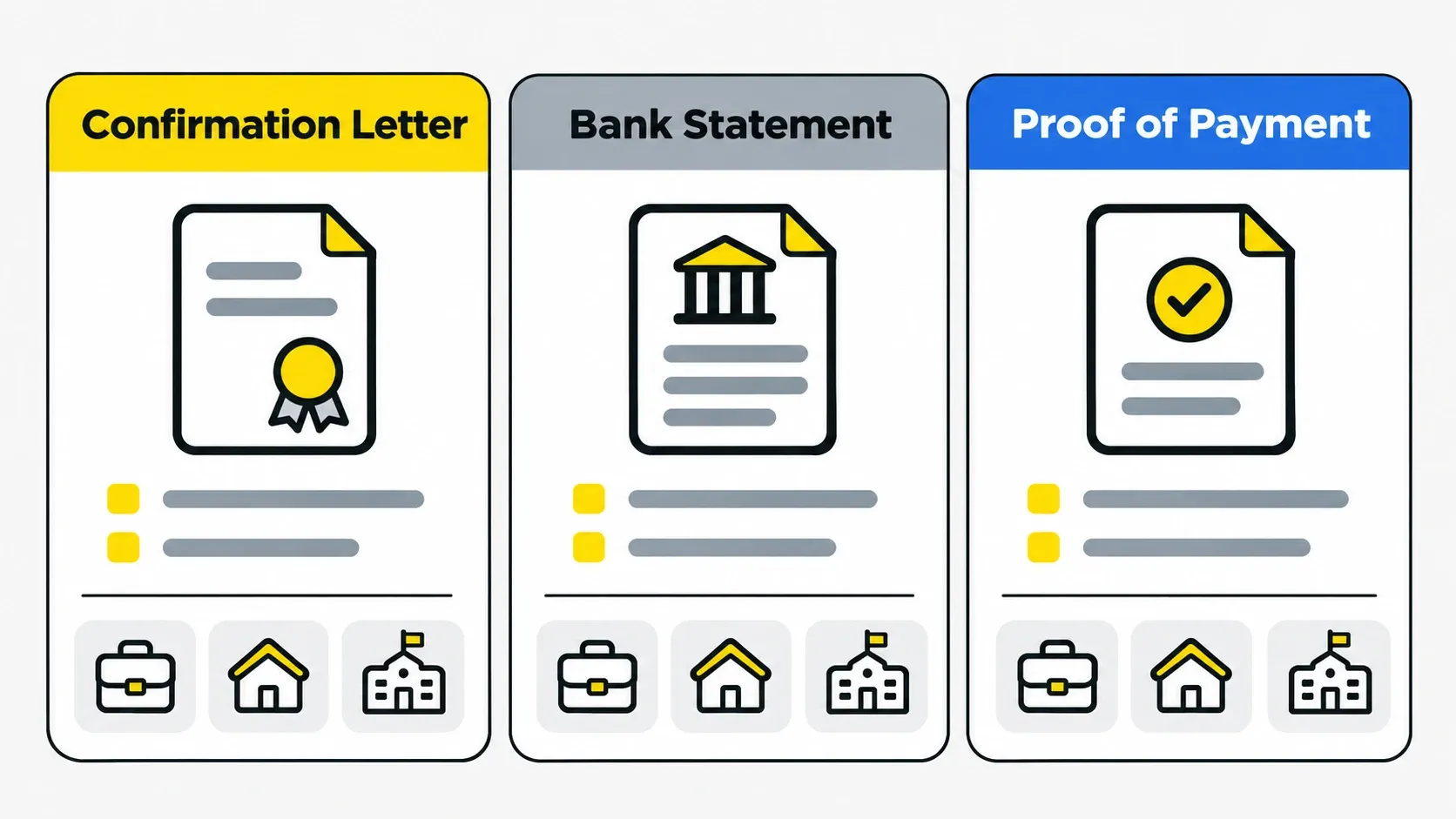
Confirmation letter, statement, proof of payment: three documents, three jobs
| Document | What it shows | Who asks for it |
|---|---|---|
| Confirmation letter | That the account exists and belongs to you, with its details | Employers, landlords, schools, government |
| Bank statement | Transaction history over a period | Landlords, lenders, embassies |
| Proof of payment | A single transaction you sent | Sellers, anyone you have just paid |
Confusing the three is a common reason documents get rejected. If someone asks for "proof of account", don't send a statement; if they ask for a statement, a confirmation letter will not do. If you are the one being paid and want to know what to make of the document you receive, the guide to proof of payment in South Africa covers the buyer's side of the exchange.
Two honest limits of wallet letters
A confirmation letter from a wallet provider is not accepted everywhere a bank letter is. Two cases come up often and are worth knowing before you rely on it:
- UIF claims. The Unemployment Insurance Fund often requires a letter from a registered bank, and a wallet provider's letter is frequently not accepted for benefit payouts.
- SASSA grants. Social grant payments cannot be made into a SOLmate account at all.
If your employer pays into a wallet account and you expect to claim UIF in future, check with the Fund first. Where a wallet letter works well is the everyday list at the top: salaries from most private employers, leases, school fee accounts. If you are new to the country or unbanked, a wallet account with a downloadable confirmation letter is often the fastest route to getting paid at all: see how to get paid without a bank account, how to open an account online and, if you are asked for address proof as well, what counts as proof of residence in South Africa.
Short answers
What is a bank confirmation letter? A document from your financial institution confirming that you hold an account, with your name, ID or passport number, account number and branch codes. It shows no transactions.
How do I get one? In most banking and wallet apps, from the documents or receive-money section. With SOLmate: Receive Money, EFT from Bank, then download or share the letter. Free.
Is it the same as a bank statement? No. A statement lists transactions over time; the letter only confirms the account and its details. Requesters rarely accept one in place of the other.
Does it cost anything? With SOLmate the letter is free. Traditional banks vary: many provide digital letters free, while stamped or branch-issued versions may carry a fee.
Will everyone accept it? Most private employers, landlords and schools do. UIF payouts often require a registered bank's letter, and SASSA grants cannot be paid into a SOLmate account.
Sources:
Standard Bank: how to get bank account documents
Tenders SA: bank confirmation letters in tender applications
All pages were checked on 19.10.2026.
SOLmate is not a bank. SOLmate (SOL Ecosystem (Pty) Ltd) is an authorised financial services provider (FSP No. 52248) and registered credit provider (NCRCP16037). This article is general information, not financial advice.