How to Read Your Payslip in South Africa
A payslip is the most important financial document you receive every month, and most people only look at one number on it. Here is what the rest of the lines mean, and why they matter.

A payslip is the document your employer gives you each pay period showing what you earned, what was deducted, and what actually landed in your account. The number most people check is the last one, the net pay. The lines above it matter just as much: they decide whether your tax is correct, whether your UIF is being paid, and whether money is leaving your salary that you never agreed to. Reading a South African payslip takes five minutes once you know the lines, and this guide goes through each of them.
Line one: gross pay
Gross pay is everything you earned for the period before any deductions: your basic salary, overtime, commission, and any allowances. It is not "your money" in the sense you can spend it, because statutory deductions come off it first, but it is the number everything else is calculated from. Check that the gross matches what your contract or wage agreement says, including overtime and commission for the period.
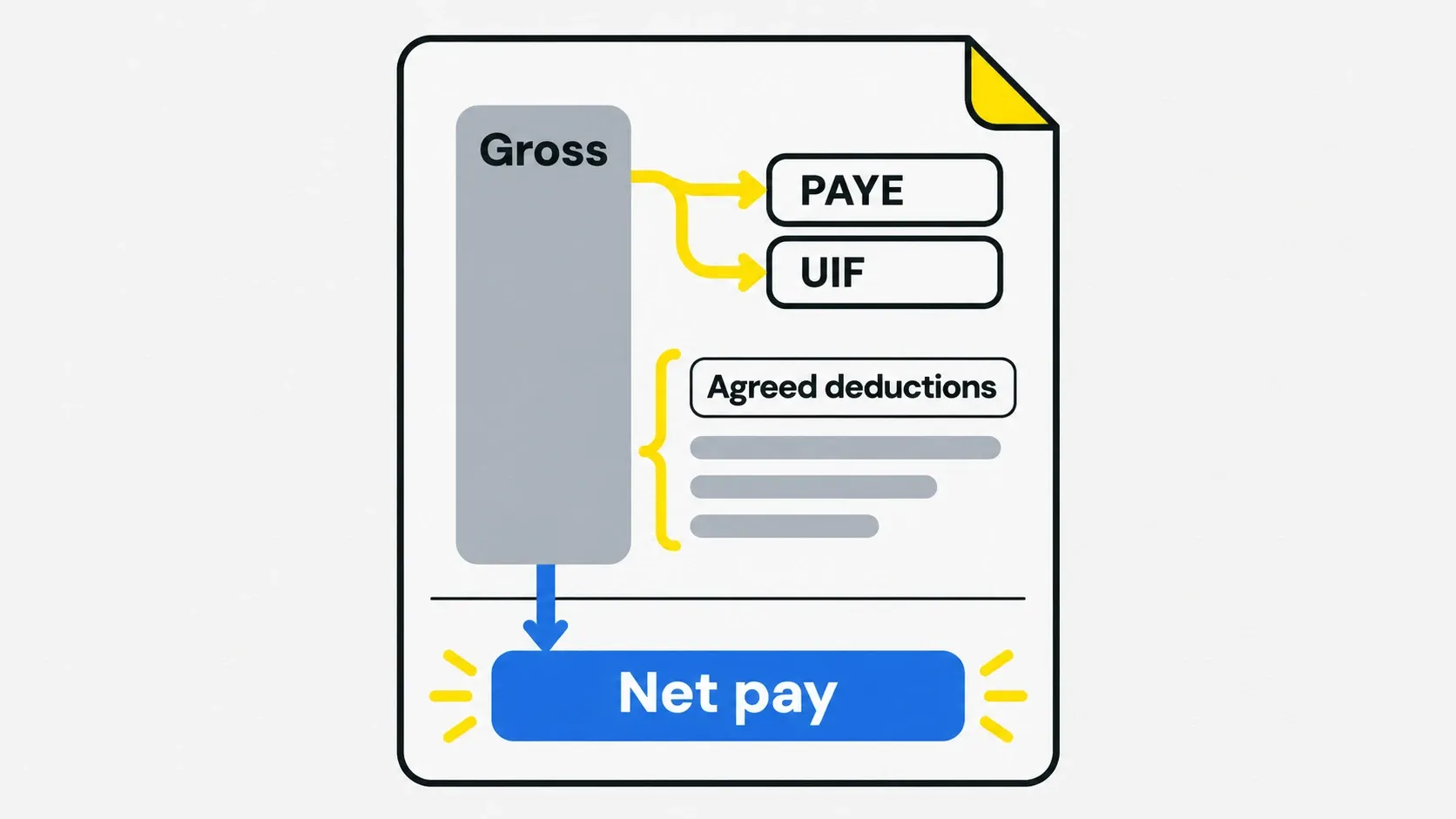
The statutory deductions
These come off every formal salary, and they are not negotiable line by line, but they are worth checking:
- PAYE (Pay As You Earn). Your income tax, deducted by your employer and paid to SARS on your behalf. It is calculated from the tax tables SARS issues each year, on a sliding scale, so it is the largest deduction for most earners above the tax threshold. If your PAYE looks wrong, the cause is usually an incorrect tax directive or an employer using out-of-date tables.
- UIF (Unemployment Insurance Fund). A small, fixed line: 1% of your pay, matched by another 1% from your employer, and capped at a monthly ceiling, so no more than R177.12 comes off your side. The fund pays benefits if you are retrenched, and covers maternity and illness. If UIF is missing from your payslip, ask about it: retrenchment and maternity benefits depend on those contributions having been made.
Employers also pay SDL and COIDA on their side, but those never appear on your payslip: they cost you nothing and cannot be deducted from your salary.
The agreed deductions
Below the statutory lines come the deductions you agreed to somewhere along the way:
- Pension or provident fund contributions, often with an employer match.
- Medical aid, usually shown as a member contribution.
- Union fees, insurance policies, funeral or savings schemes sold through the workplace.
- Garnishee or emolument orders: court-ordered deductions that repay a debt directly from your salary. If one of these appears and you were never served with court papers, treat it as an error until proven otherwise; how these orders work, and what the law allows, is explained in the article on garnishee orders in South Africa.
The number that lands in your account
Net pay is gross minus all of the above, and it should match the amount that reached your account, to the cent. If you are paid by EFT and the two numbers differ, the difference is not "bank charges": something between the payroll and the account is wrong, and it is easier to fix in the month it happened than six months later.
Why the payslip matters beyond pay day
A payslip is proof of income, and proof of income is what landlords, lenders, schools and embassies ask for when they want to know your money is regular. In practice it is the first document to reach for: where a request is really about affordability, a payslip with an employment letter answers it without any bank paperwork.
What different requesters actually check, and which documents substitute for a bank statement, is set out in the guide to bank statements and their alternatives; for loans specifically, the article on loans without a bank statement lists what lenders accept instead.
One more honest note: payslip generators that produce "dummy payslips" exist online, and they are not a paperwork shortcut. A fake payslip is fraud, lenders verify them, and the consequences land on the person who signed the application. If your income is cash or informal, the useful direction is the opposite one: documents that show your real situation, from an employment letter to a simple record of payments received.
Getting paid when there is no payslip
Plenty of South Africans are paid in cash or paid without formal documents, and the payslip-based system quietly leaves them out of things like leases and credit. If that is your situation, two things help more than any template. First, ask your employer for a letter confirming your pay, even if payroll is informal.
Second, move the salary trail somewhere verifiable: with a wallet account like SOLmate, no payslip is needed to open the account, only one identity document and a selfie, and the salary can arrive by EFT using your phone number as the payment reference, which builds a regular payment record where no payslip exists. The full picture of getting paid without a traditional bank account covers the rest of the setup.
Short answers
What is gross pay on a payslip? Everything you earned for the period before deductions: salary, overtime, commission and allowances. All deductions are calculated from it.
What is PAYE? Income tax deducted by your employer and paid to SARS on your behalf, calculated from the SARS tax tables each year on a sliding scale.
What is UIF on a payslip? The Unemployment Insurance Fund contribution: 1% of your pay, matched by your employer, capped at R177.12 from your side. It funds retrenchment, maternity and illness benefits.
Can my employer deduct anything else from my salary? Only what is statutory, court-ordered, or agreed with you (like pension, medical aid or union fees). Anything else is a query, not a deduction.
Sources:
Liberty: understanding your payslip (PAYE and UIF)
Debt Solutions 4U: payslip deductions and the UIF cap
All pages were checked on 19.10.2026.
SOLmate is not a bank. SOLmate (SOL Ecosystem (Pty) Ltd) is an authorised financial services provider (FSP No. 52248) and registered credit provider (NCRCP16037). This article is general information, not financial advice.