What Is Proof of Payment and How to Check It's Real
A proof of payment shows a transfer was sent. It does not prove the money reached your account. Here is what a genuine POP contains, how fake ones fool sellers, and what to check before releasing goods.
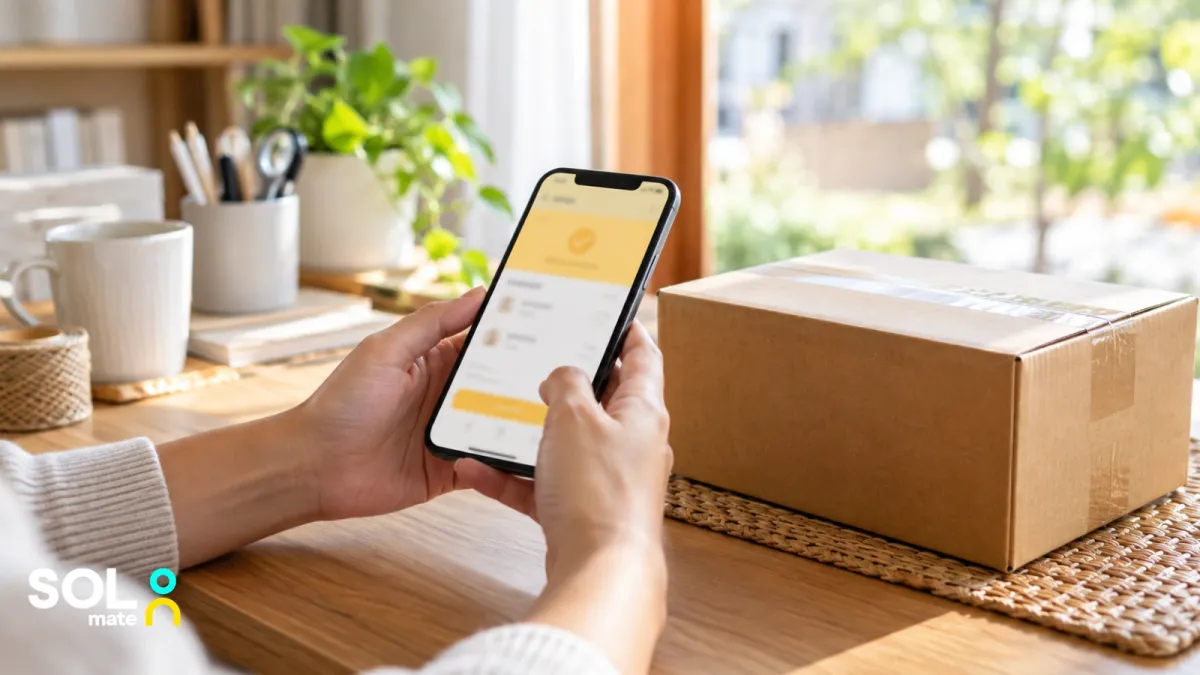
A proof of payment, or POP, is the document a payment app or banking app produces when someone sends money: a PDF or notification showing the amount, the date, and who it went to. Buyers send it to prove they have paid. The catch, and the reason this article exists, is that a POP only proves a payment was initiated. It is not confirmation that the money has arrived in your account, and fake POPs are now one of the most common scams against people selling things online in South Africa. Never release goods on a POP alone: wait until the money is visible in your own account.
What a genuine proof of payment must show
Whether it comes from a banking app or a money app, a real POP is generated automatically by the payment system, not typed by hand. It contains:
- the amount,
- the date and time of the transaction,
- a transaction or notification number,
- the recipient's details: name, bank, account number, branch number and reference,
- the name and registration details of the institution that issued it.
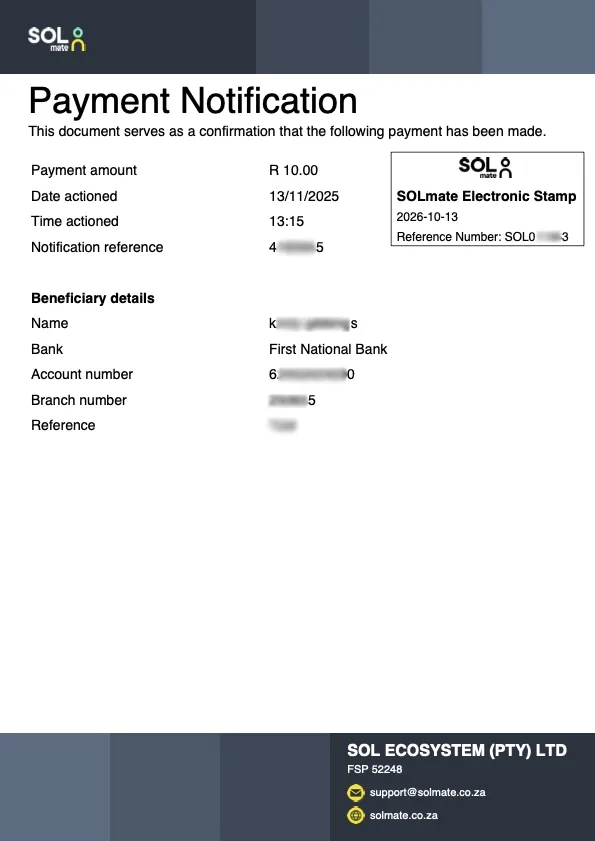
Conveniently for buyers, sending the confirmation to the person you paid is often a built-in option. With SOLmate, a payment notification for an EFT, an instant RTC transfer or a SOLpay Link can be downloaded as a PDF from the transaction details screen, free of charge, and during the send you can choose to have it delivered to the recipient by SMS or email for R1.
A POP is a message, not the money
A standard EFT between banks can take one to two business days to clear, and up to three depending on the banks involved. During that window, the POP exists but the money does not yet sit in your account. A buyer can be completely honest, send a real POP, and the transfer can still bounce or be reversed later. An instant RTC transfer, sent before 15:00, lands within about an hour, which shortens the waiting game but still does not turn a POP into proof of receipt. If you want to understand the difference between standard and instant transfers in detail, this article on instant EFT and RTC transfers in South Africa breaks down the costs and timing.
The fake POP scam, and how the table protects you
The scam is simple and it targets sellers on marketplaces and social media groups. A "buyer" sends a convincing confirmation screenshot and pressures you to release the item before the money clears. The document may look perfect: bank colours, a reference number, correct details. Some versions go further and "overpay", sending a POP for more than your price and asking you to refund the difference. Days later, the original payment bounces and your refund is gone with it.
Because the scam is a document, the defence is also a document check. Compare what you receive against what a real POP must contain:
| What to check | Genuine POP | Warning sign |
|---|---|---|
| Origin | Generated by the payment system, downloaded from the app | A photo or screenshot of a screen, cropped edges, low quality |
| Amount | Exactly your asking price | More than your price, followed by a refund request |
| Timing language | Shows date and time the payment was initiated | Pressure to release goods "today", before anything can clear |
| Recipient details | Your name and your account details, matching character for character | Vague recipient, wrong bank, or details that don't match what you gave |
| Verification | Money visible in your own account | "Trust me, check tomorrow", or excuses about weekend delays |
The rule from the table's last row is the one that matters: the only proof of payment that counts is the money in your own account or app. Everything else is a claim. Sellers who adopt the one-line rule "goods move when the balance moves" are immune to every version of this scam.
Receipts are not proofs of payment either
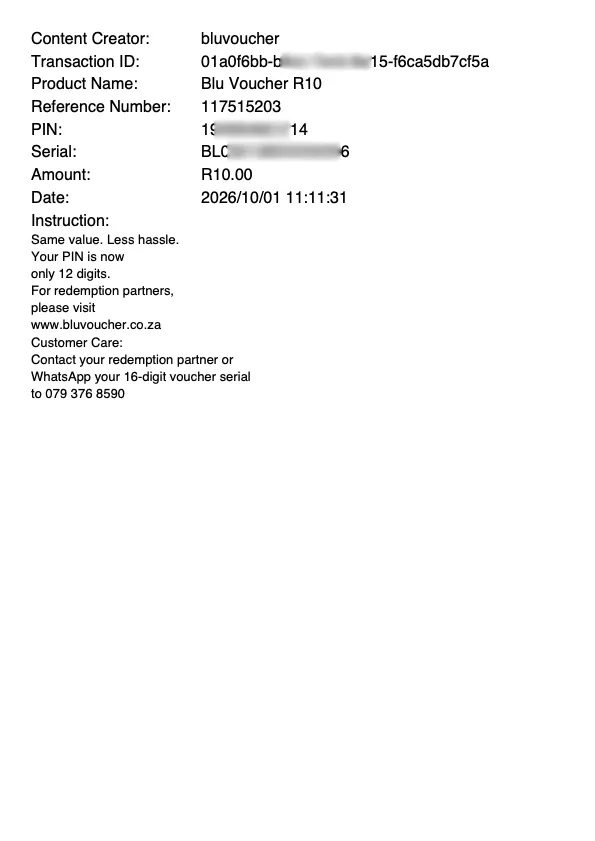
One confusion worth clearing up: when you buy a voucher, electricity or DStv through a money app, what you receive is a receipt, not a proof of payment. A receipt confirms a purchase: the product, transaction number, reference, amount and date. It is a useful record, but it is a different, less formal document, and it will not satisfy someone who asked you for a POP.
One honest note about receiving money
If you receive money into a wallet account, the same logic applies in reverse: don't promise the sender anything, and don't act on their POP, until you see the funds on your balance. Providers watch for fraud patterns on the receiving side too. For example, SOLmate runs a manual review on transfers that try to move almost the entire balance of an account very shortly after money was paid in, the classic pattern of a hijacked or scammed account draining itself. Legitimate users are unaffected, but it is a good illustration of why "the money is in the account" and "the money has been moved out again within the hour" are both things a careful receiver should notice.
Where SOLmate fits
If you send money to people who don't have a bank account, or you receive money yourself and want the confirmation trail to be simple, a wallet account keeps it in one place. Every EFT, RTC and SOLpay Link payment produces a downloadable PDF notification with the amount, the recipient's details and SOL Ecosystem (Pty) Ltd's authorisation details (FSP 52248) printed on it. You can read more about SOLmate's fees, or about the cheapest ways to send money in South Africa and how to choose a money transfer app.
Short answers
What is a proof of payment? A document, usually a PDF, produced by a banking or money app when a payment is sent, showing the amount, date, recipient and a transaction or notification number.
Is a POP proof that the money arrived? No. It shows a payment was initiated. A standard EFT can take up to two or three business days, and the payment can still fail after the POP was issued.
How do I spot a fake POP? Don't judge the document, judge the outcome: release goods only when the money is visible in your own account or app. Be extra careful with overpayments and refund requests.
Can I send a proof of payment to someone else? In most money apps, yes. With SOLmate you can have the payment notification sent to any number or email address during the transfer, for R1.
Sources:
EWN: Gumtree SA flags fake payment scam targeting sellers
Gumtree SA: Stay Safe Shopping Online, How to Spot a Scam
Absa South Africa on verifying payments before releasing goods
All pages were checked on 19.10.2026.
SOLmate is not a bank. SOLmate (SOL Ecosystem (Pty) Ltd) is an authorised financial services provider (FSP No. 52248) and registered credit provider (NCRCP16037).