Loans Without a Bank Statement or Payslip in South Africa: What the Law Actually Asks For
Registered lenders must verify income — but a 2018 court ruling scrapped the rigid three-payslips-or-three-statements list. What lenders can accept instead, why cash earners get stuck, and how to read the ads that promise no statement and no credit check.

You can borrow legally in South Africa without handing over a bank statement or a payslip. What you cannot do is borrow from a registered lender without that lender checking, somehow, that you can afford to repay. The bank statement was never the point; it was just the easiest way to do the check. Once you see that, the question changes from "who lends without paperwork" to "what can prove my income when the usual paperwork doesn't exist".
What the Bank Statement Is Doing There
The National Credit Act obliges every registered credit provider to run an affordability assessment before granting credit: what comes in, what already goes out, and what is left to service a new instalment. For years the regulations spelled out the evidence in a rigid list: three recent payslips, or three months of bank statements, or the latest financial statements if you were self-employed. Three months of statements answered two questions at once. It showed income arriving, and it showed the debit orders already leaving.
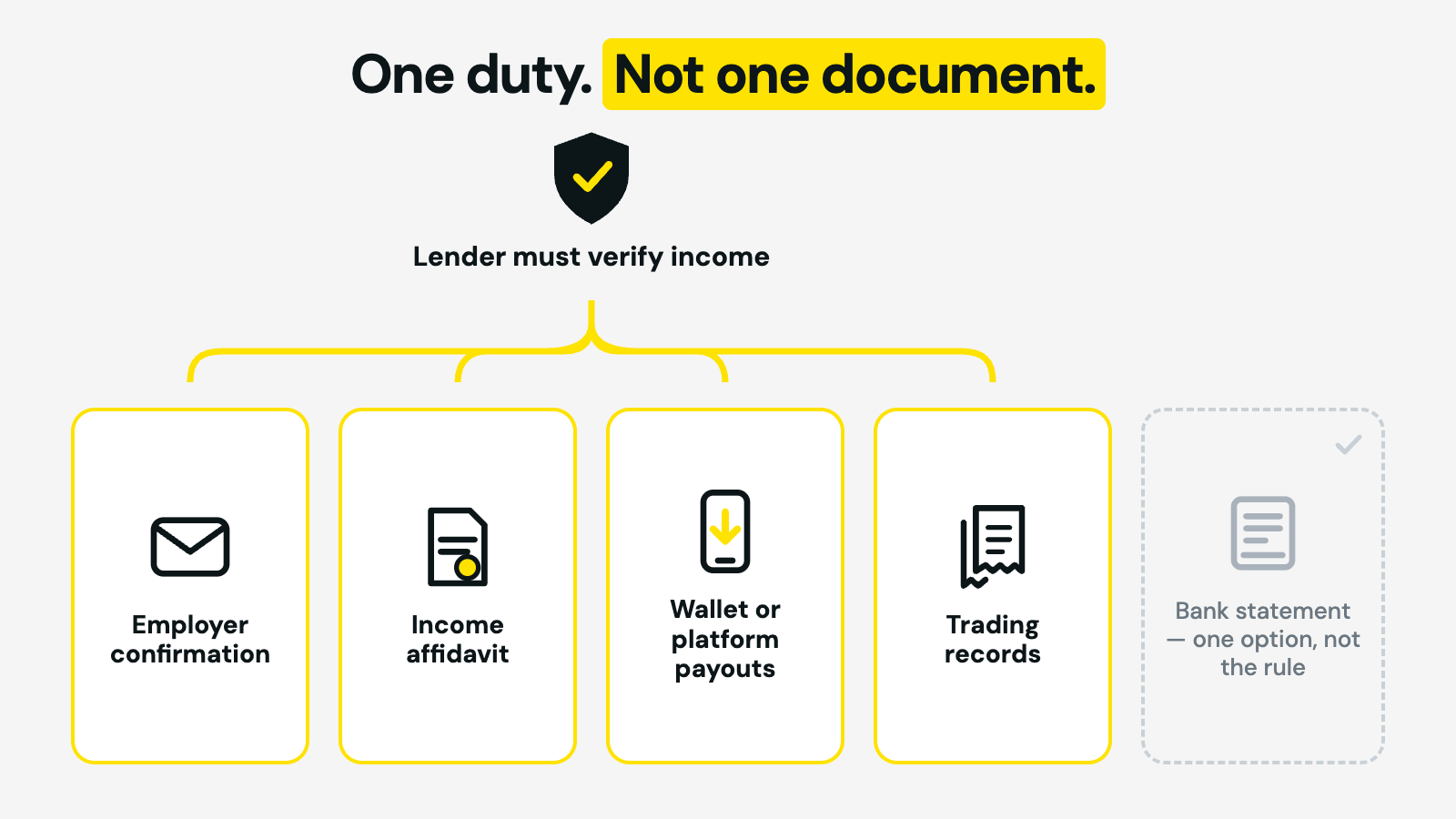
That rigid list no longer stands. In 2018 the High Court set it aside as irrational for the millions of people who earn without a payslip, and lenders were left with the underlying duty rather than the prescribed documents: take practicable steps to validate the consumer's income. Practicable is the word that matters. A lender may still ask for a statement because it is convenient, but the law does not require you to have one, and a lender that refuses to consider anything else is making a business choice, not following a rule. The broader picture of how that assessment works, and how your bureau record feeds it, sits in the credit score guide.
Who Gets Stuck Without One
The people searching for this are rarely trying to hide anything. A domestic worker paid in cash on the last Friday of the month has income and no statement. A driver on a ride-hailing app has weekly payouts and no payslip. Someone whose wages land in a cousin's account, because a bank turned away their permit, has a paper trail with the wrong name on it. A trader at a taxi rank has months of steady takings and nothing a bank branch would recognise. In each case the money is real and the record is missing, and a lender that only reads bank statements cannot see either.
The fix for the record is usually cheaper than a loan. Getting paid into an account in your own name turns cash into a history, and that history is what any lender will eventually want to see, whatever they call the document. A foreign passport or an asylum permit is enough to open one with a licensed non-bank provider; the guide to accounts without an SA ID covers which documents work and why branches say no.
What Lenders Can Accept Instead
Since the court ruling, income can be validated with whatever reasonably proves it. Common substitutes include a letter or written confirmation from an employer, a sworn affidavit of income for informal earners, a record of payouts from a platform or a wallet, and, for small traders, recent stock invoices or point-of-sale records. Some lenders also look at how you have paid existing accounts, because a paid-up phone contract or store account already says a lot about repayment. None of this removes the credit check. A registered lender will still pull your bureau file, still weigh existing debt against income, and still say no when the numbers do not work. What disappears is the demand for one specific document you may never have had.
When Your Income Already Lives in the Wallet
The simplest way around the paperwork is to stop generating it elsewhere. A SOLmate account opens in the app from a photo of your SA ID, passport or asylum or refugee permit and a selfie, with no payslip and no proof of address, and it has an account number an employer or a client can pay into. Receiving EFTs is free, and the account costs R10.00 a month without a card or R29.00 with a Mastercard debit card, plus a once-off activation from R49.00. SOLmate is not a bank; it is a licensed wallet.
Cash Advance works from inside that same app. If you are eligible, the offer appears on your home screen; no bank statement is required, your personal offer and limit are shown in the app, and a credit check runs with your consent before anything is approved. Approval is not guaranteed. Approved money is paid into your wallet immediately, and repayments are deducted from the wallet on the due dates you see in the app, in one or two instalments. Details, fees and what happens if a repayment is missed are on the Cash Advance help page; wallet pricing is on the fees page. Subject to credit assessment · FSP 52248 · NCRCP16037.
The Ad That Promises No Statement and No Credit Check
Search for this topic and the results fill with a very specific offer: no bank statement, no payslip, no credit check, same-day approval. Read the four promises together. A registered credit provider is required by law to assess affordability and, in practice, to check the bureau; an advertiser that promises to skip both is either not registered with the National Credit Regulator, or is registered and not telling the truth, or is not a lender at all and will ask for an "admin fee" before a loan that never arrives. Check the registration number on the NCR website before you type in anything, and treat an upfront fee as the end of the conversation. The payday loans guide walks through the legal cost caps and the three-step lender check, and if your worry is a bad record rather than a missing document, the ITC and "blacklisting" guide explains what a lender actually sees.
Where SOLmate Fits
If the only thing between you and a fair loan is a document your income never produced, the practical move is to let your income produce a record from now on. Open a SOLmate account, have your wages or payouts land there, and if a Cash Advance offer appears on your home screen, you will not be asked for a bank statement to take it up.
Sources: National Credit Regulator, National Credit Act 34 of 2005 (section 81) and the National Credit Regulations (regulation 23A), SOLmate Cash Advance help page, SOLmate fees page. The 2018 High Court decision on regulation 23A is described in general terms; lenders' documentation practices vary and may change. SOLmate product details correct as of September 2026. This article is general information, not financial or legal advice. Cash Advance is subject to credit assessment. SOLmate is not a bank. SOLmate (SOL Ecosystem (Pty) Ltd) is an authorised financial services provider (FSP No. 52248) and registered credit provider (NCRCP16037).