
Garnishee Order on Your Payslip: What It Means, the 25% Limit and How to Get It Reduced
A garnishee order lets a creditor take part of your pay through your employer. We follow one worker's payslip back to the court: what the words mean, the 25% limit and how an order gets reduced.

Tendai's September payslip had a line he had never seen before: "Garnishee: R1,150". Nobody at work had warned him, and the money was simply gone. A garnishee order is a court order that makes someone who holds money for you, usually your employer, pay part of it straight to a creditor you owe. When it comes off a salary, South African law calls it an emoluments attachment order, and since 1 August 2018 all such orders together may not take more than 25% of your basic salary.
Tendai is an example we made up, a security guard in Pretoria on a basic salary of R6,000 a month, but his situation is ordinary. This guide follows his order from the payslip back to the court that issued it: what the words mean, how the 25% is worked out, which steps a lawful order has to pass through, and how one gets reduced or cancelled.
Garnishee Order Meaning: Two Legal Tools, One Everyday Word
Payroll offices, HR departments and most people in debt say "garnishee order" for any court-ordered deduction. The Magistrates' Courts Act has two separate tools, and it helps to know which one you are holding.
- Emoluments attachment order (EAO), section 65J. It attaches your salary or wages. Your employer, called the garnishee, deducts a fixed instalment every payday and pays it to the creditor until the judgment debt and costs are settled. This is the line on Tendai's payslip, and it is what most people mean.
- Garnishee order, section 72. It attaches a debt that someone else owes you, such as money a third party is holding for you. That person pays your creditor instead of paying you.
- Maintenance deductions. Deductions for child or spousal maintenance come from the Maintenance Act, a different law with its own rules. This guide is about debt.
From here on, "garnishee order" means what it means on a payslip: the salary kind.
How Much Can a Garnishee Order Take From Your Salary?
The ceiling is in section 65J(1A). The instalment, or the total of all instalments if you have more than one order, may not exceed 25% of your basic salary. The Act defines basic salary as your annual gross salary divided by 12, leaving out overtime and other allowances.
| Tendai's payslip | Amount | Counts towards the 25%? |
|---|---|---|
| Basic salary | R6,000 | Yes. This is the figure the limit is measured against. |
| Overtime that month | R1,200 | No. Overtime and allowances are left out. |
| Legal ceiling (25% of R6,000) | R1,500 a month | For all his orders added together. |
| His garnishee instalment | R1,150 | Inside the ceiling. |
| Room left for any second order | R350 | Not another 25%. |
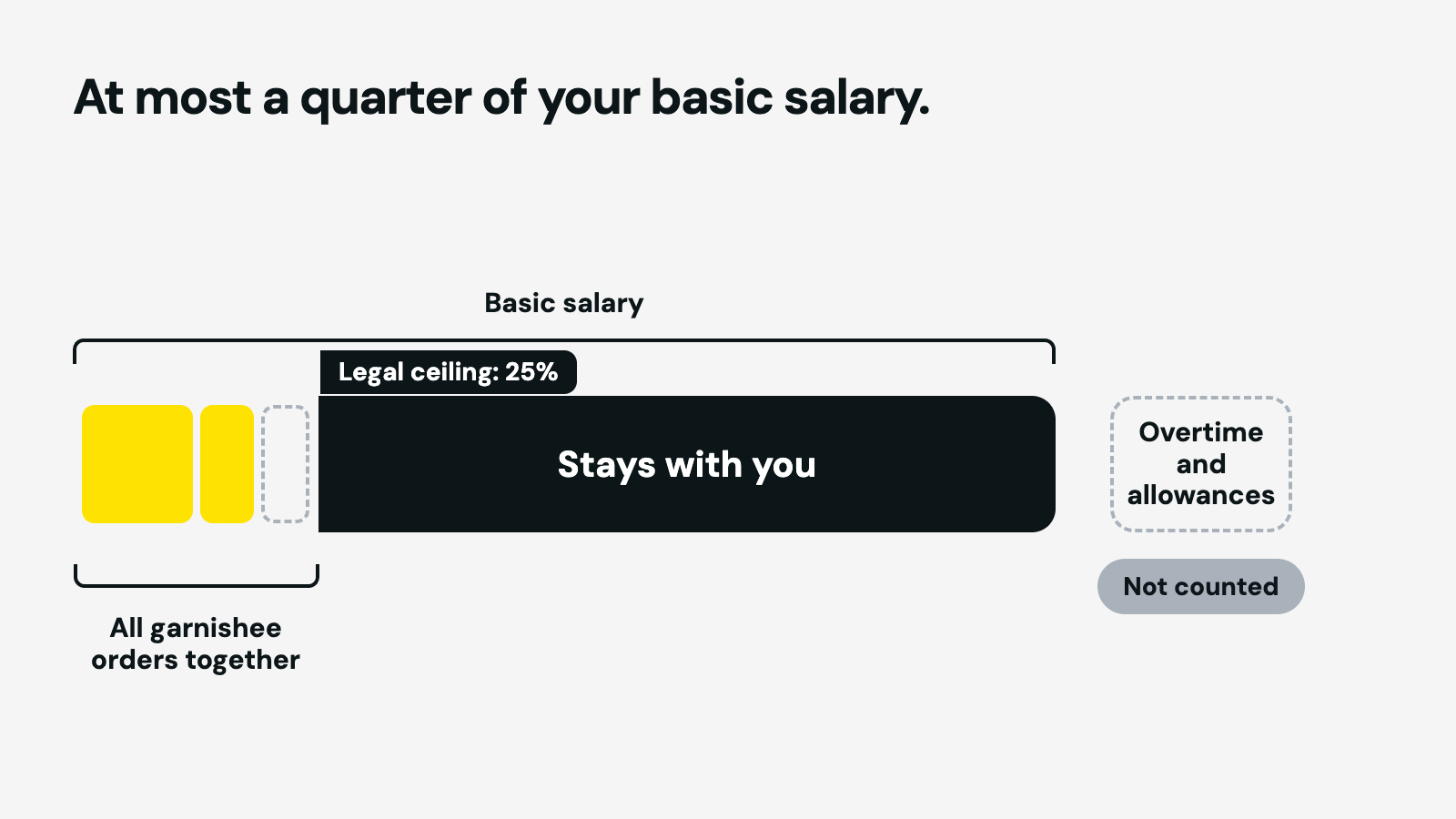
Two points get missed. First, 25% is a ceiling and not a standard rate. The court has to be satisfied that the amount is appropriate, and R1,150 out of R6,000 can still be too much for someone paying rent and supporting a family. Second, the ceiling covers all your emoluments attachment orders added together. When a second creditor arrives, the court has to share out what is left under the limit. It does not stack a new 25% on top.
People also search for a "new law on garnishee orders" from 2020. The change that matters is older. The Courts of Law Amendment Act 7 of 2017 has been in force since 1 August 2018. It brought in the 25% ceiling and the rule that a court has to authorise every order. It followed a 2016 Constitutional Court judgment, in a case brought by the University of Stellenbosch Legal Aid Clinic, which held that these orders need judicial oversight.
Know What Lands on Payday
A garnishee order is taken off before your pay reaches you, so no account, ours included, changes what your employer has to deduct. What an account can do is show you exactly what arrived and when. SOLmate is a South African money app, not a bank. An account costs R10.00 a month, or R29.00 a month with a debit card, and money arriving by EFT is free. Sign-up takes about three minutes in the app with an SA ID, a foreign passport or an asylum seeker permit, and no proof of address.

How a Lawful Order Reaches Your Payslip
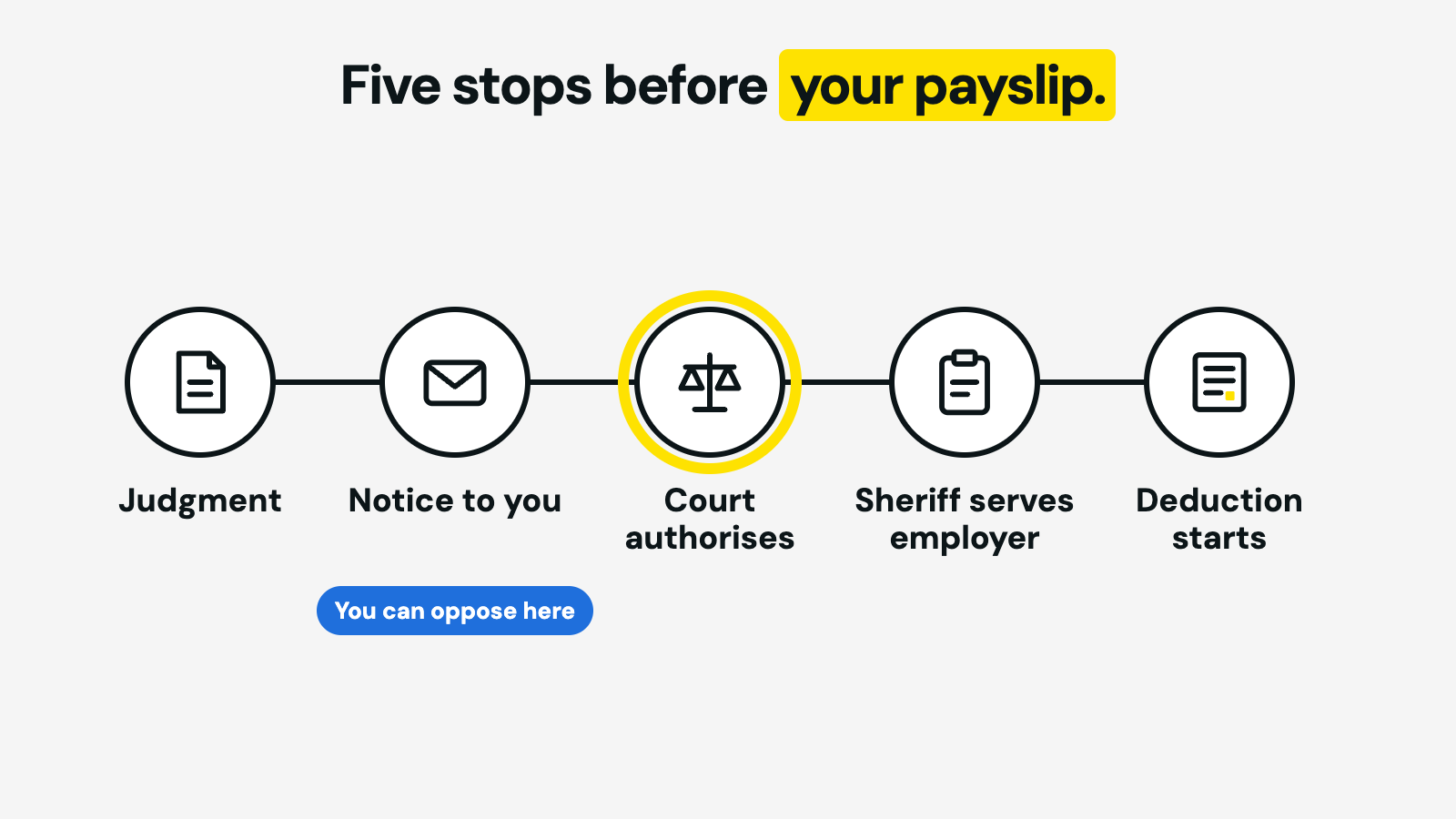
Tendai's order did not start in September. Working backwards, an order issued under today's rules has to pass through these steps.
- A judgment. The creditor first needs a court judgment for the debt. That often follows a summons nobody answered.
- Notice to you and your employer. The creditor serves a notice showing the full capital, interest and costs still outstanding, backed by a statement of account. You, or your employer, then have 10 days to file a notice of intention to oppose.
- A court decides. The order may only be issued once a court has authorised it, after satisfying itself that an order is just and equitable and that the amount is appropriate.
- The right court. It has to be the court of the district where you live, carry on business or work.
- The sheriff serves it. The order is served on your employer by the sheriff of the court.
- Deductions begin. If you are paid monthly, the first deduction comes at the end of the month after the month in which the order was served.
In Tendai's story the notice went to an address he left two years ago. That does not make the order disappear, but it explains the surprise, and it is the first thing to tell whoever advises him.
Five Things Tendai Checked First
- Which court issued it. The order names a court and carries a case number. He asked HR for a copy of what was served on them. A court far from where he lives and works is a question to raise.
- The 25%. He compared the instalment with a quarter of his basic salary. Not his take-home pay, and not his pay with overtime.
- Other orders. If more than one order is running, the instalments are added together before the comparison.
- The balance. The creditor has to send a statement every three months, free of charge, showing the payments received and the balance still owing. Tendai had never had one, so he asked for it in writing.
- The debt itself. Is it his, and how much has already been paid? The Act makes an employer liable if it unreasonably keeps deducting after the debt and costs are paid in full, which tells you it happens.
If you don't recognise the creditor at all, start with a free credit report. Court judgments are among the adverse records listed against your name, next to the accounts they came from.
Can a Garnishee Order Be Reduced or Stopped?
Yes, but only by a court or by settling the debt. Section 65J(7) lets a court suspend, amend or rescind an order at any time on good cause shown. The grounds the Act itself points to are that the deduction leaves you without enough to live on, that the amounts claimed are wrong, or that your orders together come to more than 25% of basic salary.
- Go to the clerk of the magistrate's court named on the order and ask how to apply to have it amended or rescinded. Take your payslips and a list of your monthly expenses.
- Tell your employer in writing if the deduction leaves you unable to get by. Under section 65J(6), an employer who believes that has to notify the creditor, and if the two can't agree the matter goes to court.
- Get free advice. Legal Aid South Africa runs an advice line on 0800 110 110, Monday to Friday, 7am to 7pm. Some university law clinics help with these orders, and a registered debt counsellor can tell you whether debt review suits your situation.
Two things don't work. Asking payroll to skip a month puts your employer at risk, because the order can be enforced against the employer as if it were a judgment against them. Changing jobs doesn't end it either. If you leave, the Act requires you to give the creditor your new employer's name and address, and the order can be served there.
Your employer's side is short. It has to deduct and pay over. It may keep a commission of up to 5% of what it deducts, and that comes out of the amount paid to the creditor, not out of your pay as an extra deduction. Apart from deductions you agreed to in writing, or ones required by a law, collective agreement, court order or arbitration award, the Basic Conditions of Employment Act does not allow deductions from your pay.
Before It Gets to Court
A garnishee order is the last stop on a long road: a missed payment, letters, a summons, a judgment. Every earlier stop is cheaper. If a loan is the pressure, check that the lender is charging what the law allows a micro lender to charge. A lender who simply keeps your bank card is not using a court at all, and that is a different problem with different remedies. And if the month runs out before the money does every time, a simple month-end budget is the place to start.
Where SOLmate Fits
SOLmate is a registered credit provider, so the same advice applies to us. Cash Advance repayments are deducted automatically from your SOLmate wallet on the due date shown in the app. A three-day grace period follows, then daily penalty charges begin, and late or missed repayments may be reported to a credit bureau. If you want to close it early, you can request a settlement amount that stays valid for five business days. Whoever you owe, the cheapest moment to deal with a debt is before anyone goes to court.
Subject to credit assessment · FSP 52248 · NCRCP16037
Sources: Magistrates' Courts Act 32 of 1944, section 65J and section 72; Proclamation R.22 of 2018 (Courts of Law Amendment Act 7 of 2017, in force from 1 August 2018); University of Stellenbosch Legal Aid Clinic v Minister of Justice and Correctional Services [2016] ZACC 32; Basic Conditions of Employment Act, section 34; Legal Aid South Africa; SOLmate fees; SOLmate Cash Advance help page. The Act and the SOLmate pages were checked on 7 October 2026. Tendai is an illustration, not a real person.
SOLmate is not a bank. SOLmate (SOL Ecosystem (Pty) Ltd) is an authorised financial services provider (FSP No. 52248) and registered credit provider (NCRCP16037). This article is general information, not financial or legal advice.