Can You Reverse a Debit Order? DebiCheck, the 60-Day Rule and Where Each Bank Puts the Button
Most debit orders can be disputed within 60 calendar days, but a DebiCheck you approved usually can't. What changed in April 2026, how stop, dispute and cancel differ, and where each big bank puts the button.

Yes, most debit orders in South Africa can be disputed and reversed, but only within 60 calendar days of the money leaving your account. The main exception is a DebiCheck debit order that you approved yourself: if the amount and date match what you confirmed with your bank, the bank will not reverse it, and the argument is between you and the company. One warning before you tap anything: reversing a debit order you actually owe gets the money back for now, but it does not cancel the debt.
The table below sorts debit orders by type, because the type decides what your bank can do. After that: the 60-day rule that replaced the old 40 days in April 2026, the difference between stopping, disputing and cancelling, and where each of the five big banks puts the button.
Which Debit Order Is It? That Decides What You Can Do
South African banks process three kinds of debit order. They look the same on a statement, but they were approved in different ways, and that is what counts when you want one reversed.
| Type | How it was approved | Can a past collection be reversed? | Can future collections be stopped? |
|---|---|---|---|
| EFT debit order | A form you signed, a recorded phone call or a tick box online. Your bank was never asked to confirm it. | Yes, if you dispute it within 60 calendar days because you didn't authorise it or it isn't what you agreed to. | Yes. Ask your bank for a stop payment. |
| Registered mandate | The same kind of permission, registered at your bank. Often what gets created when a DebiCheck request goes unanswered or is declined. | Yes, within 60 calendar days, if it doesn't match the terms you agreed to. | Yes. Your bank can suspend it. |
| DebiCheck (authenticated collection) | You confirmed it once with your own bank, on the app, internet banking or with card and PIN, at the start of the contract. | Not if it matches the mandate you approved. Yes, if the amount or date is different, or you never approved it. | Yes. Your bank can suspend the mandate, but the contract carries on. |
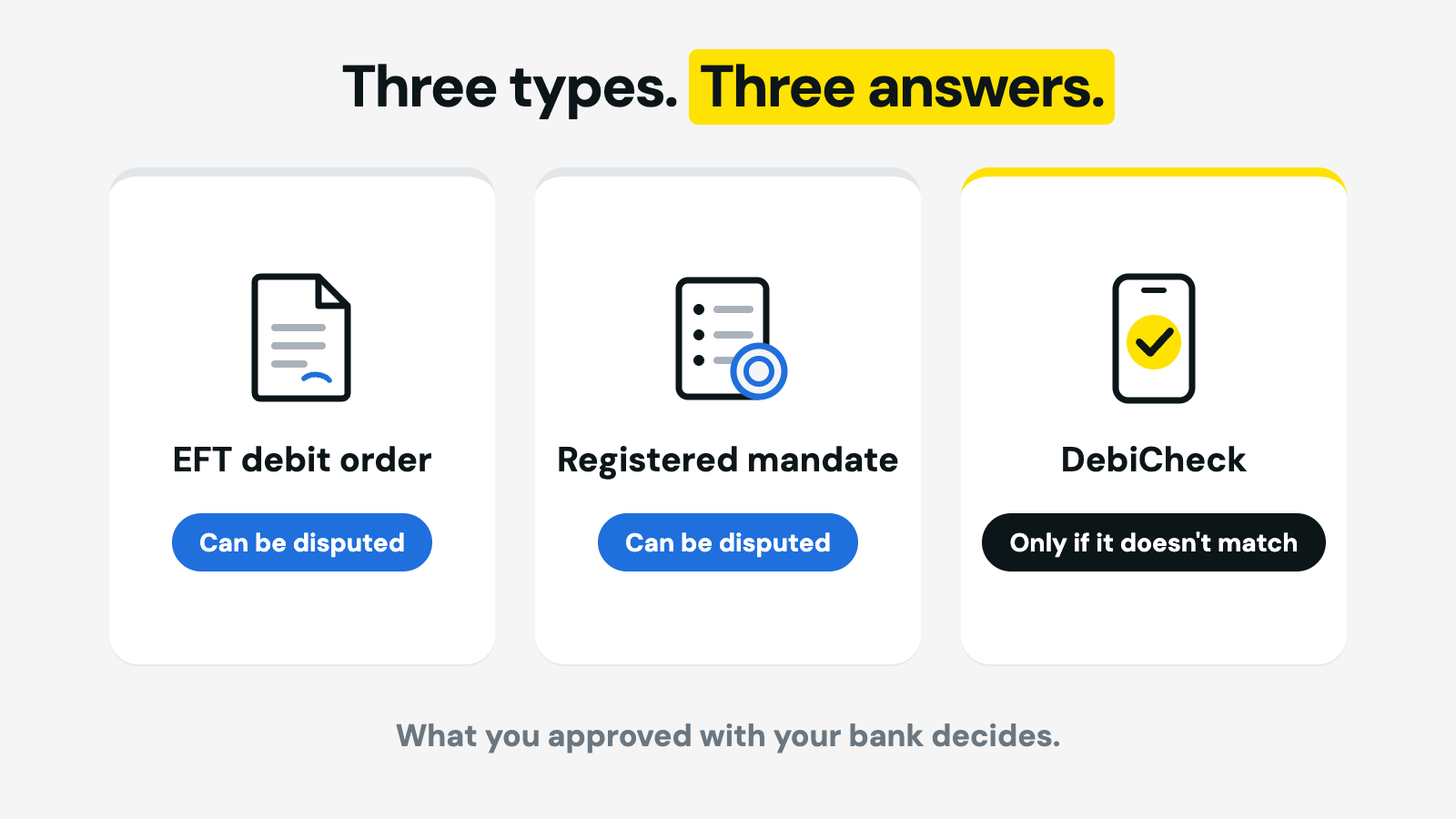
Some banks list a fourth kind, an "authenticated" debit order approved with card and PIN. For disputes it behaves like DebiCheck. If you can't tell which kind you are looking at, ask your bank. It knows how each debit order on your account was set up.
The 60-Day Rule That Replaced the Old 40 Days
On 13 April 2026 the dispute rules changed for every kind of debit order at once. The Payments Association of South Africa (PASA), with the approval of the Reserve Bank and the Financial Sector Conduct Authority, set a single window: 60 calendar days, counted from the day after the money successfully left your account, up to and including day 60. Calendar days, so weekends and public holidays count.
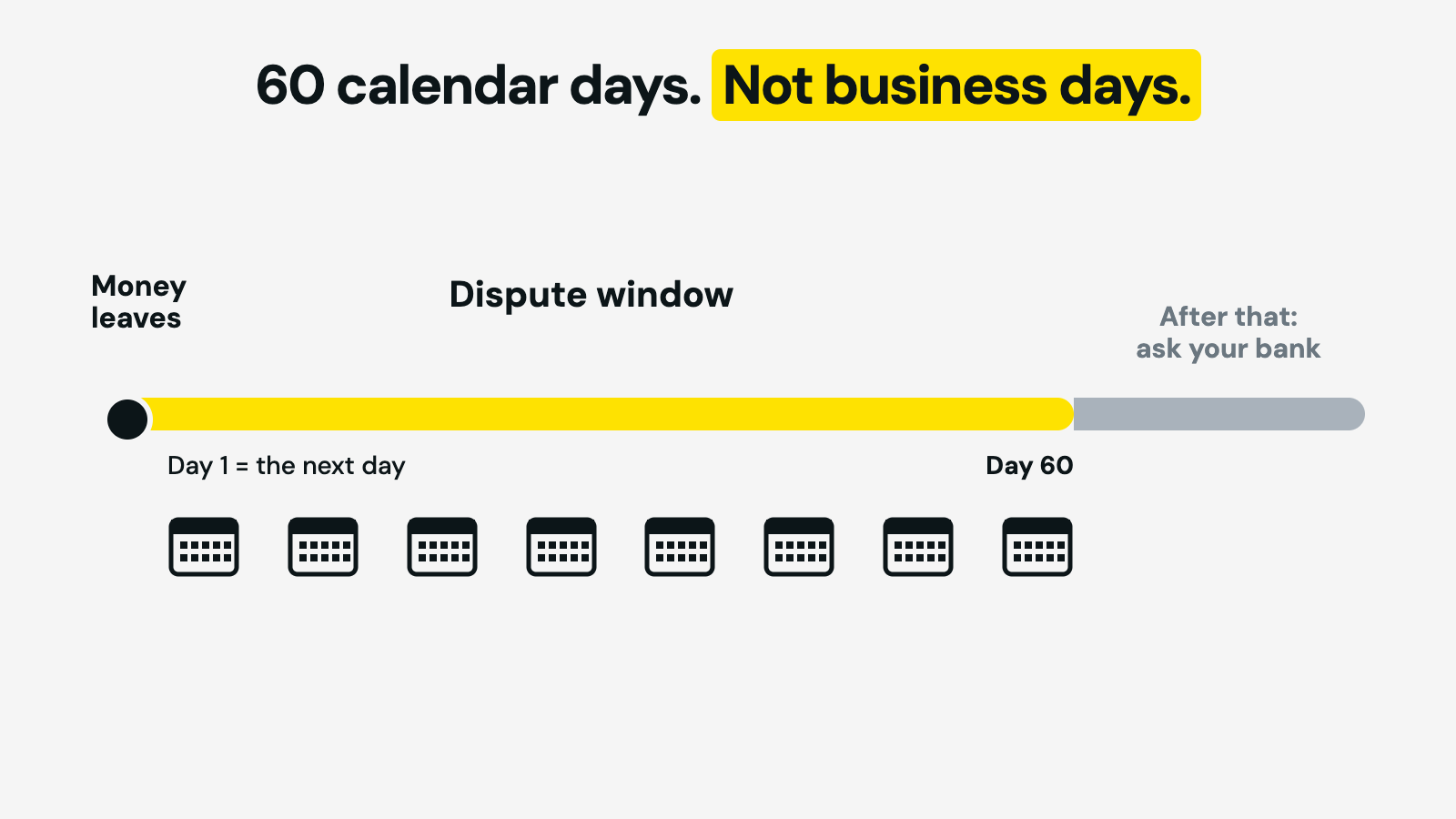
Before that date, banks generally reversed a disputed debit order immediately if it was less than 40 days old and could investigate older ones, with the outer limit at 365 days. That long tail has gone. For a collection older than 60 days, PASA's guidance is to contact your bank and follow its internal process, and some banks, Nedbank among them, tell customers to go straight to the company that collected the money.
Two things to keep in mind. First, PASA says in as many words that "reversals are neither automatic nor guaranteed": a dispute is a request, and the type of debit order decides the outcome. Second, a lot of what you will find online, including some bank help pages, still quotes 40 days. Work to 60 calendar days, and don't leave it to day 59.
The Account Behind This Guide
SOLmate is a South African money app, not a bank. An account costs R10.00 a month, or R29.00 a month with a debit card, and money arriving by EFT is free. Signing up takes about three minutes in the app with an SA ID, a foreign passport or an asylum seeker permit, with no branch visit and no proof of address.
Can You Reverse a DebiCheck Debit Order?
This is the question most people arrive with, usually after a loan or insurance instalment has gone off. The honest answer has two halves.
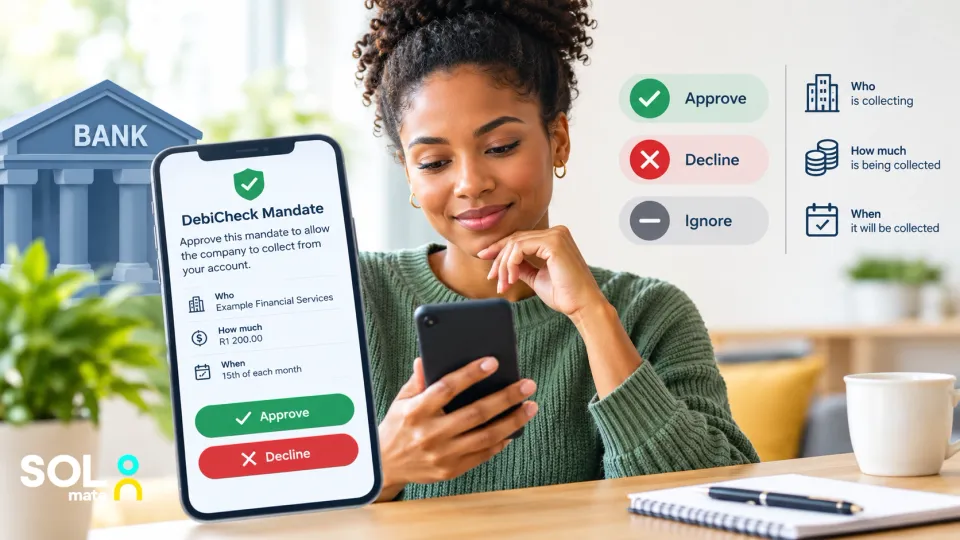
If the collection matches what you approved: no. When you accepted the DebiCheck request, your bank stored the terms: who may collect, how much, and when. Every time the company collects, the bank checks the collection against that record first. If it matches, there is nothing for the bank to dispute on your behalf. You approved it electronically, and that approval is the proof.
If it doesn't match, or you never approved it: yes. An amount higher than the one you confirmed, a collection outside the dates you agreed to, or a mandate you have no memory of accepting are all grounds to dispute with your bank inside the 60 days. If the same instalment came off twice, contact the company and ask your bank whether the second collection falls inside the mandate.
What you can always do is ask your bank to suspend a DebiCheck mandate, which blocks future collections. Suspending is not cancelling. The loan or policy behind it still exists, and missing the payments is a breach of that contract. And when a new DebiCheck request arrives that you don't recognise, decline it. That is the whole point of the system.
Stop, Dispute, Cancel: Three Different Requests
Banks use these words precisely, and asking for the wrong one wastes days.
- Dispute (or reverse) is about money that has already left. It goes to your bank, inside 60 calendar days.
- Stop payment is about a collection that hasn't happened yet. It also goes to your bank, and it needs lead time: FNB, for example, asks for at least five business days before the debit date, keeps a stop payment valid for 12 months and charges a fee for it. A stop can fail if the company changes the amount or the reference.
- Cancel ends the contract itself, and only the company can do that. Follow the notice period in your agreement and get the cancellation in writing. Until then the instalments stay owed, whether or not the debit order goes through.
The order that usually works: cancel with the company first, then stop the debit order at the bank as a backstop, and dispute only a collection that should not have happened.
What It Costs to Reverse a Debit Order You Owe
Disputing a valid debit order because the month is tight is the expensive way to find R500. The company doesn't lose the claim. It loses one payment, and it responds. Capitec's own list of consequences is a fair summary: a cancelled policy or service, an unpaid instalment with arrears interest, being handed over for collection with the costs added, and a lower credit score that makes the next application harder.
That last one lingers. A missed instalment can be reported to the credit bureaus like any other missed payment, and payment history weighs heavily in your credit score. If an account is handed over or goes to judgment, you are into the territory covered in our guide to ITC checks and "blacklisting".
If the real problem is that a debit order lands before your pay does, ask the company to move the collection date. Many will. A debit order that bounces for lack of funds carries its own penalty, often the largest single fee on a bank's price list, so lining the dates up with payday is worth one phone call. A simple month-end budget shows which debit orders the month can actually carry.
Where the Five Big Banks Put the Button
Every bank offers a self-service route for small or recent debit orders and sends the rest to a phone line or branch. This is what each bank's public help page said when we checked on 5 October 2026.
| Bank | Self-service route | What the bank's page says about limits | Otherwise |
|---|---|---|---|
| Capitec | Banking app | For unauthorised debit orders. A DebiCheck that matches its mandate can't be disputed. Mandates can be suspended. | Branch |
| FNB | App, Online Banking, Cellphone Banking | Debit orders of R200 or less. The page still refers to 40 days. | The other channels listed on FNB's disputes page, for any amount |
| Absa | Banking App: Menu, Debit Orders, pick the debit order, Reverse Payment | Up to R500 online. The page still says debit orders older than 40 days can't be reversed on the app. | debitorder@absa.co.za or a branch |
| Nedbank | Money app or Online Banking: your account, Debit orders, Reverse debit order | Not every debit order can be reversed this way. A valid DebiCheck is not disputable. Nedbank's page quotes the 60-day window. | 0800 555 111 for a debit order you didn't authorise |
| Standard Bank | Banking App: Accounts, Debit orders, Reverse a debit order | The step guide lists debit orders under R3,000 from the last 60 days. Money back within two business days. | 0860 123 000 or a branch |
Read the limits as a description of what the app will let you do, not of your rights. The 60-day window is an industry rule and applies at every bank, including where a help page hasn't caught up. If the app refuses a debit order that is inside the window, phone the bank or go in.
If the Bank Says No
- Go back to the company. PASA's advice is to approach it first in any case, because the agreement to collect is between you and the company. Ask for a copy of the mandate. If they can't produce one, say so to your bank.
- Complain to the bank in writing and keep the reference number. A dispute and a complaint are separate things: the first is a transaction request, the second gets a formal answer.
- Take it to the National Financial Ombud Scheme. It took over the work of the Ombudsman for Banking Services, it is free, and it can be reached on 0860 800 900 or through nfosa.co.za.
If the debit order is one you have never heard of, also check what else has been listed in your name. A free credit report shows accounts opened with your ID number.
Where SOLmate Fits
If you have a SOLmate Cash Advance, the same thinking applies. Repayments are deducted automatically from your SOLmate wallet on the due date shown in the app. A three-day grace period follows, then daily penalty charges begin, and a missed payment may be reported to a credit bureau. So keep the wallet funded for the due date. If you would rather settle early, you can request a settlement quote in the app.
Subject to credit assessment · FSP 52248 · NCRCP16037
Sources: PASA, Debit Order Dispute Enhancements FAQ (the 60 calendar day window, in force from 13 April 2026), PASA on debit order types, the bank help pages linked in the table, National Financial Ombud Scheme, SOLmate fees, SOLmate Cash Advance help page. Bank procedures and limits are quoted from each bank's public pages as checked on 5 October 2026 and can change; your bank's current terms decide. Facts about SOLmate were checked against SOLmate product pages on 5 October 2026.
SOLmate is not a bank. SOLmate (SOL Ecosystem (Pty) Ltd) is an authorised financial services provider (FSP No. 52248) and registered credit provider (NCRCP16037). This article is general information, not financial or legal advice.