
Credit Score in South Africa: The Complete Guide (2026)
Who keeps score, what moves it, how to read your report, how long negative entries legally stay, what "blacklisting" really means, and how to build a credit score from nothing — the whole South African credit system in one guide.

Quick answer: your credit score is a number a credit bureau calculates from your credit report — the record of every credit agreement you've held and how you paid it. In South Africa there are several registered bureaus, each with its own scale (TransUnion scores out of 999, Experian out of 740), so the same person has different numbers at different bureaus. You're entitled to one free report a year from each bureau under the National Credit Act, checking never lowers your score, errors can be disputed, and most negative entries have a legal expiry date. This guide covers the whole system end to end: who keeps score, what moves it, how to read your report, how long things stay, what "blacklisting" really means, and how to build a score from nothing.
What a Credit Score Is — and What It Isn't
A credit score is a prediction compressed into one number: how likely you are to repay borrowed money, judged on how you've handled credit so far. It's built from your credit report (also called a credit record or credit profile) — the file a bureau keeps on you, listing every credit agreement you've signed, the balances, the monthly payment history, who has looked at your file, and any adverse entries such as defaults or judgments.
Two things it isn't. It isn't a measure of how much you earn — a high salary with a messy payment history scores worse than a modest one paid on time. And it isn't a single national number: there's no government score. Each bureau applies its own model to the data it holds, which is why your number moves depending on who you ask. Lenders don't see your life; they see this file. That's the liberating part — the score is documented repayment behaviour, and behaviour from today forward is entirely in your hands.
Who Keeps Score: Credit Bureaus in South Africa
Credit bureaus are private companies registered with the National Credit Regulator (NCR) under the National Credit Act (NCA). The best known are TransUnion and Experian; XDS and several smaller bureaus are also registered. They don't lend money and don't decide your application — they collect, store and report.
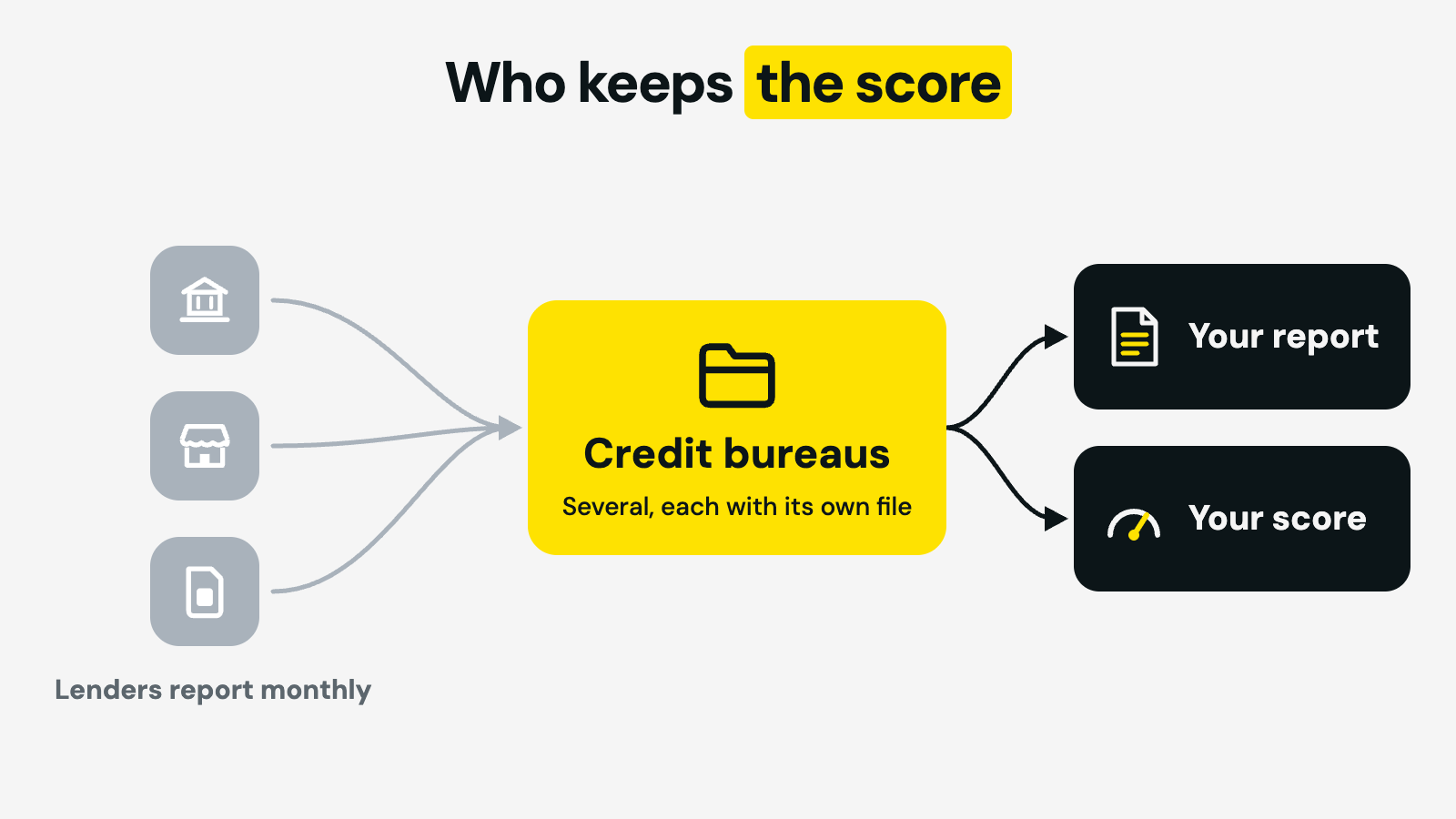
The data comes from credit providers. Banks, retailers with store accounts, cellphone networks, micro-lenders and other registered credit providers report your accounts and payment status to the bureaus, typically every month. Bureaus also pull public records — court judgments, debt-review and sequestration notices — and log every time a lender pulls your file. Because not every provider reports to every bureau, your files at different bureaus can differ in content, not just in the score attached to them. That's the practical reason to check more than one.
The Scales and Ranges (Briefly)
Each bureau publishes its own bands. Roughly, on TransUnion's 0–999 scale 681–766 reads as good and 767+ as excellent; on Experian's 0–740 scale about 634–657 is good and 658+ great. The national average sits around 612 on TransUnion's scale — fewer than half of consumers clear 700. We break down every band, what the average means for you and what the number does to loan pricing in the dedicated guide: What Is a Good Credit Score in South Africa? The short version: compare your score only to the scale it came from, and think in zones (below average / above average / top band) rather than digits.
What Goes Into Your Score
Bureaus don't publish their formulas, but the inputs are consistent across models, and their rough order of weight is well established:
- Payment history. Every instalment paid on time builds the score; every missed or late one erodes it. This is the heaviest factor by a distance.
- Credit utilisation. How much of your available credit you're using. Balances persistently near the limit read as strain; comfortable headroom reads as control.
- Adverse records. Defaults, judgments and debt-review flags dominate everything else for as long as they stand.
- Enquiries. Each credit application is a "hard" enquiry logged on your file. A burst of applications in a short period reads as credit-hunger. Checking your own score is a "soft" enquiry and doesn't count.
- Depth and age of history. A longer track record with a mix of account types gives the model more to work with. A thin file — few or no accounts — is a real obstacle in its own right.
How to Check Your Credit Score for Free
Section 72 of the NCA gives every consumer the right to one free copy of their credit record from each registered bureau every 12 months, and a further copy at a regulated fee after that. In practice several bureaus and score apps now give free ongoing access with a registered account, so the annual right is a floor, not a ceiling. The route is the same everywhere: go to the bureau's own website, verify your identity (ID number plus security questions or a selfie check), and the report is delivered online.
Three practical notes. First, self-checks are soft enquiries — they never lower your score, so check as often as you like. Second, check at least two bureaus, because lenders don't all query the same one and errors live in individual files. Third, read the report, not just the number: the number tells you where you are; the report tells you why. The step-by-step routes to each bureau are in our guide on how to check your credit score for free.
How to Read Your Credit Report
A South African credit report follows a fairly standard layout regardless of bureau:
- Personal details. Name, ID number, addresses, employers. Wrong addresses are harmless; an unfamiliar one can be an early sign of identity fraud.
- Accounts and payment profile. Each open and recently closed credit agreement with its limit, balance and a month-by-month grid of payment status — typically 24 months visible, up to five years held. This grid is what most of your score is built from.
- Enquiries. Who has pulled your file and when. Your own checks are listed separately as soft enquiries.
- Adverse listings. Accounts a provider has classified as in default, handed over, written off or similar.
- Public records. Civil judgments, administration orders, sequestration, and a debt-review flag if you're under debt counselling.
Go through it line by line looking for accounts you don't recognise, payments marked missed that you made, a settled debt still showing a balance, or a paid-up judgment still listed. Under the NCA you have the right to dispute inaccurate information, and the bureau must investigate within 20 business days; if it can't verify the entry with the credit provider, it must remove it. A corrected file often does more for a score than a year of good behaviour, and the dispute costs nothing.
How Long Information Stays on Your Record
Negative entries don't last forever. Regulation 17 of the NCA sets maximum display periods for each type of information:
| Type of information | Maximum period on your record |
|---|---|
| Payment profile (monthly payment history) | 5 years |
| Enquiries (who looked at your file) | 2 years |
| Adverse classifications of behaviour (e.g. "delinquent", "slow payer") | 1 year |
| Adverse classifications of enforcement action (e.g. "handed over", "written off") | 2 years |
| Civil court judgments | 5 years, or earlier once rescinded or abandoned |
| Debt review / debt counselling | Until a clearance certificate is issued |
| Sequestration | 5 years, or until rehabilitation |
Two additions matter. Since the 2014 "removal of adverse information" regulations, an adverse listing must be removed once you've paid the amount in full — you or the provider notify the bureau, and it comes off. Paid-up judgments are treated the same way. And these are maximums: the clock starts from the date of the event, not from when you notice it. If something is still showing past its expiry, that's a dispute, and it will be removed.
"Blacklisting", Debt Review and Judgments
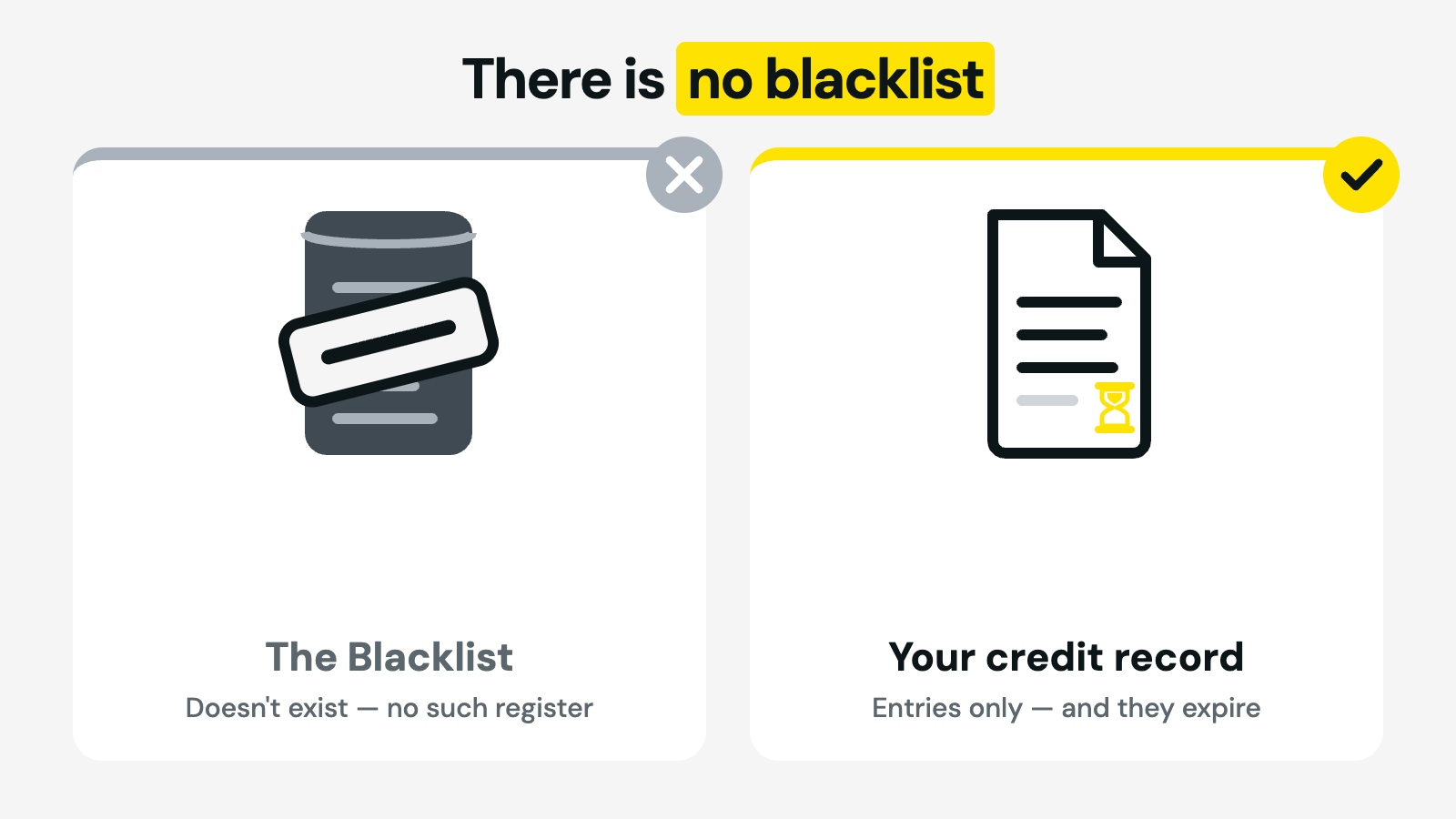
There is no blacklist in South Africa. The word survives from a pre-NCA era when bureaus mainly recorded negative events; today every registered bureau holds both positive and negative data, and no lender consults a list of banned names. What people mean by "blacklisted" is one of three specific things, each with its own exit:
- An adverse listing — a provider has flagged an account as in default or handed over. Exit: settle it and have the listing removed; or wait out the 1–2 year display period.
- A judgment — a creditor obtained a court order for the debt. Exit: pay it, and the judgment must be removed from your file; or apply to court for rescission if it was granted in error.
- A debt-review flag — you applied for debt counselling under section 86 of the NCA. While flagged you can't take new credit; the flag lifts when a debt counsellor issues a clearance certificate after all restructured debts are settled.
One more piece of protection worth knowing: prescribed debt. Most consumer debt prescribes after three years with no payment, no acknowledgement and no legal action, and since 2015 the NCA (section 126B) prohibits collecting or selling prescribed debt. A collector calling about a ten-year-old store account is testing whether you know that. We unpack ITC checks and "blacklisting" in full in our ITC check and blacklisting guide.
Score vs Affordability: What Lenders Actually Check
A common misunderstanding is that lending is a score threshold — clear it and you're in. In South Africa the score is one input into a bigger legal duty. Under the NCA, every registered credit provider must run an affordability assessment before granting credit: verify your income, look at your existing obligations and living expenses, and confirm there's genuinely room for the new repayment. Granting credit without doing so is "reckless lending", and a court can set the agreement aside. This is why an offer of a loan with "no credit check" or "guaranteed approval" should be read as a warning rather than a promise: a registered provider legally can't skip the assessment, so whoever is advertising that is either not registered or not telling the truth. The payday loans guide walks through the legal cost caps and what a compliant short-term loan actually looks like.
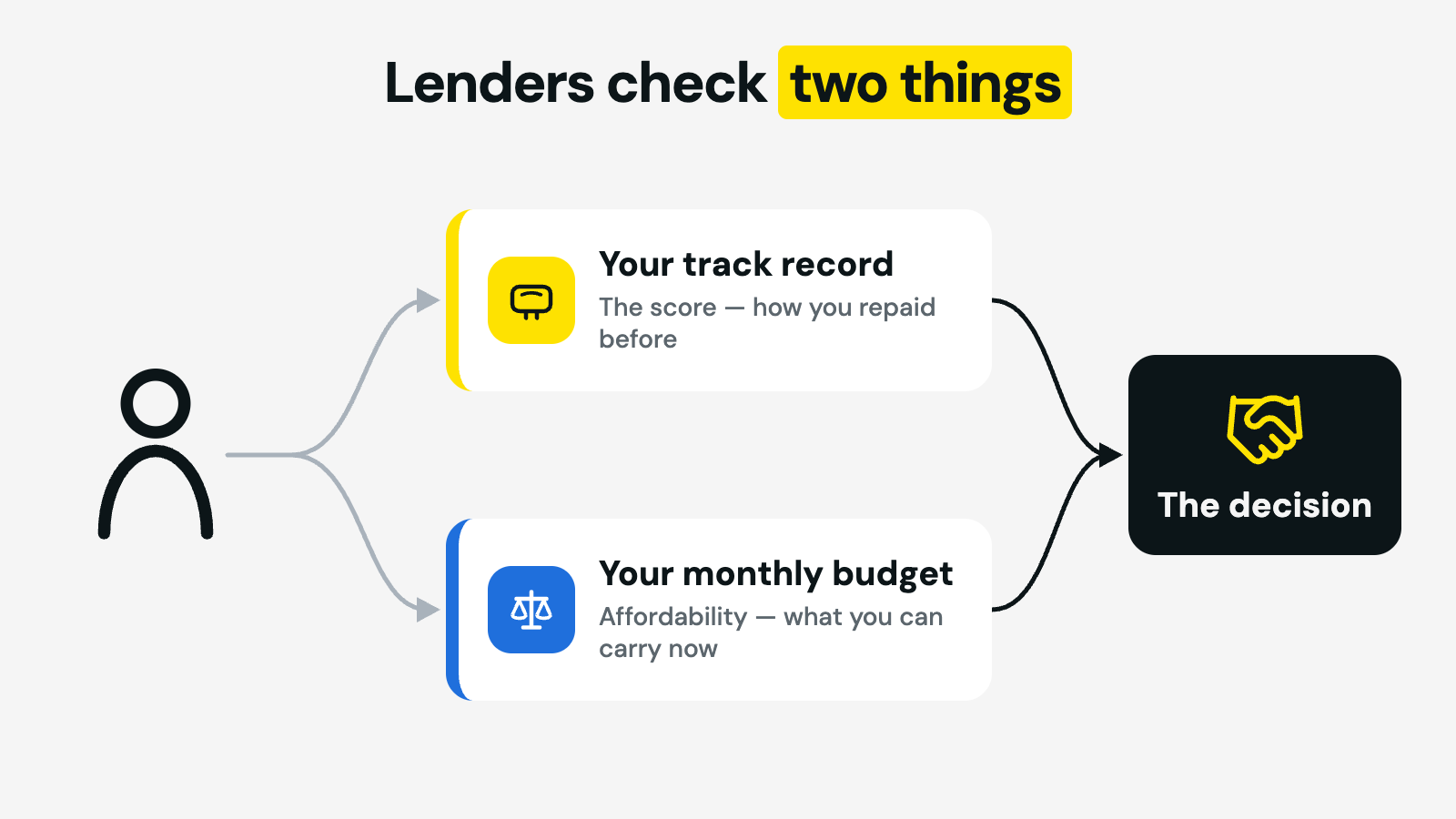
The score, then, determines on what terms a registered lender will deal with you — interest rate within the legal cap, limit, whether it needs a deposit — while the affordability assessment determines whether there's room at all. Both are required; neither is sufficient alone.
Building a Credit Score From Zero
If you've never held a credit agreement, you don't have a bad score — you have no score, and to a lender that's nearly the same problem. There's nothing in the file for the model to read. Building one is mechanical:
- Get an account that receives your income. It isn't a credit product, but it's the base: lenders verify income from statements, and automatic repayments need somewhere to draw from. If you're new to the system, see how to open an account online and how to get paid without a traditional bank account.
- Take one small, manageable credit agreement. A store account, a cellphone contract, a small limit card or a modest loan — the size doesn't matter, the reporting does. Confirm the provider is NCR-registered and reports to the bureaus, otherwise it builds nothing.
- Pay it on time, every time, for months. Automate the payment so it can't be late. Six to twelve months of clean payment history is usually enough to turn "no file" into a scorable one.
- Don't stack applications. One agreement, run well, beats four applications in a month.
Improving a Damaged Score
There's no legitimate fast lane, and anyone selling "credit repair" is mostly selling the dispute right you already have for free. The plan that works is boring: fix errors on the report first (free, weeks); automate every repayment so nothing is ever late (immediate); bring balances down relative to limits; stop applying for credit you don't need; settle any adverse-listed accounts so the listings can be removed; then let the file age. Scores follow the file, and the file follows time — expect months of movement, not days. The good-credit-score guide goes deeper on the four habits and what each one is worth.
Where SOLmate Fits
SOLmate is not a bank and doesn't issue credit scores. It is a registered credit provider, and its one credit product — the SOLmate Cash Advance — is offer-based: if you're eligible, an offer appears on your home screen in the app; if not, there's nothing to apply for. Accepting an offer involves consenting to a credit check, so your bureau file is part of the assessment, and approval isn't guaranteed. Once approved, the money lands in your wallet immediately and repayments deduct automatically on the due date — the "never accidentally late" mechanics are built in, though the wallet needs money in it. A three-day grace period applies after a missed due date before daily penalty charges start, and late or missed repayments may be reported to a credit bureau, where the record can stay for at least five years. In other words, it behaves exactly like the rest of the credit system described above — which is the point: the same habits that build a score elsewhere build one here.
The foundation under all of it is the account itself. A SOLmate account opens from the app, receives EFT payments free, and costs R10.00 a month without a card (R29.00 with a debit card, plus activation from R49.00) — the "income lands here, obligations pay from here" base that every affordability assessment and every automated repayment relies on. What each fee on a statement means, and which ones are avoidable, is in Bank Charges in South Africa Explained.
The Bottom Line
Your credit score is a summary of documented repayment behaviour, kept by private bureaus under NCR rules, on scales that differ by bureau. You can see it free, dispute it free, and most of what hurts it has a legal expiry. There's no blacklist and no shortcut — just a file that follows what you do. Check it, fix what's wrong, automate what's due, and give it time.
Read next in the Credit score series
Frequently Asked Questions
What is a credit score in South Africa?
A number a registered credit bureau calculates from your credit report — your credit agreements, payment history, enquiries and adverse records — to predict how likely you are to repay. Each bureau uses its own scale, so your number differs between bureaus.
Which credit bureaus operate in South Africa?
Several bureaus are registered with the National Credit Regulator; the best known are TransUnion and Experian, with XDS and others also registered. Not every credit provider reports to every bureau, so files can differ.
How do I check my credit score for free?
Under section 72 of the National Credit Act you get one free credit report from each registered bureau every 12 months, requested directly from the bureau's website. Several bureaus and apps also offer free ongoing access. Checking your own score is a soft enquiry and doesn't lower it.
What is the difference between a credit score and a credit report?
The report is the full record — accounts, payments, enquiries, judgments. The score is a single number the bureau derives from that record. Fix the report and the score follows.
How long does bad credit stay on my record?
Regulation 17 of the NCA sets maximums: adverse behaviour classifications one year, enforcement-action classifications two years, enquiries two years, payment history and judgments five years, debt review until a clearance certificate. Adverse listings and judgments must be removed earlier once the debt is paid in full.
Am I blacklisted?
There is no blacklist in South Africa. What people call blacklisting is an adverse listing, a judgment or a debt-review flag on your bureau file — each of which has a defined way to clear it.
Does a lender only look at my score?
No. Every registered credit provider must also run an affordability assessment — verifying income, expenses and existing obligations — before granting credit. A "no credit check" or "guaranteed approval" offer is a warning sign, not a shortcut.
How do I build a credit score with no credit history?
Open an account that receives your income, take one small credit agreement with an NCR-registered provider that reports to the bureaus, automate the payments, and keep it clean for six to twelve months. Avoid multiple applications.
Does the SOLmate Cash Advance affect my credit score?
Accepting an offer involves a credit check with your consent, and late or missed repayments may be reported to a credit bureau, where the record can stay for at least five years. Repayments deduct automatically from your wallet on the due date, with a three-day grace period.
Sources: National Credit Regulator (National Credit Act 34 of 2005, sections 72, 81, 86 and 126B; Regulations 17 and 23A; 2014 regulations on the removal of adverse consumer credit information), TransUnion South Africa, Experian South Africa, SOLmate Cash Advance help page, SOLmate fees. Score bands are indicative and set by each bureau's current model; retention periods are statutory maximums and bureaus may display less. Correct as of September 2026. This article is general information, not financial advice. SOLmate is not a bank. SOLmate (SOL Ecosystem (Pty) Ltd) is an authorised financial services provider (FSP No. 52248) and registered credit provider (NCRCP16037).