ITC Check and "Blacklisting" in South Africa (2026): What They Really Mean, How to Check for Free, and Your Honest Loan Options
"ITC" is a bureau's old name and "blacklisting" is a myth. Here is what is actually on your credit report, how long each entry lasts, the three free exits, and why "guaranteed loans for blacklisted" are a warning sign.

Two phrases cause a lot of trouble in South Africa: "ITC check" and "blacklisted". People pay strangers to "check their ITC". They assume one missed account has put them on some national list. Then they search for "loans for blacklisted", which is where the worst lenders in the country advertise. This guide explains what both phrases actually mean. ITC is the old name of one credit bureau. Blacklisting isn't a legal concept; it's a small set of specific entries on a credit report, and each has an expiry date and a way out. Borrowing honestly with a damaged file is also possible, but it looks nothing like the ads that promise same-day approval with no questions asked.
Quick Answer
An "ITC check" is a credit bureau check. ITC (Information Trust Corporation) was the name TransUnion South Africa traded under before it rebranded, and the name stuck. You can do the real thing yourself, free, at every registered bureau. "Blacklisting" doesn't exist in South African law. What does exist are adverse listings, court judgments, debt review flags and administration orders on your credit report. All of them are regulated, time-limited and removable. As for loans: every registered lender has to assess affordability before lending, so a "guaranteed approval for blacklisted" offer comes either from an unregistered lender or from someone running an upfront-fee scam.
What "ITC" Actually Means (and Why Everyone Still Says It)
Information Trust Corporation was one of the oldest credit bureaus in the country. TransUnion acquired it and dropped the ITC name years ago, but by then a whole generation had learned to call any bureau enquiry "an ITC check" and any negative record "being on ITC". Lenders still say it. So do landlords and HR departments.
A few things follow from that. There is no separate ITC database; your TransUnion file is the old ITC file, and it's one of four consumer bureau files lenders actually query (TransUnion, Experian, XDS and Consumer Profile Bureau). "ITC status" isn't a yes/no verdict either. It's whatever happens to be on your report at that bureau on that day. And nobody needs to charge you for it. Under section 72 of the National Credit Act, every registered bureau must give you one free copy of your credit report every twelve months, and it must show you your record free of charge at any time after you've disputed something on it. We cover each bureau's free route step by step in how to check your credit score in South Africa.
Is There a Blacklist? No. Here Is What Exists Instead
There is no list, register or flag called "blacklisted" anywhere in the credit system. No bureau keeps one, the National Credit Regulator doesn't maintain one, and no lender can look you up on one. When someone says you're blacklisted, they mean one of five things is sitting on your credit report:
- An adverse listing. A lender has classified an account with a negative status word such as "slow payer", "delinquent", "default", "handed over" or "written off". This is the lender's own classification, reported to the bureaus.
- A default or enforcement action. The account has gone to collectors, or legal action has started. A step further than a classification.
- A court judgment. A creditor sued you, you didn't defend, and a magistrate's court granted judgment against you for the debt.
- A debt review flag. You applied for debt counselling under section 86 of the NCA and the bureaus were notified. While the flag is on, no lender may give you new credit.
- An administration order. An older, court-supervised arrangement for people with small total debts. Rarer today, but it still shows up on some files.
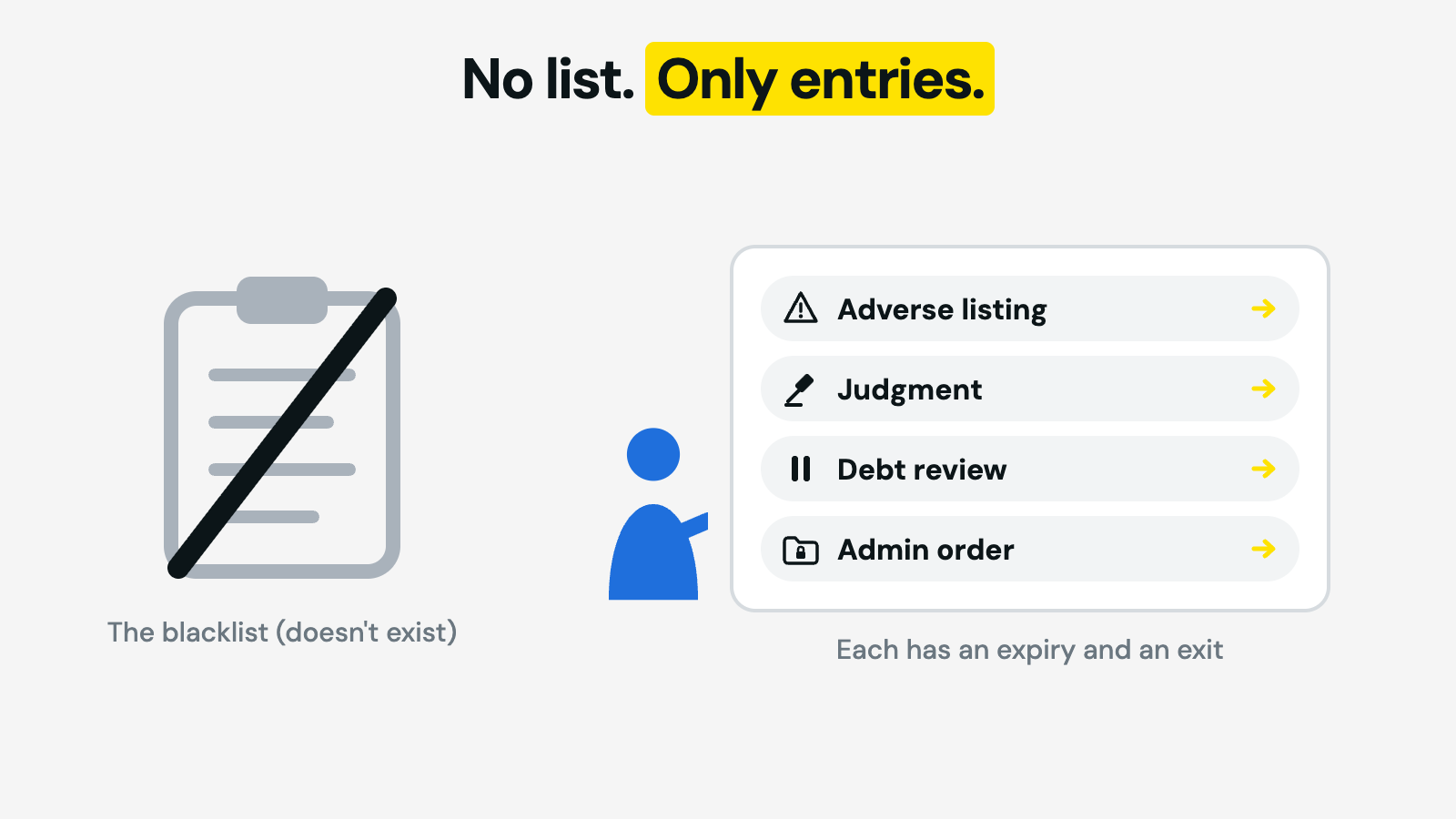
Each of these has a legal expiry date and a legal exit. Once you know which one you actually have, "blacklisted" turns into a to-do list.
How to Check Whether You Are "Blacklisted" (Free)
Since "blacklisted" just means "something adverse is on my report", checking is the same as pulling your report. Do it at more than one bureau. Lenders don't all report to all four, and the entry you're worried about may only be sitting at one of them. Have your ID number, a cellphone that can receive an OTP and, for some portals, a photo of your ID.
- Go to the bureau's own consumer portal, not a third-party site, and register with your ID number.
- Request your free annual report. The score is a bonus. The report is what you need.
- Open the sections labelled adverse information, judgments, debt review and enquiries. If all four are empty, you aren't "blacklisted" by anyone's definition, even if a lender turned you down last week.
- Write down the reporting lender, the account number and the date of every negative entry. You'll need them later.
If you're not sure what each section means, our credit score guide explains how to read a South African credit report. One more thing: if you've never borrowed formally, an empty report isn't a bad one. That's a "thin file", which is a different problem with a different fix.
How Long Each Negative Entry Stays
Regulation 17 of the National Credit Regulations sets maximum retention periods that bureaus may not exceed:
- Adverse classifications of your behaviour (words like "slow payer"): one year.
- Adverse enforcement actions (handed over, written off, repossession): two years.
- Civil court judgments: five years, or earlier if the judgment is rescinded or the debt is settled.
- Debt review: until you receive a clearance certificate from your debt counsellor, at which point the flag must come off.
- Administration orders: ten years, or until rescinded.
These periods are less scary than they look, for two reasons. Since the 2014 regulations on the removal of adverse consumer credit information, adverse listings must be removed once you've settled the underlying debt. The lender has to tell the bureau and the bureau has to take the entry down, both within short statutory windows. And a judgment that has been paid up must also be removed, without you going back to court for a rescission. The full retention table is in the credit score pillar. In practice you have three exits, not one: pay, dispute, or wait.
How to Get Off the "Blacklist": The Three Exits
Exit 1: Pay or settle, then insist on removal
If the entry is accurate and the debt is real, settling it is the fastest route to a clean file. Get a paid-up letter from the lender or collector and keep it. Check the bureau report a few weeks later. If the adverse listing is still there, lodge a dispute with the bureau and attach the paid-up letter; the law is on your side here. A settled account will still appear in your payment history as a closed account, which is fine. What has to go is the adverse classification.
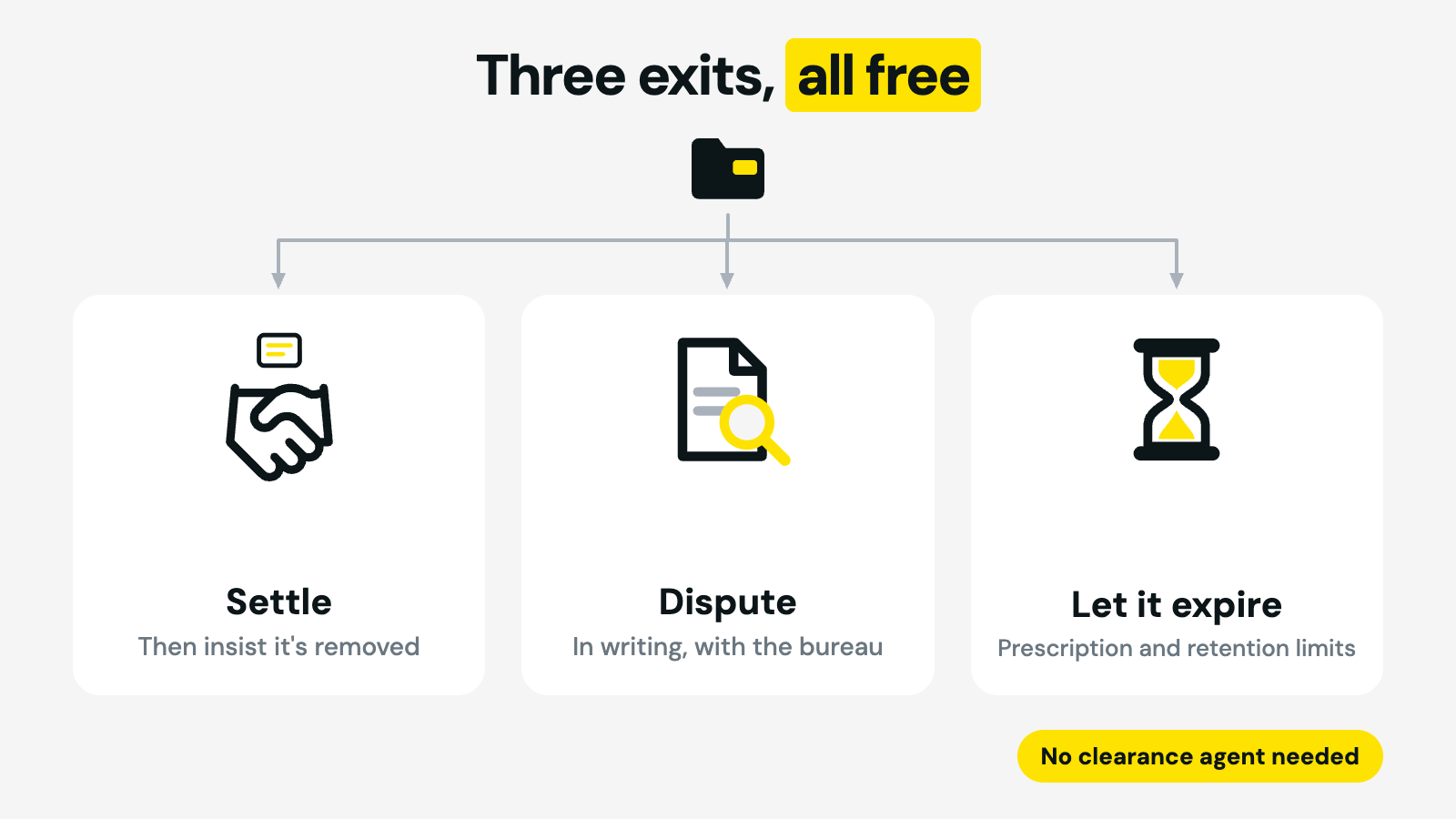
Exit 2: Dispute what is wrong
Many "I'm blacklisted" stories turn out to be errors. An account that was paid but never updated. A listing from a lender you've never dealt with. An identity mix-up. A debt that has prescribed. You may dispute any entry in writing with the bureau, and the bureau must investigate with the lender. If it can't verify the entry within the statutory period, it has to remove it. This costs nothing and you don't need a "clearance agent". The step-by-step process is in our guide to disputing an error with a credit bureau, including where to escalate if the bureau drags its feet.
Exit 3: Let prescription and expiry do their work
Most ordinary consumer debts prescribe after three years without a payment, an acknowledgement or a summons. Section 126B of the NCA makes it unlawful for a lender or collector to pursue a prescribed debt, and a bureau may not keep reporting it. Separately, even accurate negative entries expire on the Regulation 17 timetable above. If a collector calls about a store account from 2019 and you haven't paid or acknowledged it since, ask them in writing for the date of last payment before you say anything else. An acknowledgement can restart the clock.
Debt Review Is Not Blacklisting, But It Does Lock New Credit
Debt review (debt counselling) gets its own section because it's the one entry that is both voluntary and the hardest to leave. You apply through an NCR-registered debt counsellor, your debts are consolidated into one reduced monthly payment, and your creditors can't enforce while you pay. The trade-off is that the bureaus flag you, and no registered lender may give you new credit until the counsellor issues a clearance certificate under section 71. There's no shortcut around that flag. Anyone offering a loan to someone under debt review is breaking the rules by definition. For a person who really is over-indebted, debt review is a legitimate protection. For someone who was talked into it to "fix their blacklisting", it can turn into a five-year detour. Check the counsellor's registration on the National Credit Regulator's website before you sign anything.
"Loans for Blacklisted": What the Ads Don't Say
Type "blacklisted" into a search engine and what comes back is mostly lenders: "loans for blacklisted clients", "same-day approval", "no ITC check", "guaranteed". Those promises are impossible for a lawful lender to keep, and it helps to understand why.
Section 81 of the National Credit Act requires every credit provider registered with the NCR to assess your ability to repay before granting credit. Regulation 23A spells out what that means: income, expenses and existing obligations, which in practice means pulling a bureau report. A lender who skips that step is lending recklessly, and a court can set the agreement aside. So a "no credit check" promise means one of three things. The lender isn't registered at all (a loan shark, or mashonisa, with no rules on interest or collection). Or the lender is registered, is lying in the ad, and will check you anyway. Or there is no loan, and the "approval" is bait for an upfront "admin fee", "insurance" or "release fee", after which the money never arrives. If you remember one thing from this section: a fee before payout is the clearest sign of a scam there is.
None of this means a damaged file makes you unlendable. It means a real lender will price for risk within the NCA's caps, will lend smaller amounts, and will care more about your current income than about a default from 2021. For how regulated short-term credit actually works, with costs, caps and what to look for on the agreement, see our guide to payday loans in South Africa.
Your Honest Options When Your File Is Damaged
Roughly in order of what they cost you:
- Clean the file first if you can. One settled-and-removed adverse listing changes your position with every lender at once. Even a single disputed error coming off can turn a decline into an approval.
- Borrow small from a registered lender. Look up the NCRCP number on the NCR register before you apply. Expect a smaller limit and a proper affordability check. That check is your proof you're dealing with someone lawful.
- Ask your employer. A salary advance or employer loan leaves no bureau footprint and usually carries no interest.
- If you are over-indebted, use debt review deliberately. Not as a fix for a listing, but as protection from enforcement, with a counsellor you've verified.
- Don't pay anyone to "clear your name". Disputes are free. Settlements you can negotiate yourself. Prescription happens on its own.
Where SOLmate Fits
SOLmate is not a bank, and it doesn't keep a blacklist either. It's a digital wallet with a Mastercard debit card, and as a registered credit provider it offers a small credit product called Cash Advance to eligible customers. The flow is built the other way round from what you may be used to: you don't apply blind and wait for a verdict. If you're eligible, a Cash Advance offer appears on your SOLmate home screen with the available amount and repayment options; your personal offer and limit are shown in the app. You choose, review the full repayment details, consent to a credit check, accept the loan documents and sign with an OTP. Approval isn't guaranteed, because a credit assessment is completed with your consent before any money moves. No bank statement is required, though, and once approved the money is paid into your wallet immediately.
Repayments come off the wallet automatically on the due dates shown in the app, in one or two instalments. A three-day grace period applies after a missed due date. After that, daily penalty charges begin, and a late or missed repayment may be reported to a credit bureau, where the record can stay for at least five years. Every registered lender works under the same rule, which is why it makes sense to treat a Cash Advance as a bill you've already scheduled rather than extra money. You can settle early at any time by requesting a settlement quote in the app; it's valid for five business days. Full details are on the Cash Advance page.
If you're rebuilding from a damaged file, a wallet with predictable costs is a useful base whether or not an offer ever appears. A SOLmate account costs R10.00 a month without a card or R29.00 a month with the debit card (activation from R49.00). EFT deposits are free. You can open an account in the app with a South African ID, a passport or an asylum or refugee permit. The full price list is on the fees page.
The Bottom Line
"ITC" is a bureau's old name and "blacklisting" is a myth. Both get used to sell you things you can do for free: checking your own report, disputing errors, negotiating your own settlements. Find out exactly which entry is on your file and use the exit that fits it. And be suspicious of any lender whose main selling point is that they won't look. The ones who do check are the ones the law makes answerable to you.
Read next in the Credit score series
Frequently Asked Questions
What is an ITC check in South Africa?
An ITC check is an informal name for a credit bureau check. ITC (Information Trust Corporation) was the former name of TransUnion South Africa, so "checking your ITC" means checking your TransUnion credit report. Every registered bureau must give you one free report a year, so you never need to pay for it.
How do I know if I am blacklisted?
Pull your free credit report from at least two bureaus and look at the adverse information, judgments, debt review and enquiries sections. If those are empty, nothing negative is on your file. There is no separate blacklist to check.
Does blacklisting exist in South Africa?
No. South African law has no concept of a credit blacklist. What people call blacklisting is an adverse listing, a court judgment, a debt review flag or an administration order on a credit report, each with a maximum retention period set by Regulation 17 of the National Credit Act.
How long does blacklisting last?
It depends on the entry. Adverse classifications may stay up to one year, enforcement actions up to two, judgments up to five years or until paid or rescinded, debt review until a clearance certificate is issued, and administration orders up to ten years. Settled adverse listings and paid-up judgments must be removed earlier.
How do I remove my name from ITC?
There is no name to remove, only entries. Settle the debt and get a paid-up letter, dispute any entry that is wrong or unverifiable with the bureau in writing, and let prescribed or expired entries fall off. All three routes are free; you do not need a clearance agent.
Can I get a loan if I am blacklisted?
A registered lender may still lend to you after an affordability assessment, usually a smaller amount at a higher regulated cost. A lender who promises approval without any check is either unregistered or running an upfront-fee scam, so treat "guaranteed" and "no credit check" as warning signs, not features.
Does debt review count as being blacklisted?
Debt review is a flag on your credit report, not a blacklist, but while it is active no registered lender may give you new credit. It is removed when your NCR-registered debt counsellor issues a clearance certificate after your restructured debts are paid.
Does SOLmate lend to blacklisted people?
SOLmate does not use a blacklist. Cash Advance is offered only to eligible customers, the offer appears in the app, and every application goes through a credit assessment with your consent. Approval is not guaranteed, and no bank statement is required; your personal offer and limit are shown in the app.
Sources
- National Credit Act 34 of 2005, sections 71, 72, 81 and 126B; National Credit Regulations, Regulations 17 and 23A; Removal of Adverse Consumer Credit Information regulations (2014) — National Credit Regulator.
- Free annual credit report — TransUnion South Africa; complaints about bureau data — Credit Ombud.
- SOLmate Cash Advance mechanics and fees — help/solmate-cash-advance and solmate.co.za/fees, checked September 2026.
- Retention periods and prescription rules are statutory maximums as at September 2026 and may change; this article is general information, not financial or legal advice. Bureau names and procedures are cited as factual references, not endorsements.
- SOLmate is not a bank. SOLmate (SOL Ecosystem (Pty) Ltd) is an authorised financial services provider (FSP No. 52248) and registered credit provider (NCRCP16037). Cash Advance is subject to credit assessment.