Mashonisa Loans in South Africa: What They Really Cost, the WhatsApp Trap, and Your Legal Options
A mashonisa charges R30 to R50 a month on every R100. What that costs against the legal maximum, why WhatsApp lenders ask for a fee first, what the law says about your ID or SASSA card, and where a legal small loan comes from.
Quick answer: A mashonisa is an informal moneylender, almost always unregistered, who lends small amounts fast and charges around R30 to R50 a month for every R100 borrowed. For a registered lender, the legal maximum on a R2,000 one-month loan works out to about R24 per R100, fees and VAT included. A "mashonisa on WhatsApp" or "mashonisa online" is something else again: usually a stranger who asks for a fee before paying out, then goes quiet.
People go to a mashonisa because it is quick, close to home and asks no questions. This guide doesn't judge that. It puts the price in rands, sets out what the law says about the ID book or SASSA card left as security, covers what to do if you already owe one, and shows where a legal small loan can come from instead.
What "Mashonisa" Means
Mashonisa is the township name for an informal moneylender: a neighbour, a colleague, a shop owner, someone who waits near the pay point on grant day. The National Credit Regulator (NCR) uses three names for the same thing: loan sharks, mashonisas and skoppers. The loans are small, often a few hundred rand to get through to payday, and the deal is simple. R100 now, R130 to R150 back at month-end.
Many people assume such a small, private arrangement sits outside the law. It doesn't. Since November 2016 the registration threshold in the National Credit Act (NCA) has been R0, and the NCR puts it plainly: anyone who lends money and charges interest must register as a credit provider, "irrespective of the credit amount or the number of clients". The same caps on interest and fees apply to the mashonisa down the road as to a national lender. The difference is that one of them ignores the rules.
R2,000 From a Mashonisa vs the Legal Ceiling
Take R2,000 borrowed for one month. The last column is the most a registered lender may charge under the NCA regulations on a first short-term loan of the year: initiation fee, 5% interest and the monthly service fee, VAT included.
| Mashonisa at 30% a month | Mashonisa at 50% a month | Registered lender, legal maximum | |
|---|---|---|---|
| You receive | R2,000 | R2,000 | R2,000 |
| You owe after one month | R2,600 | R3,000 | R2,473.75 |
| Cost of that month | R600 | R1,000 | R473.75 |
| Three months, paying only the interest | R1,800 paid, R2,000 still owed | R3,000 paid, R2,000 still owed | Total cost capped at R811.75, and the loan is finished |
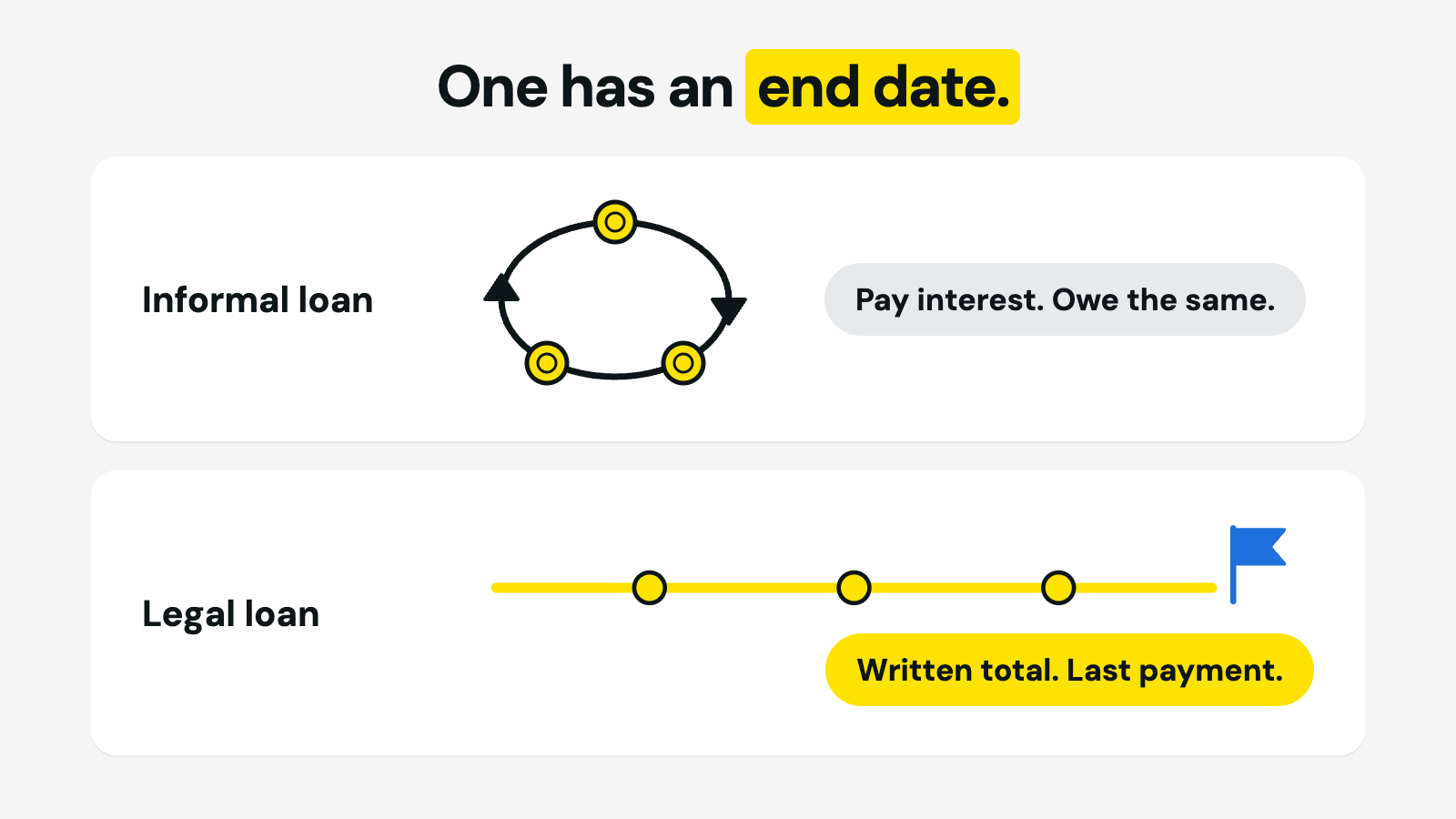
At 30% the first month looks almost comparable: R600 against R473.75. The bottom row is where the two part ways. A legal loan has a written agreement, a total repayment amount and an end date. A mashonisa loan often has none of the three. When the full amount isn't there at month-end, you pay the interest, the R2,000 stays exactly where it was, and the same bill arrives again next month.
The legal figure is also a ceiling, not a price list: a registered lender may charge less. How that ceiling is built, for loans from R2,000 to R8,000, is set out in rands in our micro loans guide.
Mashonisa on WhatsApp, Online, for Blacklisted: What Is Behind Each One
The old mashonisa was someone you knew. The searches people type today are mostly about finding one they don't know, and that changes the risk.
| What people look for | What is usually behind it | What to do |
|---|---|---|
| Mashonisa on WhatsApp or Facebook | A phone number in a group or an advert. No office, no agreement, and very often a request for an "admin", "insurance" or "release" fee before the loan is paid. | Never pay to receive a loan. The NCR's position: an upfront payment for a loan is unlawful. Don't send photos of your ID, banking details or an OTP. |
| Mashonisa online | Either the same stranger with a web page, or a registered lender using the word in its advertising. | Ignore the name. Look for an NCRCP number and check it on the NCR register. |
| Mashonisa for blacklisted | A promise to skip the credit check. A registered lender has to assess you before lending, so a lender who skips it is unregistered or not telling the truth. | Find out what is actually on your record first. |
| Mashonisa for unemployed | A lender who doesn't ask about income is securing the loan some other way, usually with your bank or SASSA card. | Keep your card and PIN. See the section on collateral below. |
| Legal mashonisa | A registered credit provider. Once a small lender registers and follows the caps, it is simply a micro lender. | Check the NCRCP number on the register before you sign. |
Two minutes is enough to tell a registered lender from a mashonisa with a logo. Find the NCRCP number on the website, the app or the agreement, then look it up on the NCR's register of registrants. No number, or a number that belongs to another business, is your answer.
If the reason you are searching is a bad record, "blacklisted" is not what most people think it is. Our guide to ITC checks and "blacklisting" explains what a listing is, how long it stays and how to clear it.
A Small Loan Where Nobody Asks for Your Card
SOLmate is a registered credit provider (NCRCP16037), and its small loan is called Cash Advance. There is no one to message and nothing to queue for: if you are eligible, an offer appears on your SOLmate home screen. You pick from the amounts and repayment options offered and see the full repayment details before you sign. No bank statement is required. A credit check is done with your consent, and the application can be approved or declined. Once it is approved and you have signed with an OTP, the money is paid into your SOLmate wallet immediately.
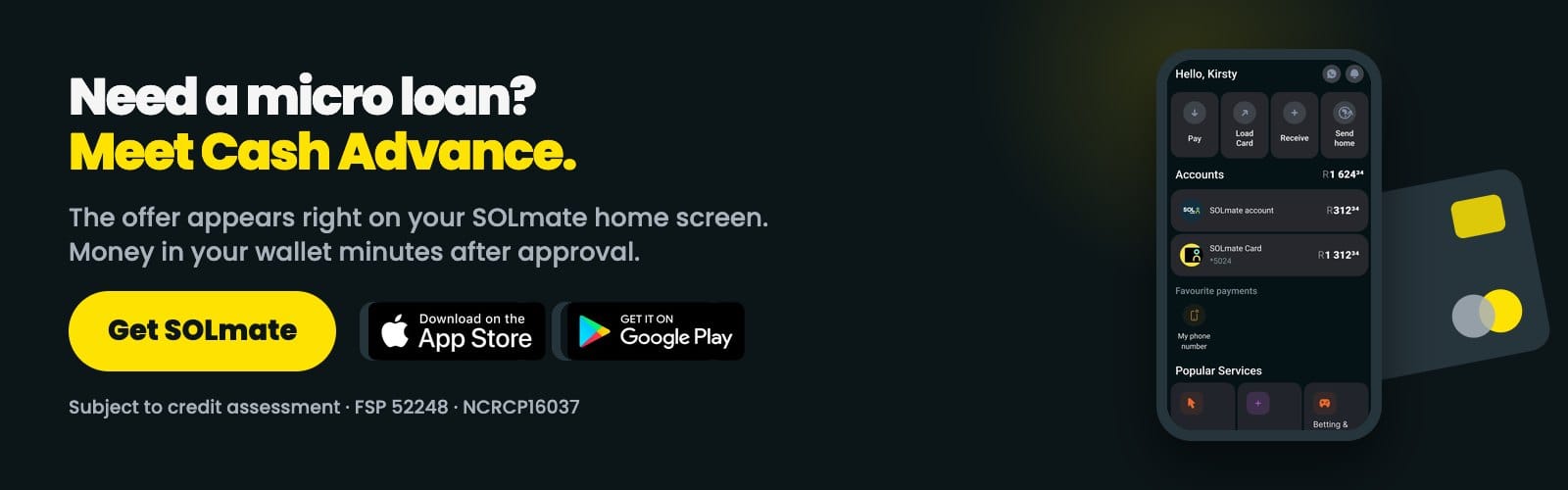
Your personal offer and limit are shown in the app. If there is no offer on your home screen, a Cash Advance isn't available to you right now. Repayments are deducted automatically from your wallet on the due date shown in the app. A three-day grace period applies after the due date, then daily penalty charges begin, and a missed payment can end up on your credit record. The full terms are on the Cash Advance page.
Subject to credit assessment · FSP 52248 · NCRCP16037
Your ID, Bank Card or SASSA Card Is Not Collateral
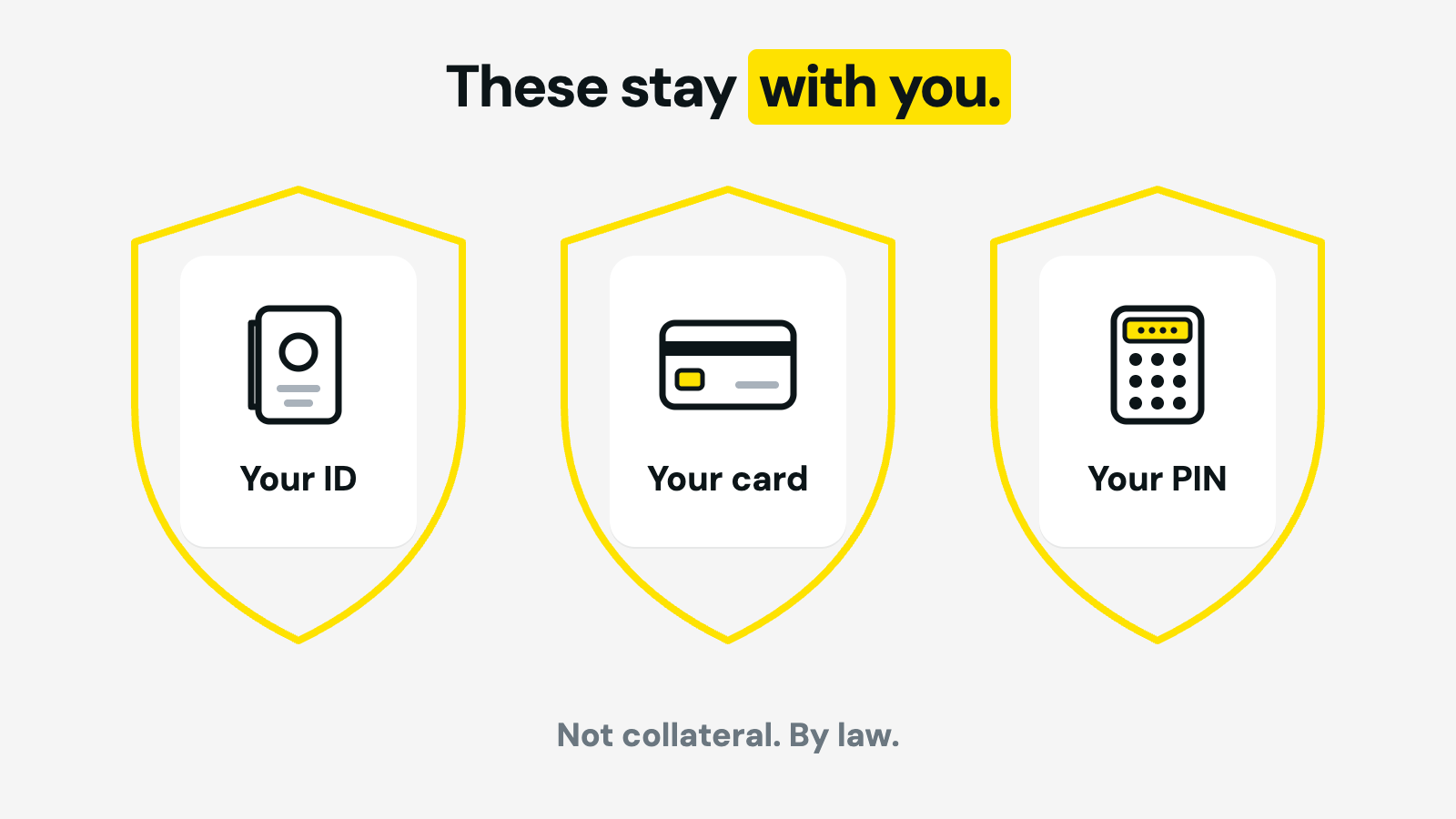
The most common mashonisa security is the borrower's own card: the lender keeps it with the PIN and draws the repayment on payday or grant day. The law is direct on this. Section 90 of the NCA makes it unlawful for a credit agreement to require you to hand over an identity document, a bank or ATM card, or a PIN, and section 133 makes it an offence to use them to collect a debt. The NCR's wording is that retaining these items is "a criminal offence in terms of the National Credit Act".
This is enforced. In a joint operation in De Aar in the Northern Cape on 2 September 2024, the NCR reported seven arrests and the seizure of 81 bank cards, 41 ID books and 7 SASSA cards from lenders.
If a lender is holding yours:
- Report it at the nearest police station and to the NCR on 0860 627 627 or complaints@ncr.org.za.
- Stop the card. Ask your bank to block it and issue a new one. For a SASSA card, ask SASSA for a replacement.
- Change the PIN on anything the lender has seen.
If You Already Owe a Mashonisa
Debt to an informal lender feels private, and that is part of how it keeps going. A few things are worth knowing.
Threats are crimes, whatever you owe. Intimidation, assault and taking your belongings are matters for the police, not part of a loan.
The agreement itself is on weak ground. Under section 89 of the NCA, a credit agreement is unlawful if the lender was required to be registered and wasn't, and a court can declare it void. That is a decision for a court, not a reason to expect the lender to walk away, so get advice before you change what you pay. The NCR call centre is the place to start.
Write it down. What you borrowed, when, and every payment since. With interest-only payments, the total you have paid passes the original amount within a few months.
Don't borrow from a second mashonisa to pay the first. If this is one of several debts you can't keep up with, a debt counsellor registered with the NCR can look at all of them together.
Before You Borrow From Anyone
A loan of any kind is the expensive way to cover a short month. Cheaper options first:
- Ask your employer about an advance on wages you have already earned.
- Talk to whoever you owe. A school, a landlord or a municipal account will often accept part now and part later, and that costs nothing.
- Use your stokvel or savings club if you belong to one and its rules allow it.
- Go to a registered lender and hold the total repayment on the agreement against the legal maximum. The percentages are in our payday loans guide.
If the barrier is paperwork (cash wages, no payslip), read what lenders can accept instead of a bank statement. And if the same gap opens every month, no loan will close it: a simple month-end budget is the place to start.
Where SOLmate Fits
SOLmate is a digital wallet and a registered credit provider, so the caps, the credit check and the agreement you see before signing apply to us as they do to any lawful lender. The account costs R10.00 a month, or R29.00 a month with a debit card plus a R49.00 activation fee, and money coming in by EFT is free. All fees are published. You can open an account with an SA ID, a passport or an asylum seeker permit. If you are eligible for a Cash Advance, the offer shows on your home screen.
Frequently Asked Questions
Is a mashonisa legal in South Africa?
Lending money at interest is legal only for registered credit providers. Anyone who lends and charges interest must register with the National Credit Regulator, whatever the amount or number of clients. A mashonisa who is not registered is lending unlawfully.
How much interest does a mashonisa charge?
Commonly 30% to 50% a month: R100 borrowed becomes R130 to R150 owed at month-end. The legal maximum interest on a short-term loan is 5% a month, plus capped fees. On R2,000 for one month the most a registered lender can charge in total is R473.75.
Are mashonisa loans on WhatsApp real?
Treat them as unsafe. A lender you can only reach by WhatsApp cannot be checked, and a request for a fee before the loan is paid is the mark of a scam. The NCR says an upfront payment for a loan is unlawful.
Can a mashonisa keep my ID or SASSA card?
No. The National Credit Act does not allow a lender to hold your ID, bank card, SASSA card or PIN as security, and the NCR treats it as a criminal offence. Report it to the police and to the NCR on 0860 627 627.
What is a legal alternative to a mashonisa?
A registered credit provider with an NCRCP number you can check on the NCR register. Its charges are capped by law, it must show you the total repayment before you sign, and it may not take your ID or cards.
Sources: NCR media release on retention of IDs and cards (October 2021), NCR statement on Northern Cape operations (September 2024), NCR media release on fake credit providers and upfront payments (April 2020), NCR register of registrants, Review of Limitations on Fees and Interest Rates Regulations, 2015, National Credit Act 34 of 2005 (sections 89, 90 and 133) and the registration threshold determination of 11 May 2016, SOLmate Cash Advance help page, SOLmate fees. The 30% to 50% monthly rates are those commonly reported for informal lenders in South African press and field research; the table is our illustration, with the legal maximum calculated by us (VAT at 15% on fees). Facts re-checked against SOLmate product pages (/fees, /help/solmate-cash-advance) on 30 September 2026. This article is general information, not financial or legal advice. Cash Advance is subject to credit assessment. SOLmate is not a bank. SOLmate (SOL Ecosystem (Pty) Ltd) is an authorised financial services provider (FSP No. 52248) and registered credit provider (NCRCP16037).