
Instant EFT vs Standard EFT in South Africa: RTC Explained (2026)
A standard EFT costs a few rand and takes 1–2 business days; an instant payment lands in minutes and costs several times more. Here's how both actually work, when the speed premium is worth paying — and when it's money down the drain.

Quick answer: South African bank transfers run at two speeds. A standard EFT is cheap (R8 from a SOLmate wallet) but settles in batches — money reflects in 1–2 business days. An RTC payment ("instant EFT", Real-Time Clearing) travels a separate real-time rail and lands within minutes — R40 from a SOLmate wallet, sent before 15:00, reflecting within 60 minutes. Neither is better; they're tools for different days. Here's how each works and a simple rule for choosing.
Why a "Slow" EFT Takes 1–2 Days (It's Not Laziness)
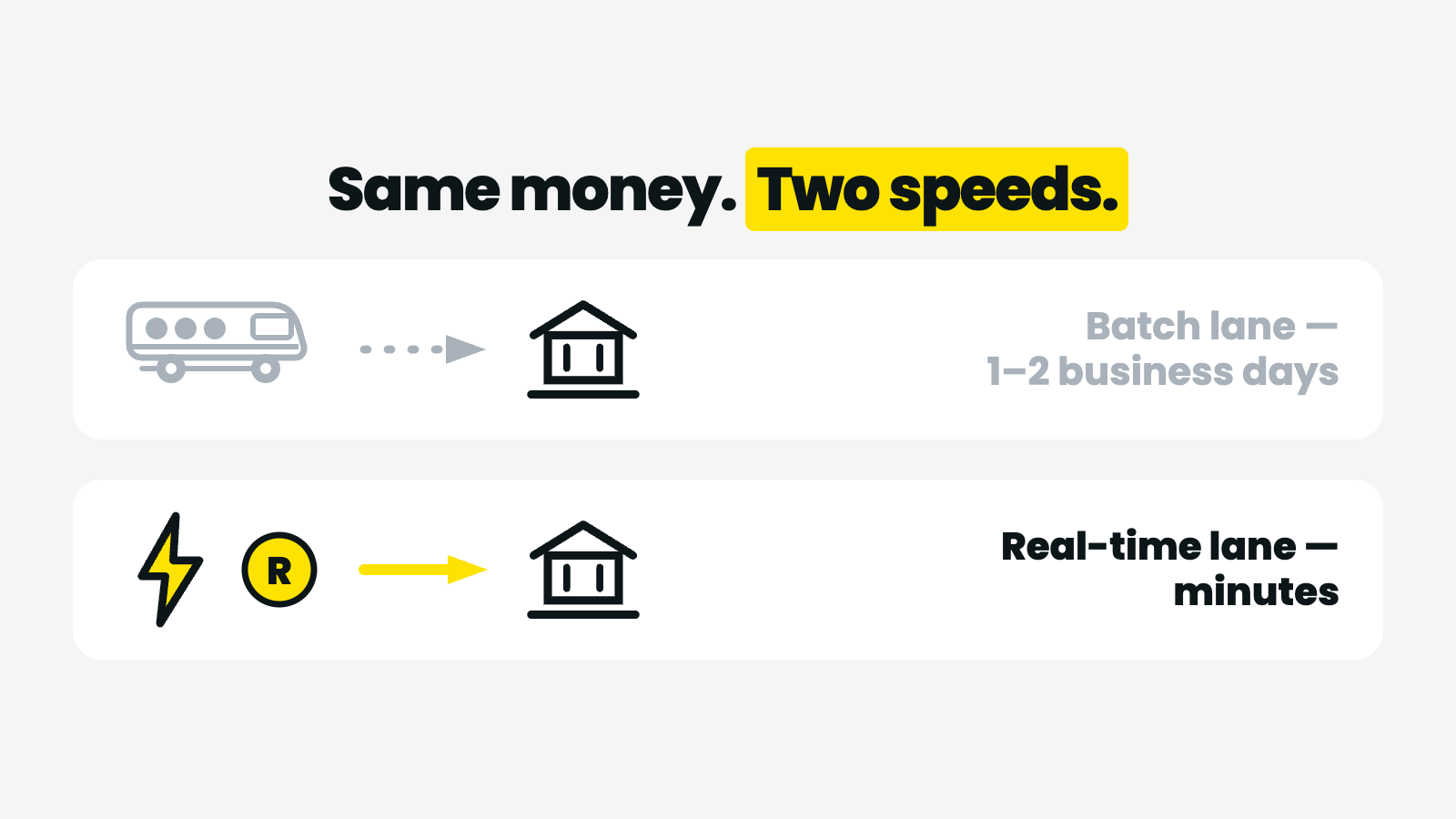
A standard EFT doesn't crawl — it queues. Banks collect the day's payments into batches and pass them through the national interbank clearing system at set times on business days. Your R500 travels with millions of other payments in the same consignment, which is exactly why it costs a few rand instead of forty. Weekends and public holidays don't count, which is how a Friday-evening transfer becomes Tuesday money. The full steps for sending one from a wallet are on the EFT help page — it's a two-minute job in the app.
What RTC Actually Is
Real-Time Clearing is a separate payment rail that South African banks have run since 2006: instead of joining a batch, your payment is cleared individually between participating banks — the interbank leg typically takes seconds, and the money reflects in the recipient's account within minutes. That individual handling is the whole premium: you're paying for a courier instead of a seat on the bus. Across the market, real-time payments typically cost several times a standard EFT — R30–R50 is the common range.
What the Speed Costs (SOLmate as the Worked Example)
| Way to send to any SA bank | Fee | Reflects |
|---|---|---|
| Standard EFT | R8 | 1–2 business days |
| RTC (instant EFT) | R40 | within 60 min (sent before 15:00) |
| SOLmate to SOLmate | free | instant, any time |
Two things jump out of that table. First, the premium is real: R32 extra buys you roughly a day and a half. Second, the free row — if the person you pay regularly also has a SOLmate wallet, the whole speed-versus-price dilemma disappears: wallet-to-wallet is instant and costs nothing. Fees are from the public fee table.
The One Rule: Pay for Speed Only When Time Has a Price
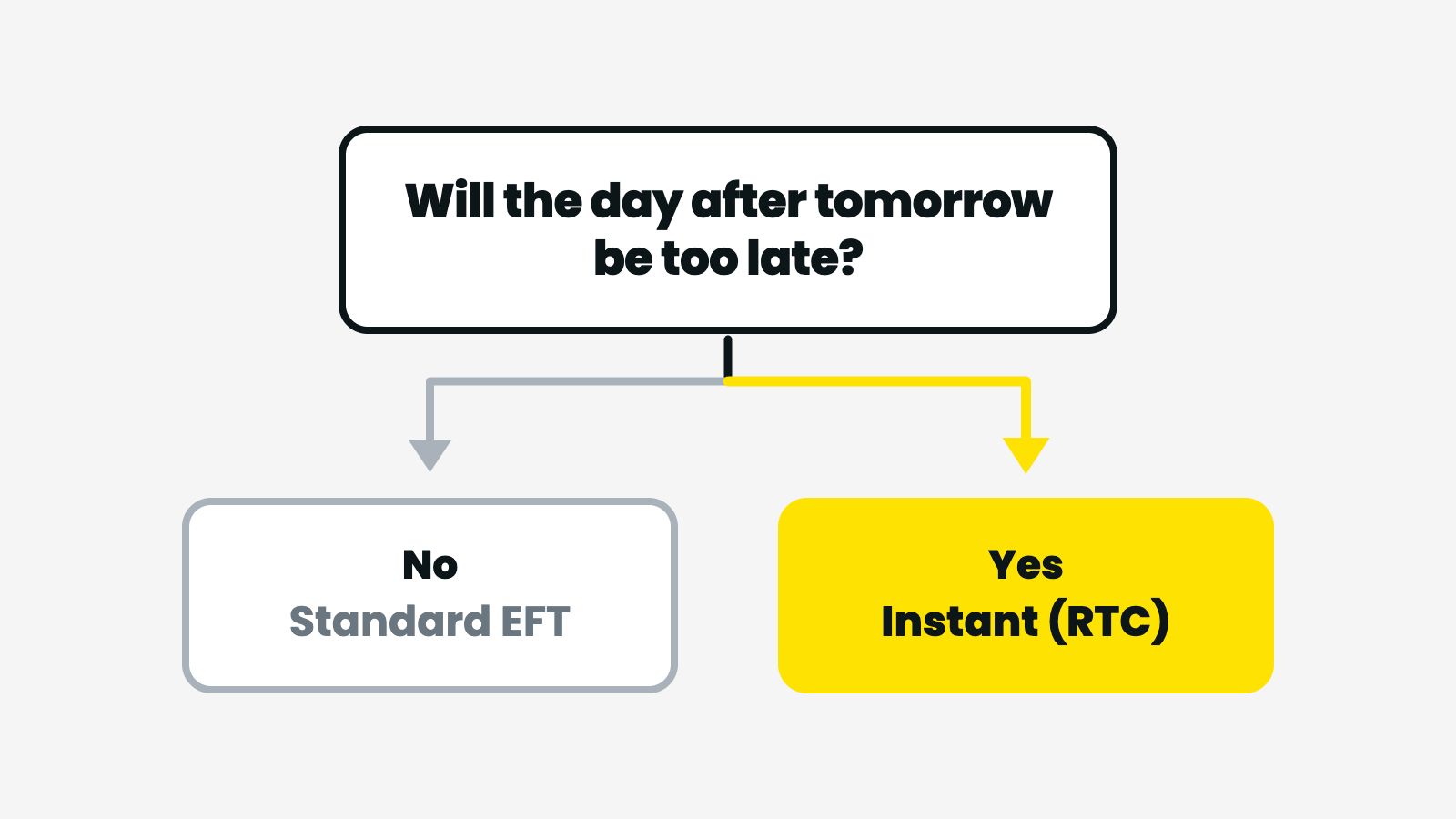
Ask a single question before flipping the RTC switch: what happens if the money arrives the day after tomorrow? If the answer is "nothing" — rent due next week, a planned transfer to family, topping up your own account — standard EFT and R8 is the right call. If the answer is "something breaks" — an emergency at home, a deposit that secures a room today, a supplier who releases goods on payment — R40 is cheap insurance. The expensive habit isn't using RTC; it's using it by default. We covered this family of charges in the wider guide to bank charges: instant-payment premiums are one of the few fees that are entirely under your control.
Sending an Instant Payment From the SOLmate App
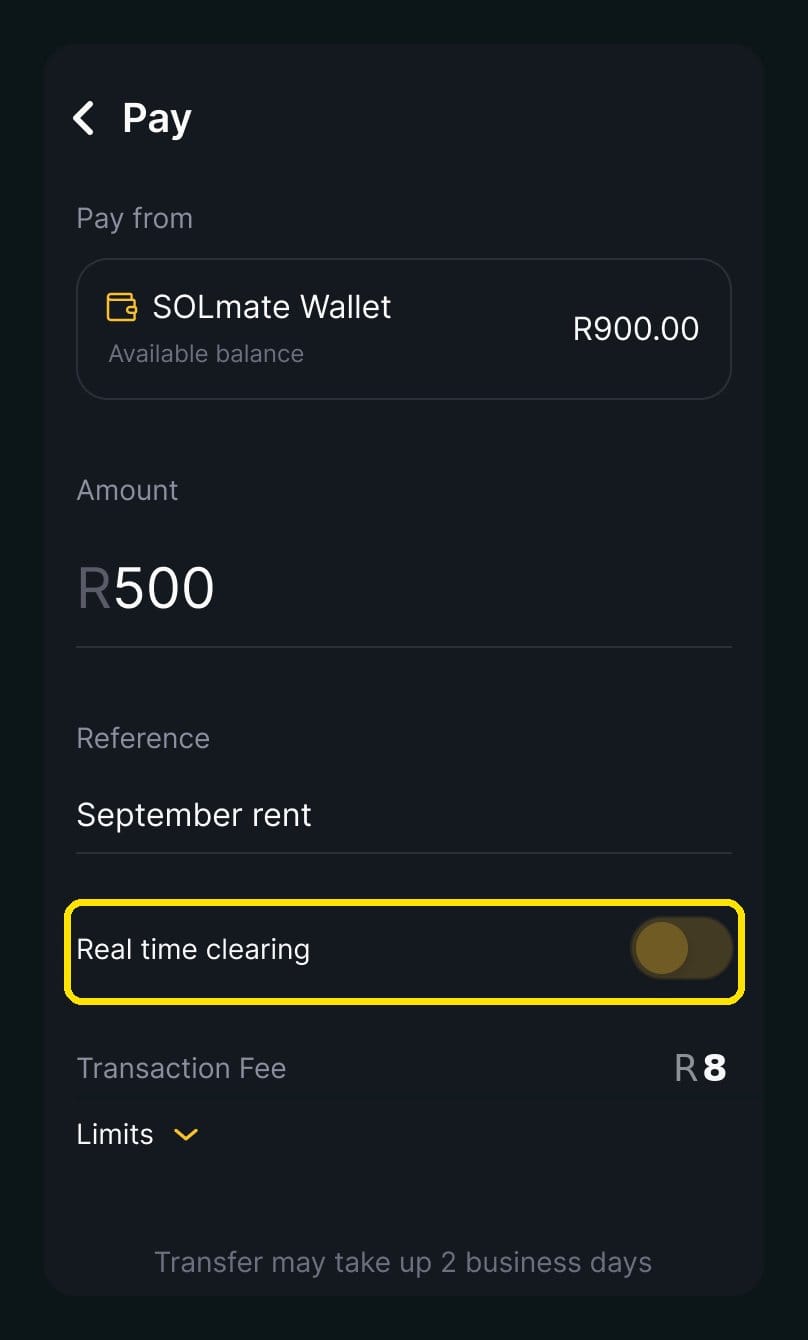
- Open Services → EFT Transactions.
- Enter the amount, select the bank, enter the account number and branch code.
- Add a payment reference (this is what shows on the recipient's statement).
- Flip the RTC switch ON for the 60-minute lane — or leave it off for the R8 batch lane.
- Review and confirm. Sent before 15:00, an RTC payment reflects within the hour.
Same form, one switch — the choice of speed is literally one toggle, which is how it should be everywhere.
Three Gotchas Worth Knowing
- Cut-off times are real. The 60-minute promise applies before 15:00; late-evening "instant" payments across providers can wait for the next processing window. When today matters, send in the morning.
- Fast money is final money. A payment that clears in seconds is much harder to recall than one sitting in a batch. Triple-check the account number before confirming an RTC — banks verify the account, not the name.
- "Instant EFT" also means something else online. Checkout pages use the same phrase for pay-by-bank gateway services at merchants. Same words, different animal: a checkout button is a payment method; the RTC switch in a banking app is an interbank transfer. This guide is about the second one.
And PayShap? The Third Rail, Briefly
South Africa's newest real-time system, PayShap, launched in 2023 on infrastructure operated by BankservAfrica — it's designed for everyday instant payments between banks, including paying to a cellphone number instead of an account. It's a bank-side service, so availability and pricing depend on your bank. For the purposes of this guide the takeaway is simple: the country is steadily moving toward instant-by-default — but until batch EFT disappears, the R8-versus-R40 judgement call above stays the most practical money skill of the three rails.
The Quiet Superpower: An Account That Speaks EFT at All
One step back: everything in this article assumes you have an account that sends and receives EFTs — which is exactly what cash-paid workers don't have, and why they pay cash-handling fees instead of R8 ones. A wallet account with a real account number receives a salary by normal EFT, sends to any SA bank at either speed, and opens in about 3 minutes with a passport, SA ID or asylum permit. The cheapest transfer is the one that starts from an account, not from an envelope of cash.
Frequently Asked Questions
What's the difference between EFT and RTC?
EFT clears in batches over 1–2 business days at a low fee; RTC clears individually in real time, reflecting within minutes, at a premium — R8 versus R40 from a SOLmate wallet.
How long does a normal EFT take?
1–2 business days. Weekends and public holidays don't count — a Friday-evening EFT is typically Tuesday money.
When should I pay for RTC?
When arrival today genuinely changes something: emergencies, same-day deadlines, payments that unlock goods or housing. Otherwise the batch lane does the same job for a fraction of the price.
Is RTC safe?
Yes — it's part of the regulated national payment system. The caution is finality: fast payments are hard to recall, so verify the account number before confirming.
Why do online shops also say "Instant EFT"?
That's a different product — pay-by-bank checkout at merchants. The RTC described here is an interbank transfer you trigger from your own app.
Can I send instantly on a weekend?
Batch EFTs wait for business days; real-time payments depend on your provider's windows and cut-offs. Wallet-to-wallet within one provider (like SOLmate to SOLmate) is instant and free at any time.
Sources: SOLmate EFT help page, SOLmate fees, BankservAfrica: real-time clearing. Fees, cut-off times and processing windows correct as of August 2026 — always confirm the live quote in-app before sending. SOLmate is not a bank. SOLmate (SOL Ecosystem (Pty) Ltd) is an authorised financial services provider (FSP No. 52248) and registered credit provider (NCRCP16037).