Payday Loans in South Africa (2026): Real Costs, Legal Limits, and How to Borrow Safely
A payday loan can be a legitimate tool or a trap — the difference is knowable in advance. What short-term credit is legally allowed to cost in South Africa, why "no credit check" is a red flag and not a feature, and how offer-based cash advances work.

Quick answer: a payday loan in South Africa is short-term credit — R8,000 or less, repaid within 6 months — and everything it may legally cost is capped by the National Credit Act: interest at 5% a month on a first loan, plus limited once-off and monthly fees. The two most-searched promises in this market, "no credit check" and "guaranteed approval", are both red flags for unlawful lenders, not features. Here's what borrowing legitimately looks like, what it really costs, and how an offer-based product like the SOLmate Cash Advance works.
What a Payday Loan Actually Is
Whatever the marketing calls it — payday loan, cash advance, instant loan, quick loan — legally it's usually the same thing: a short-term credit agreement under the National Credit Act (NCA), meaning R8,000 or less, repaid within six months, often in one or two instalments timed around your payday. Every legitimate lender offering one must be a registered credit provider with an NCRCP number, and that registration is checkable — more on that below. The product itself is neither good nor evil: used for a genuine short-term gap it's a tool; used to cover a permanent shortfall every month, it becomes an expensive habit no borrowing can fix.
What It's Legally Allowed to Cost
The NCA caps every component of a short-term loan's price. This is the single most useful table in this article:
| Cost component | Legal maximum (short-term credit) |
|---|---|
| Interest | 5% per month (first loan); 3% per month on further loans in the same calendar year |
| Initiation fee (once-off) | R165 + 10% of the amount above R1,000 — capped at R1,050 excl. VAT |
| Monthly service fee | Capped by regulation (R60 excl. VAT) |
Two practical consequences. First, a lender quoting more than these caps is acting unlawfully — walk away. Second, even at legal rates, short-term credit is expensive money: the caps are ceilings, not bargains. Borrow the smallest amount for the shortest time that solves the actual problem, and always look at the total repayment amount in the agreement, not the monthly percentage.
The "No Credit Check" Trap
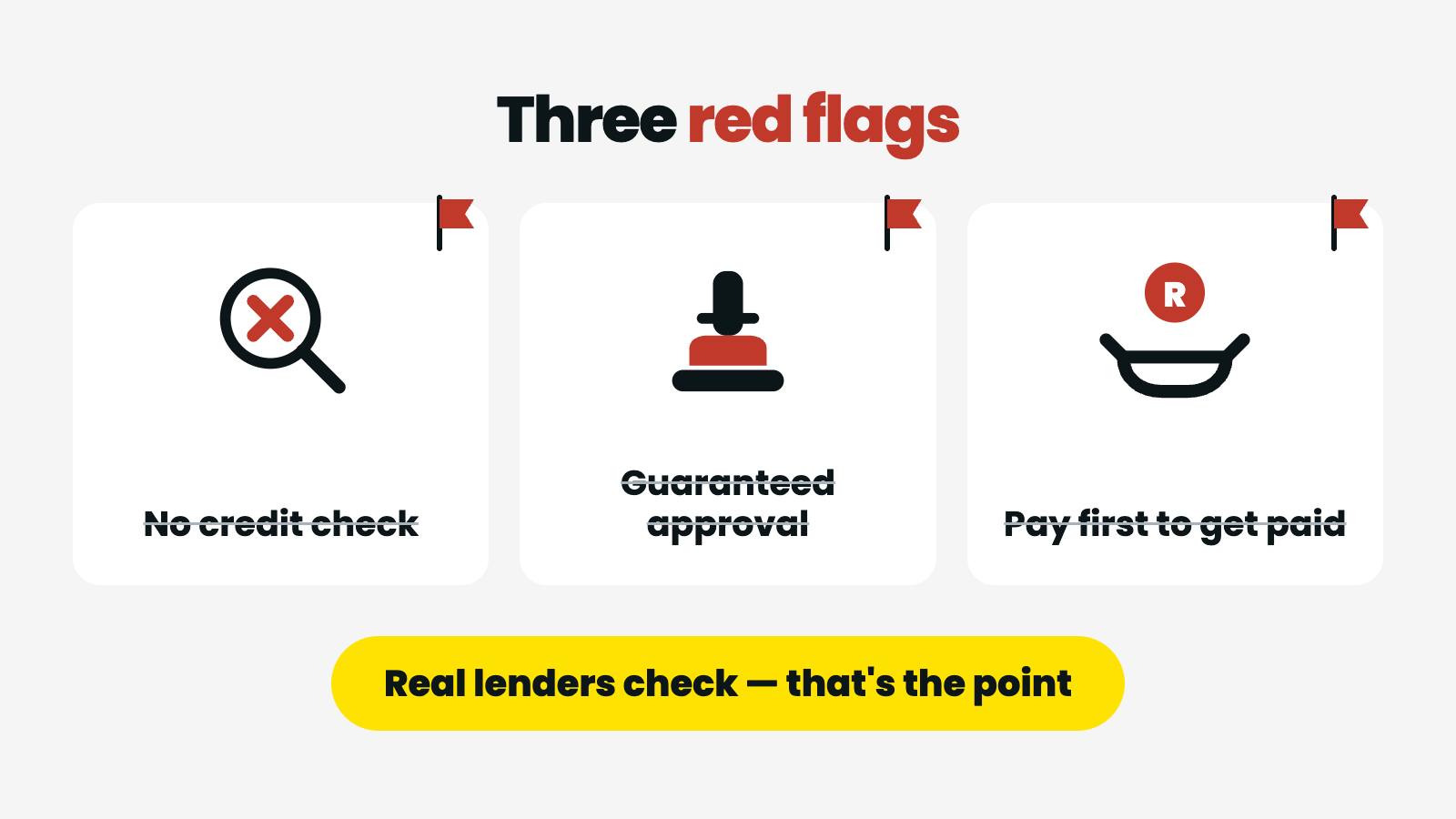
Tens of thousands of South Africans search for loans "with no credit check" every month — which is exactly why it's worth saying plainly: a legal no-credit-check loan does not exist. The NCA obliges every registered credit provider to run an affordability assessment before granting credit; skipping it is reckless lending, which the Act prohibits. So a lender advertising "no credit check" is telling you one of two things: they're breaking the law they're registered under, or they were never registered at all. Either way, that's who you'd owe money to — with everything that implies about hidden charges and collection tactics. The same logic applies to "guaranteed approval": no lawful lender can guarantee an outcome that legally depends on an assessment. The credit check isn't the obstacle between you and the money; it's the marker that the lender operates in daylight.
How to Borrow Safely Online: a 4-Point Check
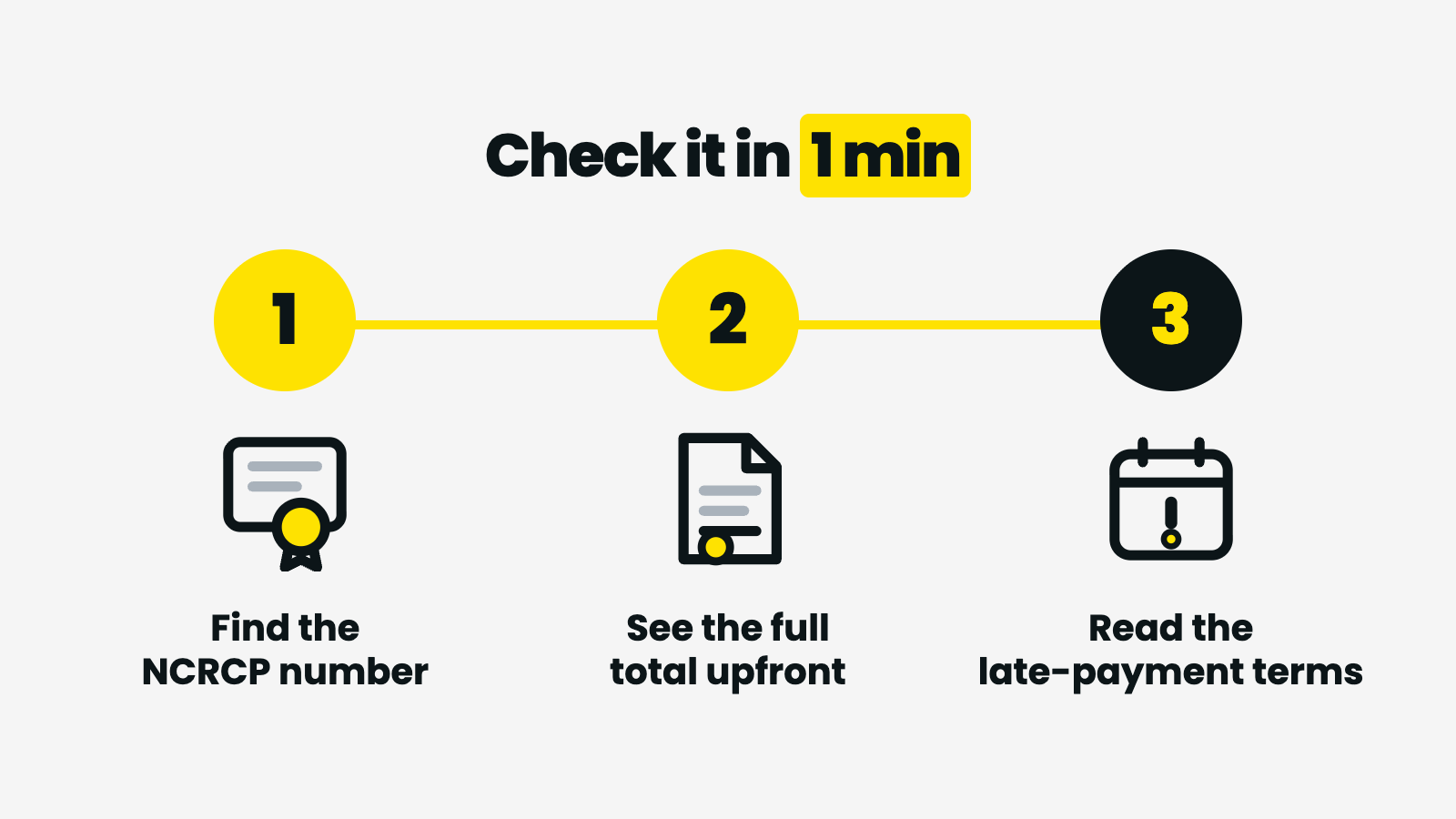
- Verify the lender's registration. Every legal credit provider has an NCRCP number, usually in the website footer, and the National Credit Regulator keeps a public register. No number — no deal.
- Demand the full cost upfront. A lawful agreement shows the total you'll repay, every fee included, before you sign. If the total appears only after you've committed, stop.
- Never pay to receive a loan. Any "upfront fee to release the funds" is a scam, full stop. Legal initiation fees are part of the credit agreement, not a prepayment.
- Know the late-payment terms before you need them. Grace periods, penalty charges, credit bureau reporting — read that section first, because it's the one that matters when things go wrong.
How an Offer-Based Cash Advance Works (SOLmate as the Worked Example)
The SOLmate Cash Advance flips the usual application flow: if you're eligible, the offer appears on your home screen in the app — amounts and repayment options are shown to you, rather than you applying blind. From there: choose the amount and repayment option, review the full repayment details, consent to a credit check (yes — see the section above; that's the daylight marker), accept the loan documents, and sign with an OTP. Approved money lands in your SOLmate wallet immediately.
Repayments are deducted automatically from the wallet on the due dates shown in the app — one or two instalments. A three-day grace period applies after a missed due date; after that, daily penalty charges begin and non-payment may be reported to a credit bureau, where the record can stay for at least five years. You can settle early at any time by requesting a settlement quote in the app, valid for five business days. How an offer appears, what it could cost and how repayments work are on the Cash Advance page; the account itself opens in about 3 minutes with an SA ID, passport or asylum seeker permit.
One honest note: no offer on your home screen means a Cash Advance isn't currently available to you — and applying is not a guarantee of approval, because the credit check is real. That's the system working as designed. Using the account actively — receiving your wages into the wallet, transacting regularly — is what gives a provider the picture it needs to make you an offer.
The Cheapest Loan Is a Smaller Gap
Most payday borrowing covers a recurring gap between income and month-end, and shaving the gap beats financing it: the caps above make every borrowed rand cost roughly 5 cents a month before fees. Two places the gap hides in plain sight: bank charges that quietly eat a chunk of a modest salary, and per-purchase fees on essentials — in the SOLmate app, airtime, data and prepaid electricity carry no fee at all. If the end of the month is a recurring cliff, a simple budget plan does more than any loan can.
Frequently Asked Questions
How do payday loans work?
Short-term credit under the NCA: R8,000 or less, up to 6 months, one or two instalments, all costs capped by law, affordability assessment required.
What's the maximum interest?
5% per month on a first short-term loan, 3% on further loans the same calendar year, plus capped initiation and service fees.
Are no-credit-check loans legal?
No. The affordability assessment is legally mandatory — "no credit check" marks an unlawful lender.
Can I get the money the same day?
Yes, from legitimate app-based providers — a SOLmate Cash Advance pays into your wallet immediately after approval and OTP signing.
Do I need a branch? I'm not in a big city.
No — the process is fully online nationwide, Cape Town to Polokwane, on your phone.
Can I repay early?
Yes, the NCA allows early settlement. In the SOLmate app you request a settlement quote, valid for five business days.
Sources: SOLmate Cash Advance help page, The Banking Association South Africa: National Credit Act, National Credit Regulator. Caps and fee formulas are set by the NCA regulations and correct as of August 2026; the terms of any specific Cash Advance offer (amounts, instalments, charges) are shown in the SOLmate app before you sign. This article is general information, not financial advice — borrow only what your budget can repay. SOLmate is not a bank. SOLmate (SOL Ecosystem (Pty) Ltd) is an authorised financial services provider (FSP No. 52248) and registered credit provider (NCRCP16037).