
How to Improve Your Credit Score in South Africa: Naledi's Six-Month Plan, and What Actually Works Fast
Turned down for a phone contract, Naledi pulled all four credit reports, found one wrong line, fixed it for free, and then did the boring things. What moved her score in weeks, what took months, and how to build a score when your file is empty.

Naledi is 31, lives in Soweto, works in admin for a logistics company, and in January she was turned down for a phone contract. Not a car, not a bond — a phone. The shop assistant shrugged and said "the score", and that was the first time she had ever heard she had one. This is what she did over the next six months, in the order she did it, with the parts that worked fast separated honestly from the parts that just took time. Naledi is a composite of readers who have written to us; the numbers are illustrative, not a promise.
Where Naledi Started
When she finally pulled her reports, the picture was ordinary and a little unfair at the same time. On TransUnion's 0–999 scale she was sitting at roughly 590 — below the national average and firmly in the "needs work" band described in our guide to what counts as a good credit score in South Africa. Behind the number were three things: a clothing account she had let slip three months behind two years earlier and then settled; almost nothing else on the file, because she had always paid cash; and, from the last six weeks, four fresh enquiries from the phone shop and three online lenders she had tried in a panic after the first rejection.
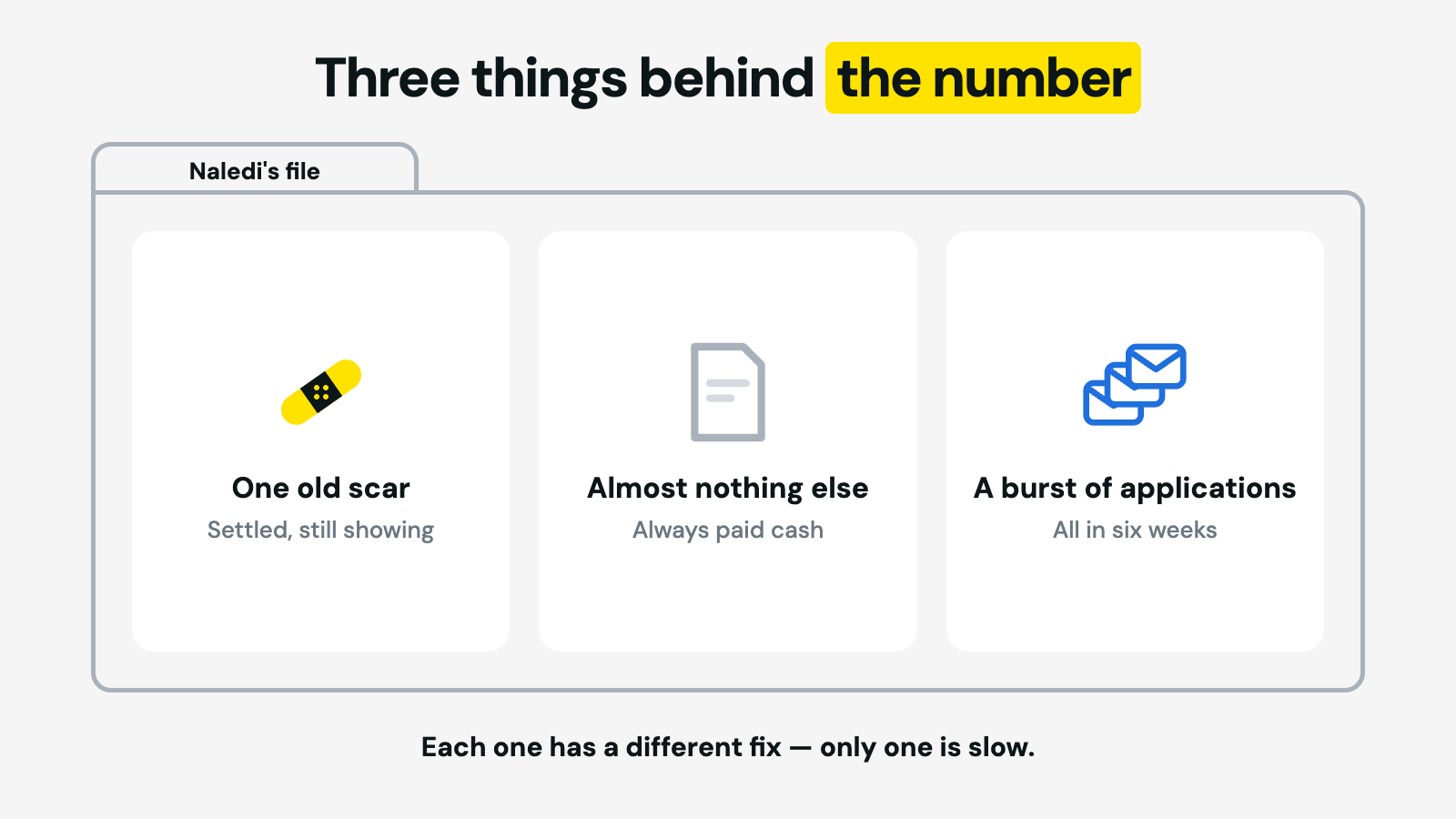
That combination — one old scar, a thin file, and a burst of applications — is the most common shape of a damaged score we see. It is also the most fixable, because each of the three parts responds to a different lever, and only one of them is slow.
Month 0: Read All Four Reports Before Touching Anything
The single most useful thing Naledi did cost nothing and took an evening. Under the National Credit Act you are entitled to one free credit report a year from every registered bureau, and lenders do not all query the same one, so she pulled all four consumer bureaus — the step-by-step routes are in our guide to checking your credit score for free.
Reading them, not just glancing at the score, is what paid off. The settled clothing account was correctly marked paid at two bureaus. At a third, it was still showing as open and in arrears — a lender feed that had never been updated. That one wrong line was doing more damage than everything else on the file combined.
She lodged a dispute in writing with proof of settlement. A bureau has 20 business days to verify an entry with the lender, and if it cannot be verified it must come off; the mechanics, and where to escalate if a bureau drags its feet, are in our credit bureaus guide. The correction landed in the fourth week. Her score at that bureau moved more in that one month than it would in the following five — which is the point worth underlining: an error on your file is the only genuinely fast lever, and it is free.
Month 1: Stop the Bleeding
Two decisions, both boring, both made in the same week.
First, she stopped applying for anything. Each of those seven enquiries had been a small hit; together they read as someone hunting for credit, and enquiries stay on a file for two years. There was nothing to undo — only the discipline of not adding an eighth. Checking your own score, for the record, is a soft enquiry and does no harm; it is applications that count.
Second, she made it impossible to be late again. Her one live obligation was the clothing account's small monthly instalment, and her salary had been landing in a cash envelope and a friend's account for years. She opened an account that receives her wages directly and set the instalment to go out the day after payday, automatically, before she could spend it. Nothing about this raised her score in month one. It simply guaranteed that from now on every line added to her payment profile would be a green one — and payment history is the heaviest factor there is.
An Account That Pays On Time For You
This is the part of Naledi's plan where a product comes in, so here is the honest version. Late payments happen far more often from forgetting than from not having the money, and the fix is an account where your income arrives and your obligations leave on schedule without you touching them. A SOLmate account opens on your phone in about three minutes with an SA ID, passport or asylum seeker permit, receives salary and EFTs free, and costs R10.00 a month without a card or R29.00 with a Mastercard debit card (activation from R49.00) — the full list is on the fees page.
If a Cash Advance offer appears on your home screen, it is built on the same principle: repayments are deducted automatically from the wallet on the due dates shown in the app, so "never accidentally late" is the default rather than a resolution. It is real credit under the NCA — a credit check with your consent, approval not guaranteed, no bank statement required, and your personal offer and limit shown in the app. One caution belongs here: a Cash Advance is a tool for a short gap, not a device for building a score, and the same automatic deduction that keeps you on time will report a missed one after the three-day grace period. Details are on the Cash Advance help page.

Months 2–3: Bring the Balance Down
Naledi's clothing account had a limit of a few thousand rand and she had been running it close to full for a year, paying the minimum. Balances that sit near the limit month after month read as strain; comfortable headroom reads as control. So for two months the instalment went up — not dramatically, just enough to bring the balance to well under half the limit and keep it there.
She did not close the account once it was low. This is a mistake people make on their way up: an old, well-behaved account is depth of history, and closing it removes exactly the evidence you are trying to accumulate. Low and open beats paid-off and gone.
Months 4–6: Let the File Age
Then came the hard part, which is that there was nothing to do. Three months of on-time instalments had been recorded; the wrong entry was gone; the enquiries were quietly getting older. A score is a summary of documented behaviour, and the only way to document more behaviour is to let more months happen.
This is the stretch where people go looking for a shortcut, and it is where the search results get ugly. "Increase your credit score fast" attracts two kinds of offers: credit-repair services that charge a fee to lodge the dispute you can lodge yourself for free, and "clearance" outfits that promise to remove accurate information, which no one can lawfully do. Our guide to ITC checks and "blacklisting" takes those apart in detail. Naledi ignored them and checked one bureau a month, which is free and harmless, to watch the line move.
What "Fast" Actually Means
Since most people arrive at this topic in a hurry, here is the whole plan sorted by speed rather than by month.
- Weeks: getting an error corrected. The dispute clock is 20 business days, and a wrong arrears line or a settled debt still showing open can be worth more than a year of good behaviour.
- Immediate to set up, months to show: automating every repayment. It cannot raise your score today; it guarantees that every line from today is a good one.
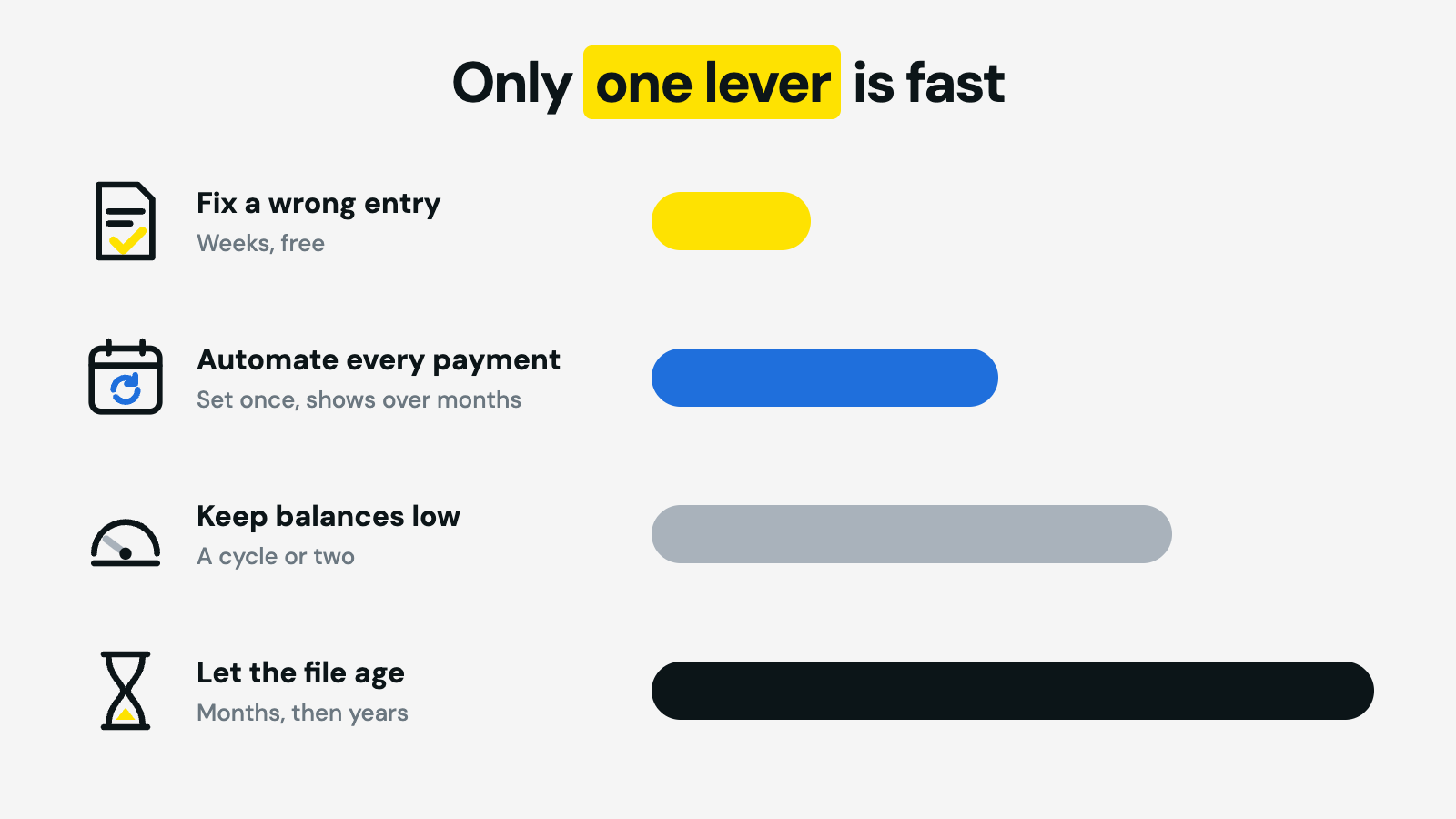
- Two to three months: bringing balances well below limits. Bureaus update as lenders report, usually monthly, so a lower balance takes a cycle or two to appear.
- Months, then years: everything else. Enquiries fade over two years. A settled adverse listing must be removed once paid under the 2014 regulations, but the payment profile behind it keeps reporting for up to five years — how each entry ages is laid out in the retention table in our complete credit score guide.
Anything promising to compress the last item into days is either lying about what it does or asking you to pay for the first item.
If You're Building From Nothing
Half of Naledi's problem was a thin file, and for many readers that is the whole problem: no arrears, no judgments, just nothing — and a model with nothing to score treats you as an unknown, which lenders price as a risk. Cash discipline, unfortunately, is invisible to a bureau.
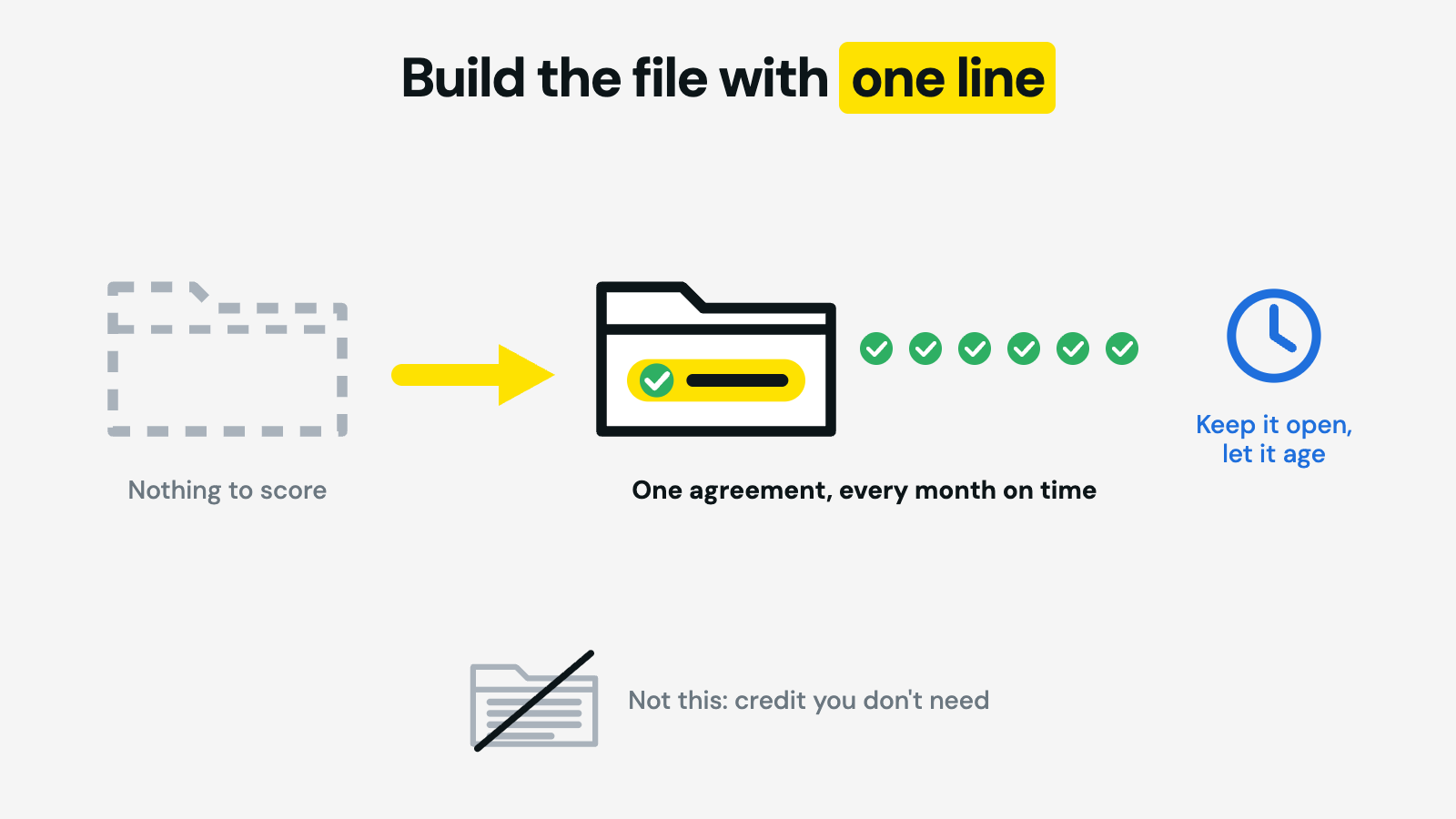
The path is one modest agreement, repaid perfectly. For Naledi that became, in month five, the same phone contract that had started all this — approved this time — with the instalment automated like everything else. It does not have to be a phone; a small store account or a low-limit card used lightly and cleared works the same way. What does not work is taking credit you do not need "to build a score" and then carrying it: a balance near the limit is a worse signal than no balance at all. Build the file with one line, keep it green, and let it age.
Where Naledi Ended Up
Six months after the shop assistant said "the score", Naledi was sitting around 670 on TransUnion's scale — out of "needs work", into "fair", with the "good" band starting just above her. Roughly a third of that movement came in one month from the corrected entry; the rest was six months of automated instalments, a lower balance, and no new enquiries. Nothing clever, nothing paid for. Twelve months of the same and she expects to cross into the good band, and that expectation is reasonable — but it is an expectation, not a guarantee, because every bureau's model is its own and every lender adds its own cut-off on top.
The lesson she would give you is the one this article is built around: check the file first, fix what is wrong, make lateness impossible, and then have the patience to be boring.
Where SOLmate Fits
SOLmate is not a bank and does not score you. What it does is remove the two most common reasons a payment is late — the money arriving somewhere else and the instalment needing to be remembered. Your salary lands in the wallet free, obligations go out on schedule, and if a Cash Advance offer ever appears on your home screen, it repays itself from the same wallet on the dates the app shows. That is the unglamorous foundation of every plan like Naledi's. Open an account in about three minutes with an SA ID, passport or asylum seeker permit.
Read next in the Credit score series
Sources: National Credit Regulator (your free annual report and dispute rights under the National Credit Act, sections 72 and 72(3); retention periods under Regulation 17; the 2014 Removal of Adverse Consumer Credit Information regulations), TransUnion South Africa (score scale), SOLmate Cash Advance help page and SOLmate fees page, correct as of September 2026. Naledi is a composite; her scores are illustrative and bureau models and lender cut-offs differ. Facts re-checked against SOLmate product pages on 18 September 2026. This article is general information, not financial advice. Cash Advance is subject to credit assessment. SOLmate is not a bank. SOLmate (SOL Ecosystem (Pty) Ltd) is an authorised financial services provider (FSP No. 52248) and registered credit provider (NCRCP16037).