Micro Loans in South Africa: What a Micro Lender Can Legally Charge, in Rands
A micro loan's price is capped by law. The maximum a micro lender can charge on R2,000 to R8,000, worked out in rands, how to check a lender on the NCR register, and why a loan shark can't keep your ID or SASSA card.

A micro loan in South Africa is a small, short loan – R8,000 or less, repaid within six months – and the law caps every rand a micro lender may charge for it. On a R4,000 loan repaid after one month, the legal maximum you can be asked to repay is about R4,804, fees and VAT included. Anyone asking for more is either breaking the National Credit Act or was never registered under it. Below: the ceiling worked out in rands for common amounts, what happens when the term stretches, and how to check a micro lender before you sign.
Micro Loan, Payday Loan, Short-Term Credit: Three Names, One Rulebook
"Micro loan", "micro lending", "cash loan" and "payday loan" are marketing words. The National Credit Act (NCA) has one category for all of them: a short-term credit transaction – up to R8,000, repaid within six months. A "micro lender" is simply a credit provider that grants these loans, from a small office on a high street to an app on your phone. The size of the business changes nothing: the NCR is clear that anyone who lends money and charges interest must register as a credit provider, whatever the loan size or the number of clients.
The caps themselves are the same ones we set out in percentages in our payday loans guide: interest of 5% a month on your first short-term loan in a calendar year (3% on later ones that year), a once-off initiation fee of R165 plus 10% of the amount above R1,000, and a monthly service fee of up to R60. Percentages are easy to read past. Rands are not, so here they are.
The Ceiling in Rands: What a Micro Loan Can Cost at Most
The table below applies the regulated maximums to four common loan amounts, repaid in full after one month, first loan of the year. Initiation and service fees are shown with 15% VAT added, because that is what lands on the agreement.
| You borrow | Max initiation fee (incl. VAT) | Max interest, 1 month | Max service fee (incl. VAT) | Most you can owe after 1 month | Cost as % of the loan |
|---|---|---|---|---|---|
| R2,000 | R304.75 | R100 | R69 | R2,473.75 | 23.7% |
| R4,000 | R534.75 | R200 | R69 | R4,803.75 | 20.1% |
| R6,000 | R764.75 | R300 | R69 | R7,133.75 | 18.9% |
| R8,000 | R994.75 | R400 | R69 | R9,463.75 | 18.3% |
Three things the numbers show. First, the initiation fee, not the interest, is the biggest single charge on a one-month loan – it is paid once, however short the loan. Second, small loans are proportionally the most expensive: the fixed R165 part of the fee weighs more on R2,000 than on R8,000. Third, these are ceilings. A lawful lender may charge less, and the only number that matters for your offer is the total repayment amount printed on the agreement before you sign – compare it with this table.
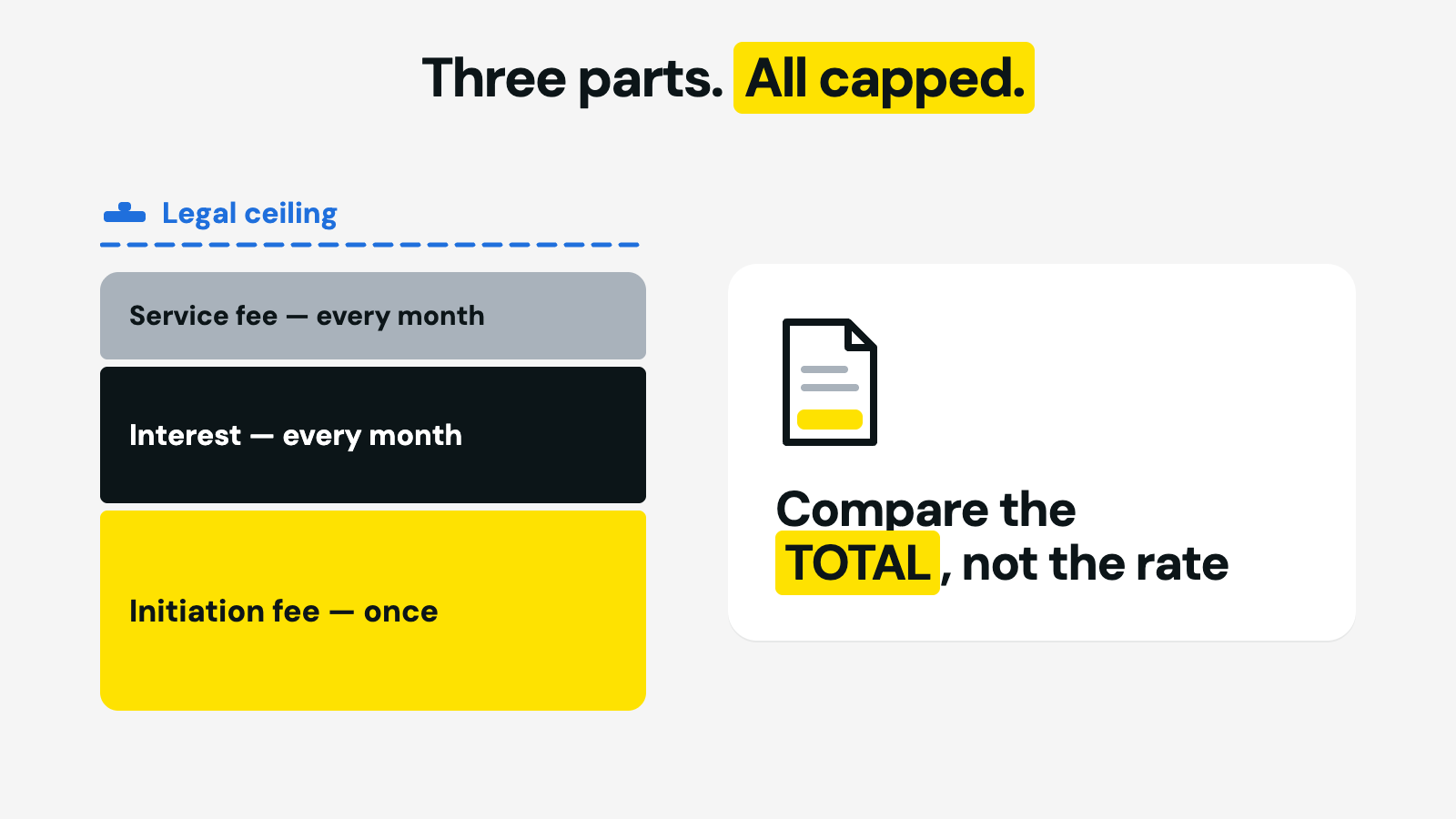
How we calculated it: initiation fee = R165 + 10% of the amount above R1,000, plus VAT; interest = 5% of the amount borrowed for one month; one month's service fee of R60 plus VAT. If a lender adds the initiation fee to the loan balance, interest can be charged on that too, so a real-world maximum can sit a few rand higher.
Stretching It Out: The Same R4,000 Over One, Three and Six Months
A longer term feels gentler because each instalment is smaller. The total tells a different story. This is the upper limit for R4,000 if the full balance stays outstanding for the whole term – paying it down in instalments lowers the interest part, but the service fee still arrives every month.
| Term | Initiation fee | Interest (max) | Service fees | Ceiling on total cost |
|---|---|---|---|---|
| 1 month | R534.75 | R200 | R69 | R803.75 |
| 3 months | R534.75 | R600 | R207 | R1,341.75 |
| 6 months | R534.75 | R1,200 | R414 | R2,148.75 |
| 1 month, second loan this year (3%) | R534.75 | R120 | R69 | R723.75 |
The practical rule: borrow the smallest amount for the shortest time that solves the problem. If the same gap comes back every month, the loan is treating a symptom – a simple month-end budget usually does more than any rate can.
When the Offer Comes to You
With a SOLmate Cash Advance you don't shop for a lender at all. If you are eligible, an offer appears on your SOLmate home screen with the available amount and repayment option, and you see the full repayment details before anything is signed. No bank statement is required: the credit check runs with your consent inside the app, and approved money is paid into your wallet immediately after you sign with an OTP. Your personal offer and limit are shown in the app; no offer on your home screen means a Cash Advance isn't available to you right now.
Repayments come off the wallet automatically on the due dates in the app, in one or two instalments; there is a three-day grace period, then daily penalty charges, and late payment may be reported to a credit bureau. Full mechanics, and an estimate of what it could cost, are on the Cash Advance page.
Subject to credit assessment · FSP 52248 · NCRCP16037
Checking a Micro Lender Before You Sign
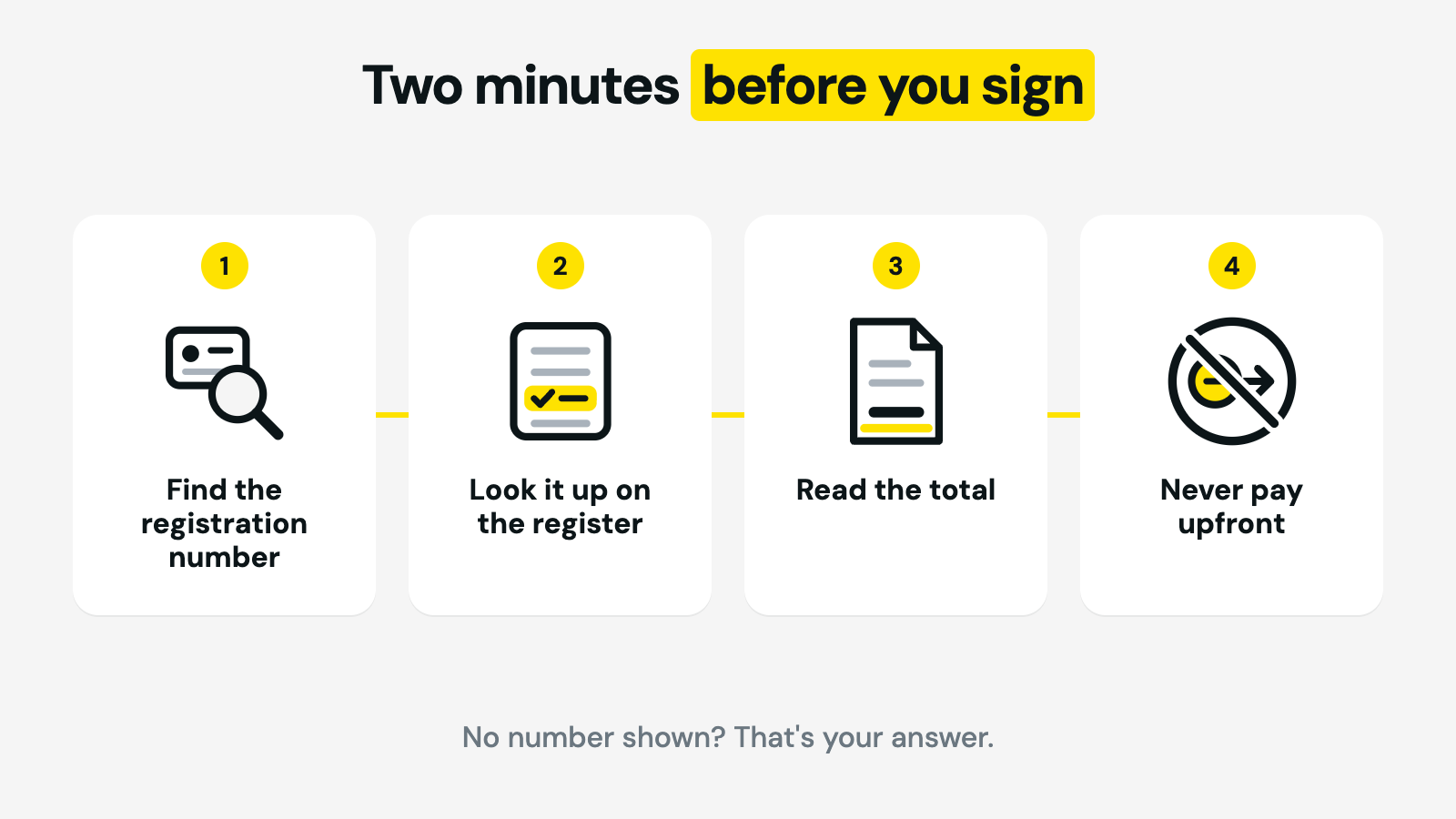
People search for a "list of micro lenders in South Africa" every month. The only list that counts is the official one: the National Credit Regulator's register of registrants, which covers every registered credit provider. A two-minute check:
- Find the NCRCP number. A registered lender shows it on its website, in its app, on its agreement and usually on the office wall. No number on display is already an answer.
- Look it up on the NCR register. The name and number should match the business you are dealing with. The search is fussy – try the number first, then part of the name.
- Read the total before the signature. A lawful agreement shows the total repayment, every fee included. Hold it against the table above.
- Refuse any upfront payment. A fee to "release" or "approve" your loan before you receive it is a scam. Lawful initiation fees are part of the agreement, not a deposit.
A registered lender will also run a credit check and an affordability assessment – that is the law working, not an obstacle. If you want to know what they will see first, you can check your credit report for free.
Loan Sharks: Where the Ceiling Stops Protecting You
The mashonisa down the road is covered by exactly the same caps – the NCR says so in as many words. The difference is that an unregistered lender ignores them, and you have little to hold on to when things go wrong. A typical illustration: R2,000 now, R3,000 at month-end. That is R1,000 for one month's credit, more than twice the legal ceiling of R473.75 in the first table.
Then there is the collateral. Some informal lenders keep a borrower's ID book, bank card or SASSA card, sometimes with the PIN, and draw the repayment themselves on payday. Under the National Credit Act, a credit provider may not keep your ID or bank cards when granting credit, and the NCR treats it as a criminal offence. If a lender holds yours and won't give it back, report it to the nearest police station and to the NCR on 0860 627 627.
Micro Loans When You're "Blacklisted"
A negative listing narrows your options, but it does not create a special category of legal loan. Adverts promising micro loans "for blacklisted" borrowers with no checks are describing a lender who skips the assessment the law requires. Our guide to ITC checks and "blacklisting" explains what a listing actually is and how to clear it. If the problem is paperwork rather than your record – cash wages, no payslip – read what lenders can accept instead of a bank statement.
Where SOLmate Fits
SOLmate is a registered credit provider (NCRCP16037), so everything above applies to us too: the caps, the credit check, the agreement you see before you sign. The account itself costs R10.00 a month, or R29.00 a month with a debit card (card activation from R49.00), and money coming in by EFT is free – see all fees. You can open an account in about three minutes with an SA ID, passport or asylum seeker permit; a Cash Advance offer, if you're eligible, appears on your home screen.
Frequently Asked Questions
Are micro lenders regulated in South Africa?
Yes. Anyone who lends money and charges interest must register with the National Credit Regulator, whatever the loan size, and follow the National Credit Act's caps on interest and fees.
What is the maximum interest on a micro loan?
5% a month on your first short-term loan in a calendar year and 3% a month on later ones, plus a capped initiation fee and a service fee of up to R60 a month (excl. VAT). On R4,000 for one month, the most you can owe is about R4,804.
Can a micro lender keep my ID or SASSA card?
No. The National Credit Act prohibits a credit provider from keeping your ID or bank cards, and the NCR treats it as a criminal offence. Report it to the police and to the NCR on 0860 627 627.
Is there an official list of micro lenders?
Yes – the NCR's public register of registrants lists every registered credit provider with its NCRCP number. Check a lender there before you sign.
Sources: Review of Limitations on Fees and Interest Rates Regulations, 2015 (in force since May 2016), NCR media release on retention of IDs and cards (October 2021), NCR register of registrants, SOLmate Cash Advance help page, SOLmate fees. Table figures are the regulated maximums calculated by us for illustration (VAT at 15% on fees); the terms of any real offer are in the agreement you sign. The loan-shark example is hypothetical. Facts re-checked against SOLmate product pages (/fees, /help/solmate-cash-advance) on 23 September 2026. This article is general information, not financial or legal advice. Cash Advance is subject to credit assessment. SOLmate is not a bank. SOLmate (SOL Ecosystem (Pty) Ltd) is an authorised financial services provider (FSP No. 52248) and registered credit provider (NCRCP16037).