
PayShap vs EFT vs RTC in South Africa (2026): Which Way to Send Money, When
Same money, three speeds, three prices. PayShap clears in seconds around the clock, a standard EFT queues in batches for 1–2 business days, and RTC buys you the courier lane at a premium. Here is the difference — and a one-question rule for choosing.

Quick answer: South Africa runs three interbank payment rails, and they solve different problems. PayShap clears in seconds, 24/7, and for small amounts is often the cheapest instant option — but your bank sets its own fees and limits. A standard EFT is the budget lane: it travels in batches, reflects in 1–2 business days, and costs a few rand. RTC ("instant EFT") is the legacy express lane: minutes to an hour, cut-off times apply, and it carries the biggest premium of the three. This guide is the side-by-side: fees, speed, limits, and a simple rule for choosing.
If you want the full story of any single rail rather than the comparison, we've covered them separately: the complete PayShap guide and the deep dive on instant EFT and RTC.
The Three Rails in One Minute
All three move money between South African bank accounts. The differences are how the payment travels, how fast it lands, and what that costs:
| Rail | Speed | Availability | Typical cost |
|---|---|---|---|
| PayShap | Seconds | 24/7, weekends and holidays included | Set by your bank; small payments often cheap or free |
| RTC ("instant EFT") | Minutes to an hour | Cut-off times apply | Premium — R30–R50 is the common market range |
| Standard EFT | 1–2 business days | Business days only | Cheapest — a few rand |
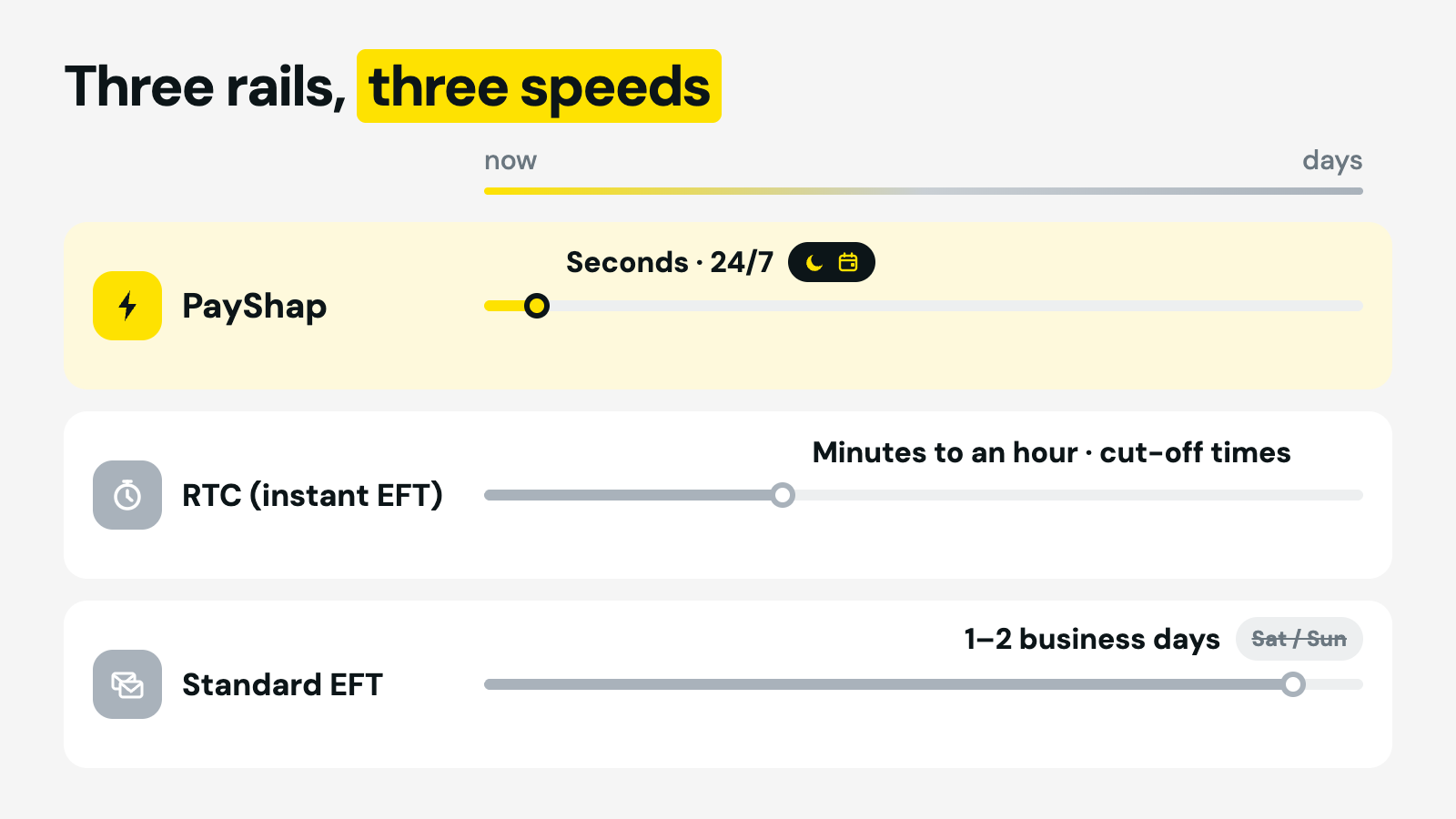
Standard EFT is the oldest and cheapest because payments queue: banks collect the day's transfers into batches and clear them together at set times on business days. Your payment shares a ride with millions of others — that's the whole discount. Weekends and public holidays don't count, which is how a Friday-evening EFT becomes Tuesday money.
RTC (Real-Time Clearing) has run since 2006 as a courier lane on top of that batch system: your payment is cleared individually between banks, typically reflecting within minutes — at several times the price of a batch EFT.
PayShap is the newest rail, launched in 2023 on infrastructure operated by BankservAfrica. Unlike RTC, it was designed to be instant from the start: payments clear in seconds, at any hour of any day, and can be addressed either to a normal account number or to a ShapID — a proxy, usually a cellphone number, linked to an account.
PayShap vs Standard EFT: Speed Is the Whole Difference
This is the easy comparison, because the two rails barely compete — they serve opposite ends of the same question.
- Speed: seconds versus 1–2 business days. A PayShap sent at 23:00 on a Sunday lands at 23:00 on a Sunday. An EFT sent at the same moment starts moving on Monday.
- Cost: a standard EFT is almost always the cheapest way to pay an account — and for larger amounts it may be the only everyday rail available, because PayShap payments are capped.
- Finality: both are hard to recall once cleared, but an EFT sitting in a batch is at least theoretically stoppable; an instant payment is gone in seconds. Triple-check account numbers either way — banks verify the account, not the name.
The practical split: anything patient goes EFT, anything urgent goes instant. Rent due next week is an R8 batch job, not a premium payment. Money that unlocks something today — a deposit, an emergency, a supplier releasing goods — belongs on an instant rail.
PayShap vs RTC: Both "Instant" — Only One Was Built for It
Here's the comparison that actually costs people money, because "instant EFT" sounds like it should be the fastest thing available. It isn't anymore.
- Speed: PayShap clears in under ten seconds in the ordinary case. RTC commonly takes around 30 minutes and can stretch to an hour, with cut-off times — a late-evening RTC can wait for the next processing window.
- Availability: PayShap runs 24/7 with no batch windows. RTC is bound by cut-offs — from a SOLmate wallet, for example, an RTC sent before 15:00 reflects within 60 minutes.
- Cost: PayShap is normally cheaper. RTC was built as a premium courier lane on top of a batch system and is priced like one; PayShap fees are set by each bank, and small payments are often cheap or free.
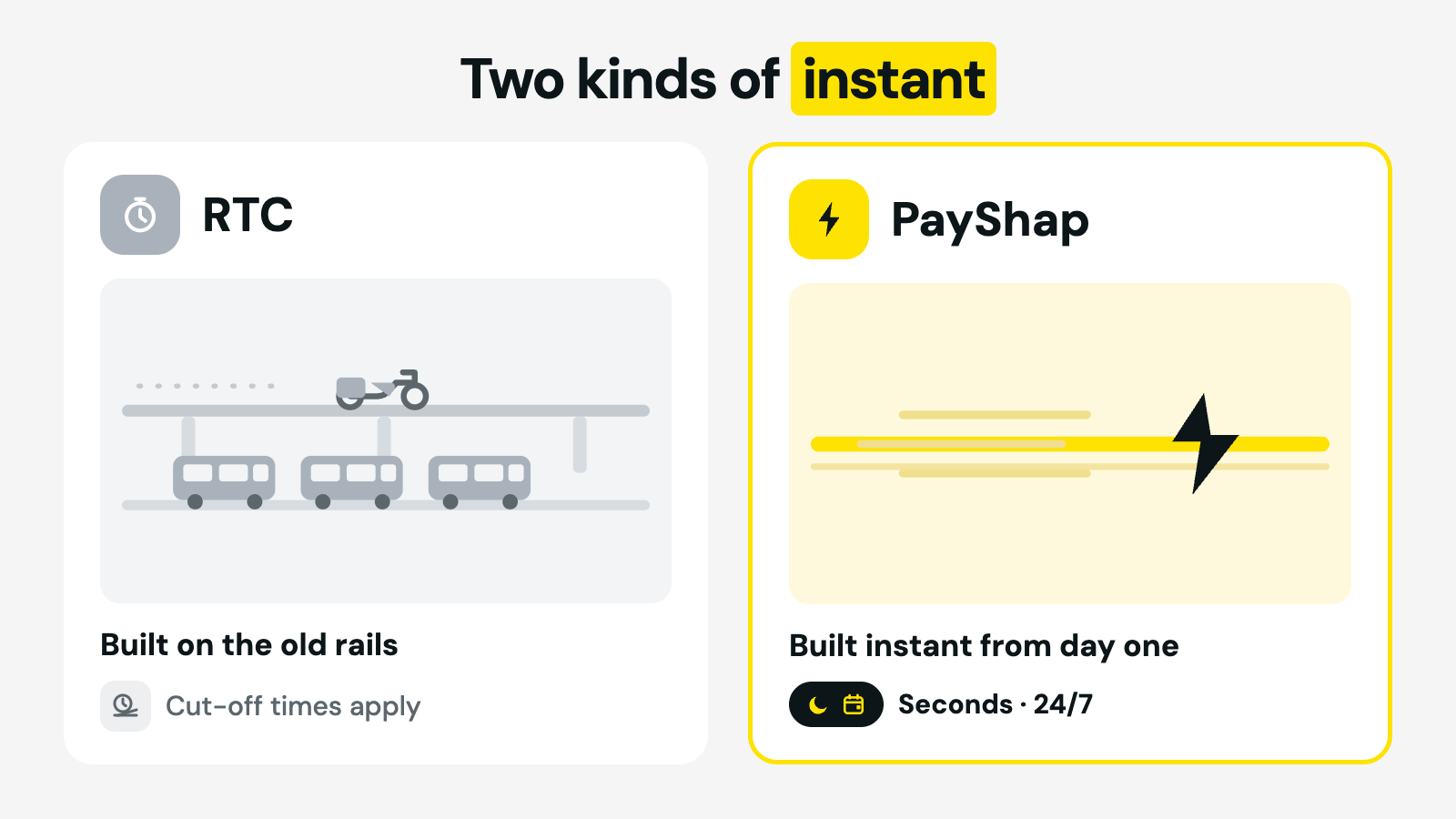
So when should anyone still use RTC? Two honest cases: when PayShap isn't available on one side of the payment — not every account sits behind a PayShap-participating bank product — and when the amount exceeds your bank's PayShap cap but still can't wait two business days. Otherwise, if your app offers both, PayShap first is the sensible default: same destination, faster, usually cheaper.
What Each Rail Costs (a Worked Example)
There is no single national price for any of the three rails — every bank sets its own fees, so the honest advice is to check your own app's pricing schedule before sending. Two patterns hold broadly, though: real-time payments across the market typically cost several times a standard EFT (R30–R50 is the common RTC range), and PayShap for small amounts is often cheap or free, with ShapID payments usually priced below account-number payments.
For a concrete, published example, here is what sending money costs from a SOLmate wallet (SOLmate is a digital wallet rather than a bank on the PayShap network, so its menu covers the two EFT-family rails):
| From a SOLmate wallet | Fee | Reflects |
|---|---|---|
| Standard EFT to any SA bank | R8.00 | 1–2 business days |
| RTC (instant EFT) to any SA bank | R40.00 | Within 60 min (sent before 15:00) |
| SOLmate to SOLmate | Free | Instant, any time |
That R32 gap between the two rails is the price of a day and a half — worth paying when today matters, wasted when it doesn't. All figures are from the public fee table; how these charges fit into the bigger picture of what a bank account costs you per month is unpacked in our guide to bank charges in South Africa.
Limits: Where PayShap Stops and EFT Keeps Going
PayShap supports single payments up to R50,000 — the system ceiling, raised from the original R3,000 in November 2024. But that's the network's number, not yours: each bank sets its own per-transaction and daily PayShap limits inside it, and defaults differ widely. Standard EFT and RTC have no comparable system-level cap for everyday amounts, which is why larger payments still travel the older rails.
Two practical notes. Daily caps are separate from per-payment caps — five R10,000 PayShaps can hit a daily wall even though each fits the single-payment limit. And banks adjust these numbers quietly: if a payment bounces while it looks well within limits, your app's current caps are the first thing to check.
Which Rail, When: Five Everyday Calls
- Paying rent or any bill due next week: standard EFT. The batch lane does the same job for a fraction of the price.
- Emergency money that must land now: PayShap if both sides have it — seconds, any hour. RTC if not.
- Weekend or late-night payment that can't wait: PayShap. Batches sleep on weekends and RTC has cut-offs; PayShap doesn't.
- An amount above your PayShap cap: RTC if it's urgent, standard EFT if it can wait two business days.
- Paying someone whose banking details you don't have: PayShap to their ShapID — all you need is the cellphone number linked to their account.
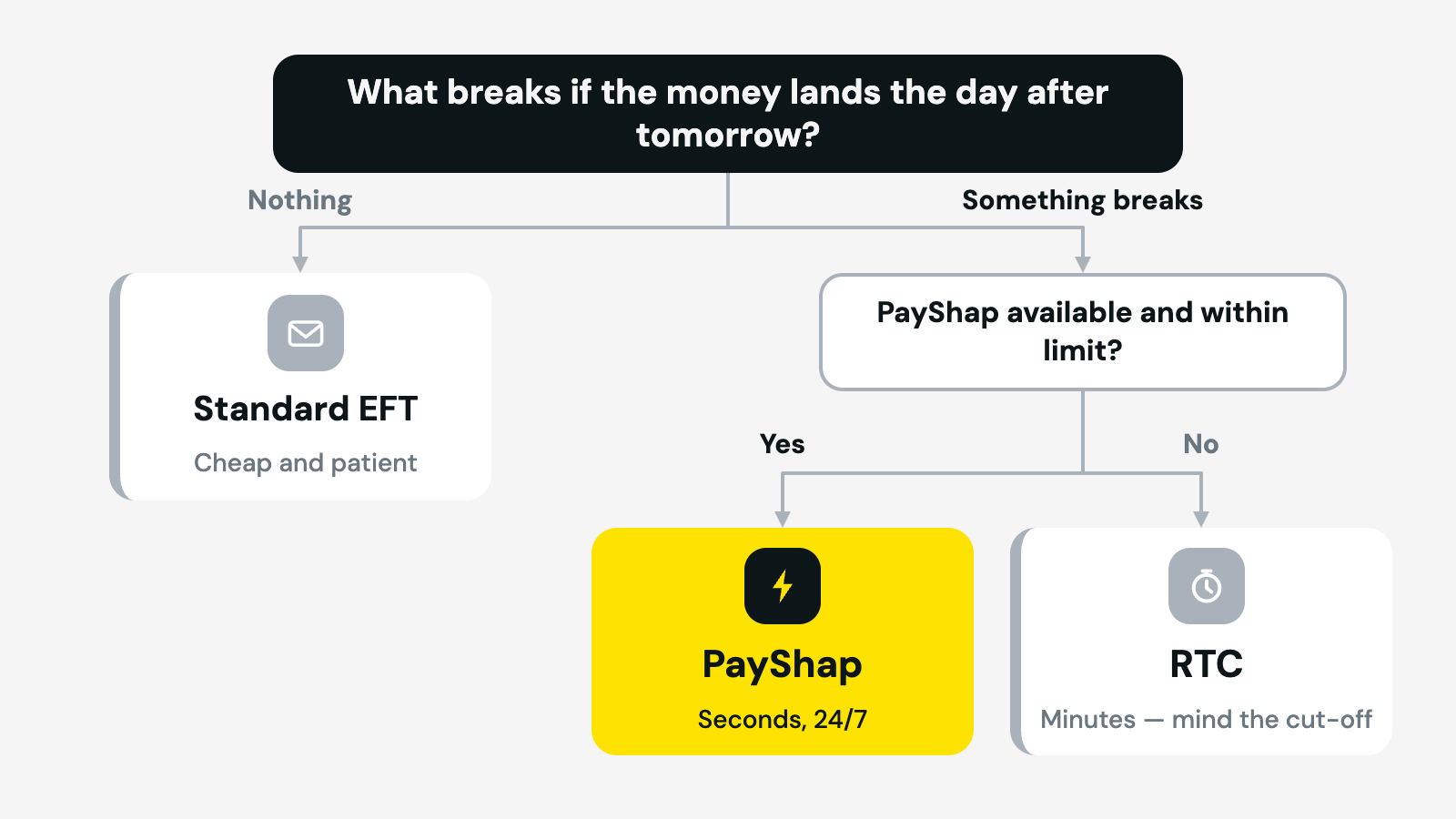
Behind all five calls sits one question: what breaks if the money arrives the day after tomorrow? If the answer is "nothing," the cheapest rail wins. If something breaks, pay for speed — and prefer the rail that was built for it.
Mind the Names: "Instant EFT" Means Two Different Things
One source of genuine confusion is worth clearing up. In a banking app, "instant EFT" means RTC — the interbank express transfer discussed here. On an online-shop checkout page, "Instant EFT" is something else entirely: a pay-by-bank gateway service at merchants. Same words, different product. And PayShap, despite doing a similar job, is not an EFT at all — it's a separate rail with its own rules, which is exactly why it escapes EFT's batch timing and RTC's cut-offs.
If you're comparing not rails but the apps built on top of them, our guide on how to choose a money transfer app covers what actually matters — fees, speed and limits rather than logos.
Where SOLmate Fits In
Straight answer: you don't send a PayShap from SOLmate — it's a digital wallet, not one of the banks on the PayShap network. What it does instead is make the everyday layer cheap: transfers between SOLmate users are free and instant at any hour, receiving money by EFT is free, and airtime, electricity and water top-ups are free. Where a rail costs money, the price is published — R8.00 for an EFT out, R40.00 for an RTC. Accounts start at R10.00 a month, or R29.00 with a Mastercard debit card (activation from R49.00), and combined transaction limits are R10,000 a day and R25,000 a month — details on the limits help page.
The sensible setup for most people is a pairing, not a choice: your bank's PayShap for instant payments to anyone, and a wallet that keeps the running costs of everything else near zero. If you don't yet have an account that can send an EFT at all, opening a SOLmate account takes about 3 minutes with a passport, SA ID or asylum permit.
The Bottom Line
PayShap, EFT and RTC aren't competitors so much as three answers to "how urgent is this?" — instant-and-modern, patient-and-cheap, urgent-and-premium. Learn the one-question rule, check your bank's PayShap fees against its RTC price once, and you'll stop overpaying for speed you don't need — and stop waiting two days for money that mattered today.
Frequently Asked Questions
What is the difference between PayShap and EFT?
Speed and how the payment travels. A standard EFT clears in batches over 1–2 business days at a low fee; PayShap clears individually in seconds, 24/7, with fees set by your bank. Both land in a normal bank account.
Is PayShap cheaper than EFT?
Usually not cheaper than a standard batch EFT, which remains the cheapest rail. But PayShap is normally cheaper than RTC ("instant EFT") for the payments where speed matters, and many banks price small PayShap payments at little or nothing.
Is PayShap the same as instant EFT?
No. "Instant EFT" in a banking app means RTC, a real-time lane built on the older clearing system, with cut-off times and a premium price. PayShap is a separate rail launched in 2023 that clears in seconds around the clock. Checkout pages also use "Instant EFT" for pay-by-bank services at merchants — a different product again.
Which is faster, PayShap or RTC?
PayShap — under ten seconds in the ordinary case, at any hour. RTC commonly takes around 30 minutes and can stretch to an hour, subject to cut-off times.
Can I send money on a weekend with PayShap?
Yes — PayShap runs 24/7, weekends and public holidays included. Standard EFTs wait for business days, and RTC depends on your provider's processing windows.
What are the limits for PayShap compared to EFT?
PayShap supports single payments up to R50,000, with each bank setting its own lower per-transaction and daily caps. Standard EFT and RTC have no comparable system ceiling for everyday amounts, which is why larger payments still use them.
Can I send a PayShap from SOLmate?
No — SOLmate is a digital wallet, not a bank on the PayShap network. From a SOLmate wallet you can send a standard EFT (R8.00) or an RTC (R40.00) to any SA bank, and SOLmate-to-SOLmate transfers are free and instant at any time.
Sources: PayShap (BankservAfrica). SOLmate fees and limits from our fees page and limits help page. Bank PayShap fees and limits are set by each bank and correct as of September 2026 — always check your own banking app. This is general information, not financial advice. SOLmate is not a bank. SOLmate (SOL Ecosystem (Pty) Ltd) is an authorised financial services provider (FSP No. 52248) and registered credit provider (NCRCP16037).