
Credit Bureaus in South Africa (2026): The Full List, Your Free Report, and How to Dispute an Error
South Africa has 53 registered credit bureaus, not four. Who they are, which ones lenders actually query, where the data comes from, how to get your free report from each, and how to dispute an error in 20 business days.

Quick answer: a credit bureau is a private company, registered with the National Credit Regulator, that collects your credit history from lenders and sells it back to lenders as a report and a score. South Africa doesn't have "the" credit bureau or even "the big four" — the NCR register currently lists 53 registered bureaus, though only a handful hold the consumer files most lenders actually pull: TransUnion, Experian, XDS and Consumer Profile Bureau. You're entitled to one free report a year from each of them, errors must be investigated within 20 business days, and no bureau keeps a blacklist. This guide is the directory: who the bureaus are, what each holds, where the data comes from, and what to do when a file is wrong.
What a Credit Bureau Is — and What It Isn't
A credit bureau (the NCA calls it a "credit bureau"; older documents say "credit reference agency") does three things: it receives payment data from credit providers, compiles it into a file per consumer, and issues reports on that file to anyone with a lawful reason to ask — a lender assessing your application, a landlord vetting a tenant, an employer in a position of financial trust, or you. On top of the file, most bureaus calculate a score using their own model, which is why the same person has a different number at different bureaus. The full picture of how those scores are built and read is in our complete guide to credit scores in South Africa; this article stays on the bureaus themselves.
Three things a bureau does not do. It doesn't lend money. It doesn't approve or decline applications — the lender does that, using the bureau's report as one input alongside its own affordability assessment (our payday loans guide shows what a compliant assessment and legal cost caps look like in practice). And it doesn't operate a blacklist; it holds entries, positive and negative, each with a legal expiry. The bureau is a librarian, not a judge.
How Many Credit Bureaus Are There in South Africa?
More than most people think. Every business that compiles and issues consumer credit information must register under section 43 of the National Credit Act, and the NCR's public register of credit bureaus listed 53 registered entities when we checked it for this article in September 2026. That number includes specialist bureaus — rental-payment databases, fraud-prevention registries, medical-account and business-credit bureaus — that most consumers never hear of but that can still hold a file on you.
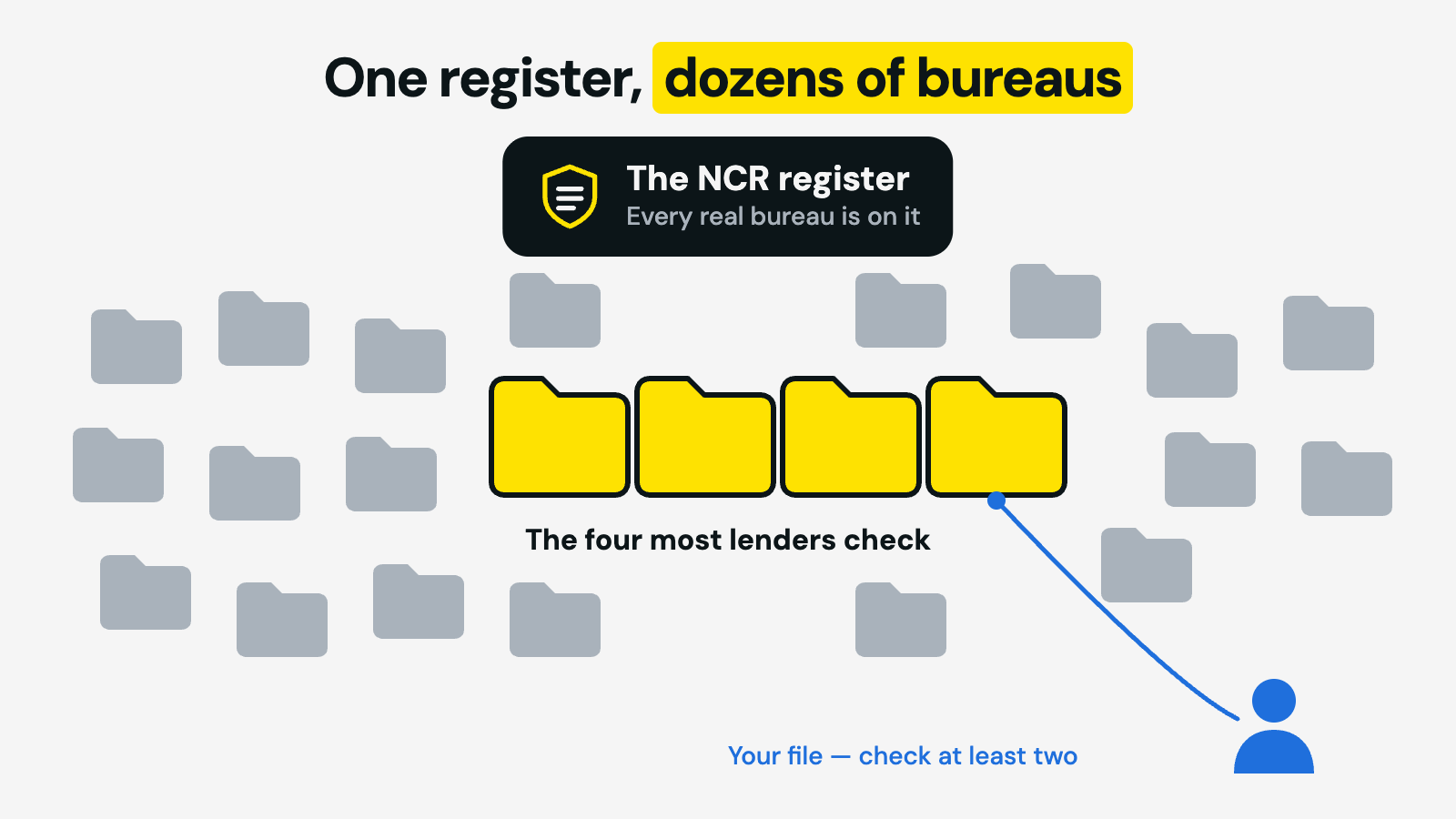
The "four major bureaus" you see quoted elsewhere is a shorthand for the consumer bureaus that lenders query most: TransUnion, Experian, XDS and Consumer Profile Bureau (CPB). Compuscan, often still listed as a fifth, has been part of Experian South Africa since the 2019 acquisition. Because not every credit provider reports to every bureau, your file at one can differ in content from your file at another — which is the practical reason to check more than one.
The Main Consumer Credit Bureaus in South Africa
Each of these is registered with the NCR and offers consumers a way to see their own file. The registration number is the thing to look for: it appears on the NCR register and confirms you're dealing with a real bureau rather than a lookalike site.
| Bureau | NCR registration | Known for | Where to request your report |
|---|---|---|---|
| TransUnion Credit Bureau (Pty) Ltd | NCRCB4 | Largest consumer database; the score most lenders and score apps quote (0–999 scale) | transunion.co.za |
| Experian South Africa (Pty) Ltd | NCRCB16 | Second major consumer bureau; absorbed Compuscan and Scoresharp in 2019; 0–740 scale | experian.co.za |
| Xpert Decision Systems (Pty) Ltd (XDS) | NCRCB5 | Consumer and commercial data; consumer reports served through its Splendi portal | splendi.co.za |
| Consumer Profile Bureau (Pty) Ltd (CPB) | NCRCB2 | Consumer bureau widely used by retailers and micro-lenders | consumerprofilebureau.com |
Registration numbers, websites and the bureaus' current contact details are published on the NCR register of credit bureaus. Use that page, not a search result, when you need a phone number or an email address: bureau contact details change, and paid "credit bureau contact" listings are a common way to route people to services that charge for things the law gives you free.
Specialist Bureaus You May Not Know Hold a File on You
The rest of the register is made up of bureaus that focus on one type of information. A few are worth knowing by name:
- TPN Group (NCRCB8) — the rental-payment bureau. Letting agents and landlords report tenants' rent payment behaviour here and check it before signing a lease. A clean TPN record matters as much as a bank score when you rent.
- Southern African Fraud Prevention Service (SAFPS, NCRCB20) — a non-profit fraud registry. If your ID has been used fraudulently, you can apply for free Protective Registration, which flags your identity so credit providers apply extra checks before opening accounts in your name.
- CreditWatch / Medical Credit Watch (NCRCB18) — medical-account payment history, used by practices and hospitals.
- Inoxico (NCRCB17) and others — business and trade-credit information rather than personal files.
The same NCA rights apply to every one of them: you can request your record, dispute what's wrong, and information expires on the same statutory timetable.
Where a Credit Bureau Gets Its Data
Bureaus don't investigate you; they receive. Under the NCA every registered credit provider — banks, store-account retailers, cellphone networks, vehicle financiers, micro-lenders — must report the credit agreements it holds with you and how you pay them, typically in a monthly file. Bureaus add public-record information: civil judgments from the courts, administration orders, sequestrations and debt-review notices. And each time a lender pulls your file for an application, the bureau logs the enquiry.
Two consequences follow. First, the data has a lag: a payment you made this week may not reach a bureau until next month's file, so a report is a snapshot, usually a few weeks behind. Second, coverage is uneven. A small lender may report to CPB and TransUnion but not to Experian; a bank may report to all four. That is why a lender's decision can surprise you — they may be looking at a bureau you haven't checked.
What a Credit Bureau Report Contains
Whichever bureau issues it, a South African credit report follows the same shape: your personal details and addresses; a list of your credit accounts with limits, balances and a month-by-month payment grid; the enquiries logged against your file; any adverse listings a provider has placed; and public records such as judgments or a debt-review flag. Negative information has a legal shelf life set by Regulation 17 — one year for adverse "behaviour" classifications, two for enforcement classifications and enquiries, five for payment history and judgments — and adverse listings and judgments must come off earlier once paid. We walk through each section, and the full retention table, in the report-reading section of the credit score guide; the ranges behind the number are in What Is a Good Credit Score in South Africa?
How to Get Your Report From Each Bureau for Free
Section 72 of the NCA gives you one free copy of your credit record from every registered bureau every 12 months, plus further copies at a regulated fee. Several bureaus and score apps now go further and give free ongoing access with a registered account, so the annual right is a floor. The route is the same at each bureau: go to the bureau's own website (from the table above or the NCR register), create a profile, verify your identity with your ID number and either security questions or a selfie check, and the report is delivered online, usually within minutes.
Three practical notes. Check at least two bureaus, because files differ. Checking your own file is a "soft" enquiry and never lowers your score. And never pay a third party for a "credit bureau check" — if a site asks for a fee before showing you your own record, it isn't a bureau. A step-by-step walkthrough of each bureau's process is coming in a dedicated guide.
How to Dispute an Error With a Credit Bureau
If your report shows an account you never opened, a payment marked missed that you made, a settled debt still carrying a balance, a paid judgment still listed, or anything past its Regulation 17 expiry, section 72(3) of the NCA gives you the right to challenge it. The process:
- Lodge the dispute with the bureau directly — every bureau has a dispute form on its website or a disputes email. State which entry is wrong and why, and attach proof (a paid-up letter, statements, an ID if it's fraud).
- The bureau has 20 business days to investigate. It must go back to the credit provider that supplied the entry; if the provider can't verify it as accurate within that time, the bureau must remove it.
- Escalate if unresolved. The Credit Ombud handles complaints about bureau information free of charge; the National Credit Regulator is the next step for regulatory complaints.
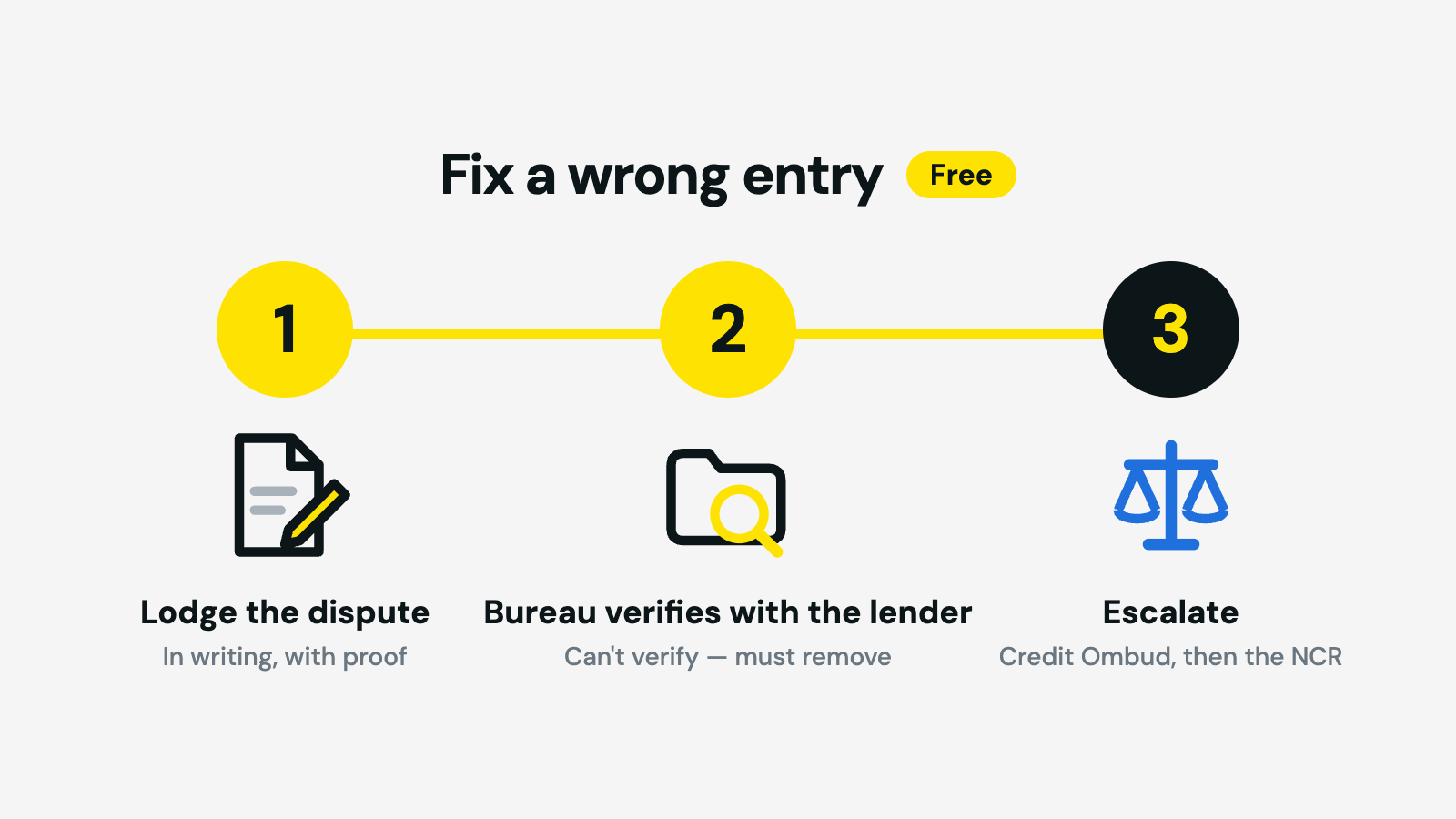
Dispute at every bureau that shows the error — a correction at TransUnion does not propagate to Experian. And do it in writing so there's a dated record when the 20 days start counting.
"Credit Bureau Listing" and Clearance
People searching for a credit bureau listing usually mean an adverse listing: a credit provider has reported an account as in default, handed over or written off. "Clearance" means getting that listing removed. Two facts change how you approach it. First, since the 2014 regulations on the removal of adverse consumer credit information, an adverse listing must be removed once the amount is paid in full — the provider is obliged to update the bureau, and if it doesn't, you send the paid-up letter to the bureau yourself and dispute the entry. Second, nobody can lawfully remove an accurate, unpaid listing before its expiry, however much they charge. "Credit clearance" services that promise otherwise are selling either the free dispute right you already have, or nothing. Once the listing is gone, the payment history behind it may remain visible for up to five years — that's not a listing, it's history, and it fades on its own.
Where SOLmate Fits
SOLmate is not a bank and not a credit bureau — it doesn't calculate scores or hold credit files. It is a registered credit provider, which means it sits on the reporting side of the system described above. Its one credit product, the SOLmate Cash Advance, is offer-based: if you're eligible, an offer appears on the home screen of the app; there is no form to apply blind. Accepting an offer involves consenting to a credit check, so your bureau file is part of the assessment and approval isn't guaranteed. Once approved, the money is paid into your wallet immediately, and repayments deduct automatically on the due date. A three-day grace period follows a missed due date before daily penalty charges start, and late or missed repayments may be reported to a credit bureau, where the record can stay for at least five years — the same rules, and the same bureaus, as every other registered lender.
The account underneath is the plain part: a SOLmate account opens from the app (the documents and steps are in how to open an account online), receives EFT payments free, and costs R10.00 a month without a card or R29.00 a month with a debit card (plus card activation from R49.00). Every fee is on the fees page; if you want to understand what the line items on any account statement mean, start with Bank Charges in South Africa Explained.
The Bottom Line
South Africa has dozens of registered credit bureaus, four that matter for most lending decisions, and one register — the NCR's — that tells you which is which. They hold what lenders report, not a blacklist; you can see each file free once a year, dispute errors free with a 20-business-day clock, and paid-up adverse listings must come off. Know the four names, check at least two, and never pay anyone to do what the Act already lets you do yourself.
Read next in the Credit score series
Frequently Asked Questions
How many credit bureaus are there in South Africa?
The NCR register listed 53 registered credit bureaus in September 2026. Four hold the consumer files most lenders query — TransUnion, Experian, XDS and Consumer Profile Bureau — and the rest are specialist bureaus covering rental payments, fraud prevention, medical accounts and business credit.
Which credit bureau do South African banks use?
Most large lenders query more than one bureau, commonly TransUnion and Experian, and often XDS or CPB as well. Which bureau a specific lender uses is its own decision and isn't published, so check at least two of your own files.
Is Compuscan still a credit bureau in South Africa?
Compuscan was acquired by Experian in 2019 and now operates as part of Experian South Africa (NCR registration NCRCB16). Reports that used to come from Compuscan are issued by Experian.
How do I get my free credit bureau report?
Section 72 of the National Credit Act entitles you to one free report from each registered bureau every 12 months. Request it on the bureau's own website by verifying your ID; several bureaus also offer free ongoing access with a registered profile.
Where do I find credit bureau contact details in South Africa?
On the National Credit Regulator's public register of credit bureaus, which lists each bureau's registration number, website, phone and email. Use it rather than third-party listings, which often route to paid services.
How long does a credit bureau take to fix an error?
Once you lodge a dispute, the bureau has 20 business days to investigate with the credit provider. If the entry can't be verified as accurate in that time, it must be removed. Unresolved disputes can go to the Credit Ombud free of charge.
Can I be removed from a credit bureau?
Not from the bureau itself — every credit-active adult has a file. Individual entries are removed when they're wrong, when they expire under Regulation 17, or, for adverse listings and judgments, once the debt is paid in full.
Does SOLmate report to credit bureaus?
SOLmate is a registered credit provider. Accepting a Cash Advance offer involves a credit check with your consent, and late or missed repayments may be reported to a credit bureau, where the record can stay for at least five years.
Sources: National Credit Regulator — register of credit bureaus (National Credit Act 34 of 2005, sections 43, 70 and 72; Regulation 17; 2014 regulations on the removal of adverse consumer credit information), TransUnion South Africa, Experian South Africa, Credit Ombud, SOLmate Cash Advance help page, SOLmate fees. Bureau count and registration details as shown on the NCR register in September 2026 and may change; retention periods are statutory maximums. This article is general information, not financial advice. SOLmate is not a bank. SOLmate (SOL Ecosystem (Pty) Ltd) is an authorised financial services provider (FSP No. 52248) and registered credit provider (NCRCP16037).